Value engineering that starts with what customers notice
Part 2 of 5 in our series on the next generation of R&D.
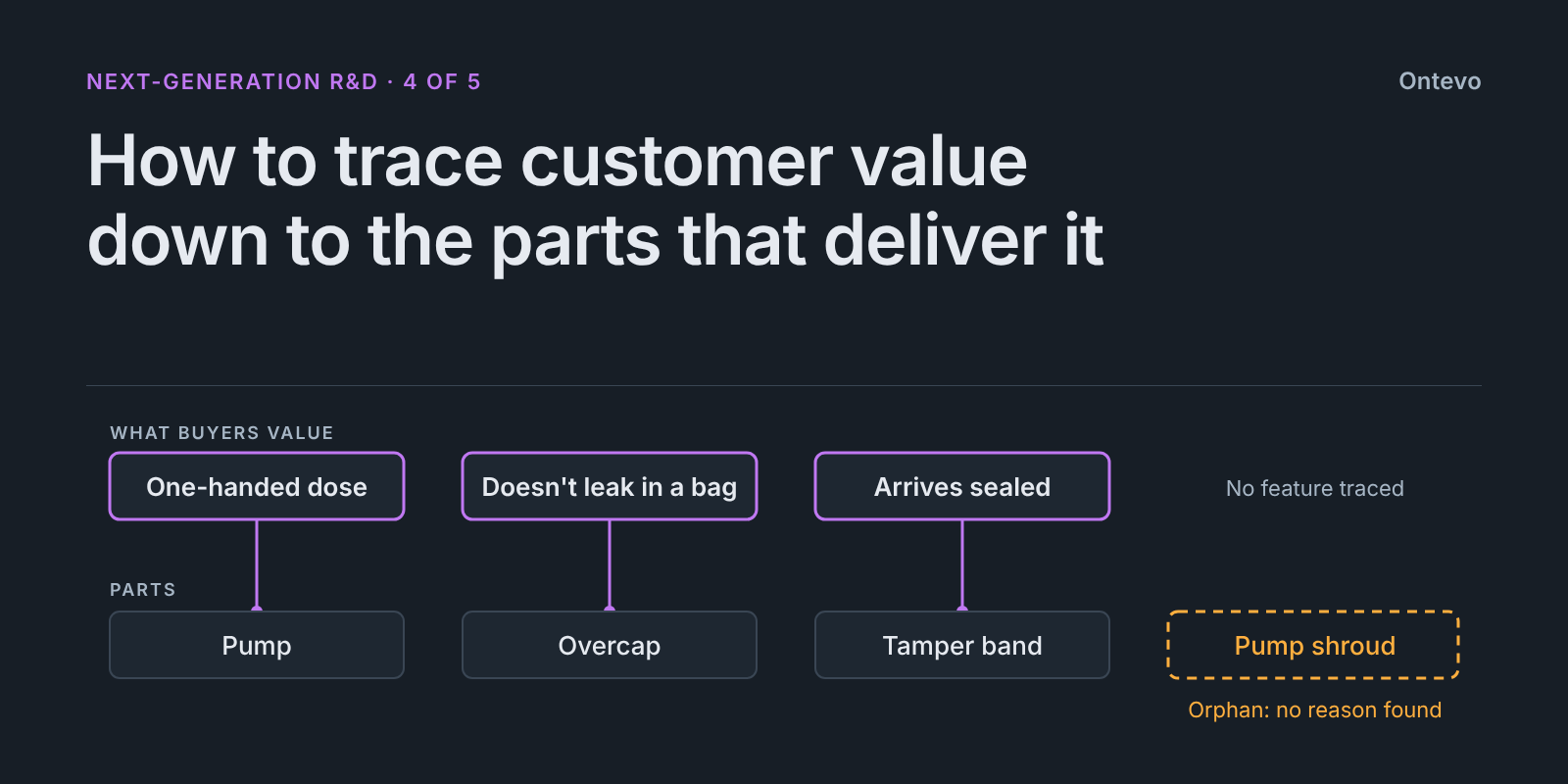
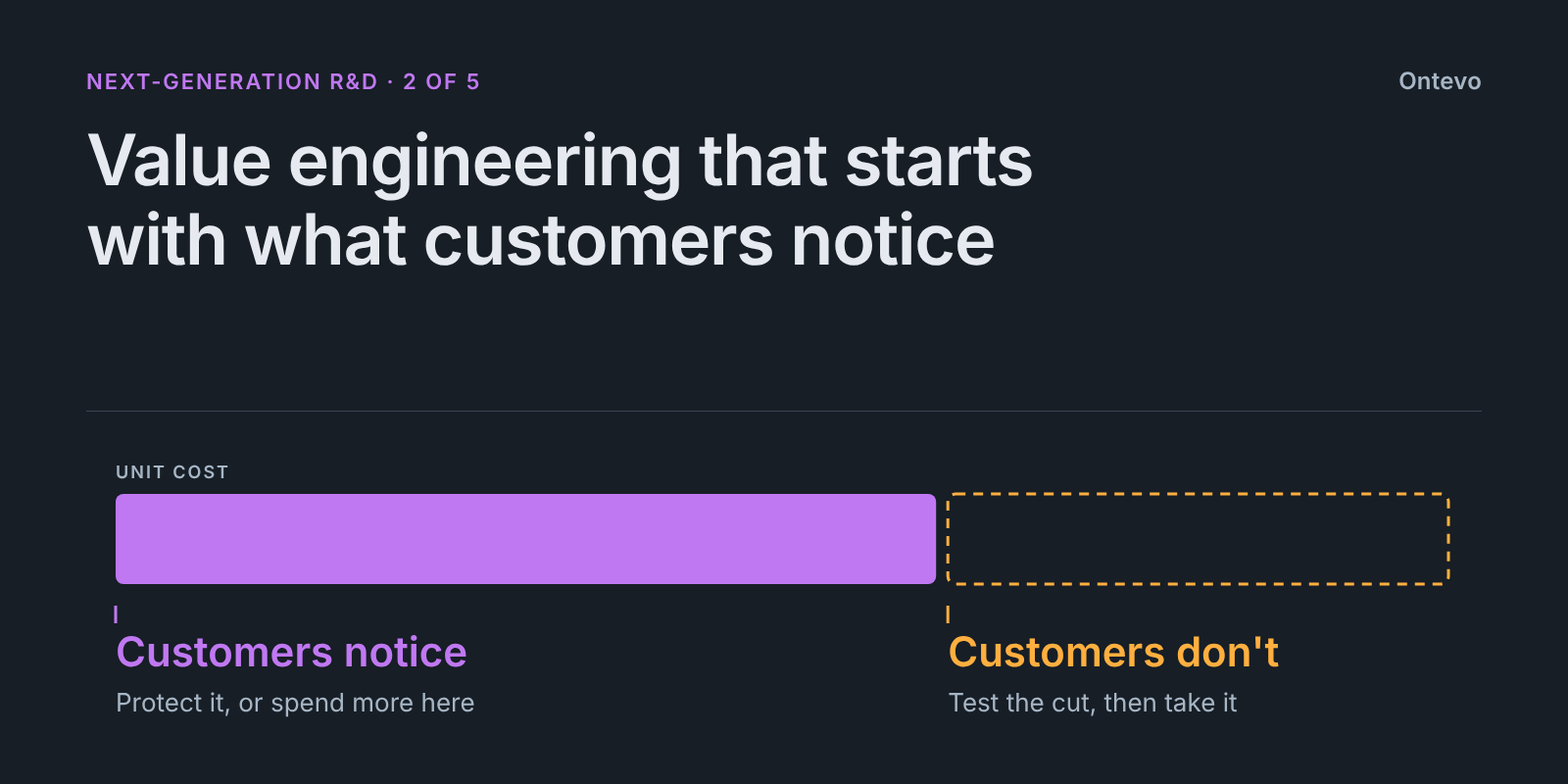
Most cost-down workshops rank ideas by dollars saved per unit and ask one customer question of each: will anyone complain? That question protects the parts customers talk about and exposes the parts they rely on in silence, which is the wrong way round.
The repair is small. Add one column to the idea list, headed "what would the customer notice", and refuse to fill it in from the conference room. Every entry needs evidence beside it. The column changes which cuts get approved, and it usually turns up one place where the product should spend more.
Function has always been half of the method
Value engineering, done by the book, scores each part by the function it performs and what that function costs, then goes after cost that buys little function. The weak point is who scores the function. In practice it is the people in the room: engineering, sourcing, marketing for an hour if they can spare it. The bill of materials has a number on every line. The customer's view arrives as five themes on a slide.
Silence makes it worse. Nobody reviews a tamper band. The Kano model calls these expected qualities: buyers say nothing when they are present and plenty when they are missing. A workshop that reads silence as indifference will cut them first.
McKinsey's consumer goods practice put the other half of the argument well in its paper on design to value. Unlike design to cost, the authors write, the work "can result in either cost reductions or cost increases."
Before the workshop
Two inputs are needed. The first is a costed bill of materials broken down until one line is one decision. "Pump assembly, $0.58" hides six parts doing different jobs, and no one can say what a customer would notice about an assembly. The second is the customer evidence for the same product: the needs buyers describe, how often, who is describing them, and which ones the product already fails.
Then generate ideas the usual way, down each cost line: a cheaper material, less material, a part removed or combined, a looser tolerance, a cheaper process or test, a smaller pack. Keep supplier renegotiation and freight lanes on a separate list. They may be worth more money, but they leave the product unchanged, so there is nothing for a customer to notice and nothing to weigh.
Seven ideas for one bottle
The product is the one this series follows: a 90 ml travel pump bottle of body lotion that sells 20,000 units a month, nets the brand $8.50 a unit and costs $3.00 to make and deliver. Every figure is illustrative, invented to show the arithmetic.
| Cost idea | Saving per unit | What customers would notice | Evidence in 1,000 buyer texts | Decision |
|---|---|---|---|---|
| Replace the printed outer sleeve with a larger label panel | $0.19 | Plainer on the shelf | Sleeve named in 4 texts, none about choosing the product | Keep, once the required label copy is confirmed to fit |
| Remove the metallized shroud on the pump | $0.05 | Probably nothing | 0 texts | Keep |
| Tighten the case pack to cut empty space | $0.03 | Nothing | 0 texts | Keep, after a transit test |
| Thin the bottle wall | $0.04 | Dents in a bag | 21 texts already report dents | Reject |
| Drop the tamper band | $0.06 | Looks opened on arrival | 37 texts mention arriving sealed | Protect |
| Fill 85 ml in place of 90 ml | $0.05 | Declared size changes | Buyers compare size per dollar | Protect |
| Drop the overcap | $0.05 | After first use, it is all that stops the pump being pressed | 182 texts on leaks in a bag | Reject, unless the pump locks |
Ranked by dollars, the seven ideas are worth $0.47 a unit. That is 15.7% of cost and $9,400 a month, and it is the number that goes on the workshop's closing slide.
Read with the extra column, three survive. The sleeve, the shroud and the case pack save $0.19 + $0.05 + $0.03 = $0.27 a unit, or $5,400 a month, with no sign that buyers would feel any of them.
Leaks in a bag are the most common complaint in the evidence, and the overcap is a poor answer to them because buyers lose it. A twist-lock pump head costs $0.08 more than the current one. Once the pump locks, the overcap has no job and its $0.05 comes out. The product's worst failure gets fixed for a net $0.03.
Put together, that is $0.27 − $0.03 = $0.24 a unit. Cost falls from $3.00 to $2.76, an 8% reduction worth $4,800 a month, on a product that now does what travel buyers ask for most. Part 1 of this series works out what the lock could be worth in added sales.
That leaves $0.15 a unit unclaimed from the thinner wall, the tamper band and the smaller fill, or $3,000 a month. At today's cost each unit contributes $5.50, so the three cuts lose money if together they cost more than $3,000 ÷ $5.50 = 546 units a month. That is 2.7% of volume. Buyers already complain about dents at the current wall thickness.
The grades are hypotheses
"Probably nothing" beside the shroud is a guess with a count attached. Zero mentions shows that buyers don't write about the part. It doesn't show they would fail to register its absence on a shelf, next to a competitor that still has one. Before the saving is booked, put both versions in front of people, either in a blind side-by-side or as a limited run in one channel.
Some rows never go to the customer at all. Safety, regulatory and durability requirements are protected by engineering judgment whether or not a buyer has ever written about them. Say so in the decision column, or the same idea will be back on the list next year.
A saving that clears the customer column still has to clear the plant. Yield, rework, damage in transit and returns can absorb a piece-price saving that looked safe on paper. We worked through that arithmetic in when a cheaper product costs more to deliver.
What Ontevo does here
Ontevo's Cost Efficiency analysis breaks a product into a leveled, costed bill of materials: assemblies, then the parts inside them. It can focus on the whole product or on one sub-component, such as the motor inside a portable fan. The costs are modeled estimates, and the assumptions behind them are listed for your team to correct.
The cost ideas it generates are changes to the product itself. Each idea states the trade for the customer, and requirements you mark as protected stay out of reach. The same Full Diagnostic has already read what buyers ask for and complain about across its 50-point diagnostic, so your team can check each saving against that evidence and decide what changes.
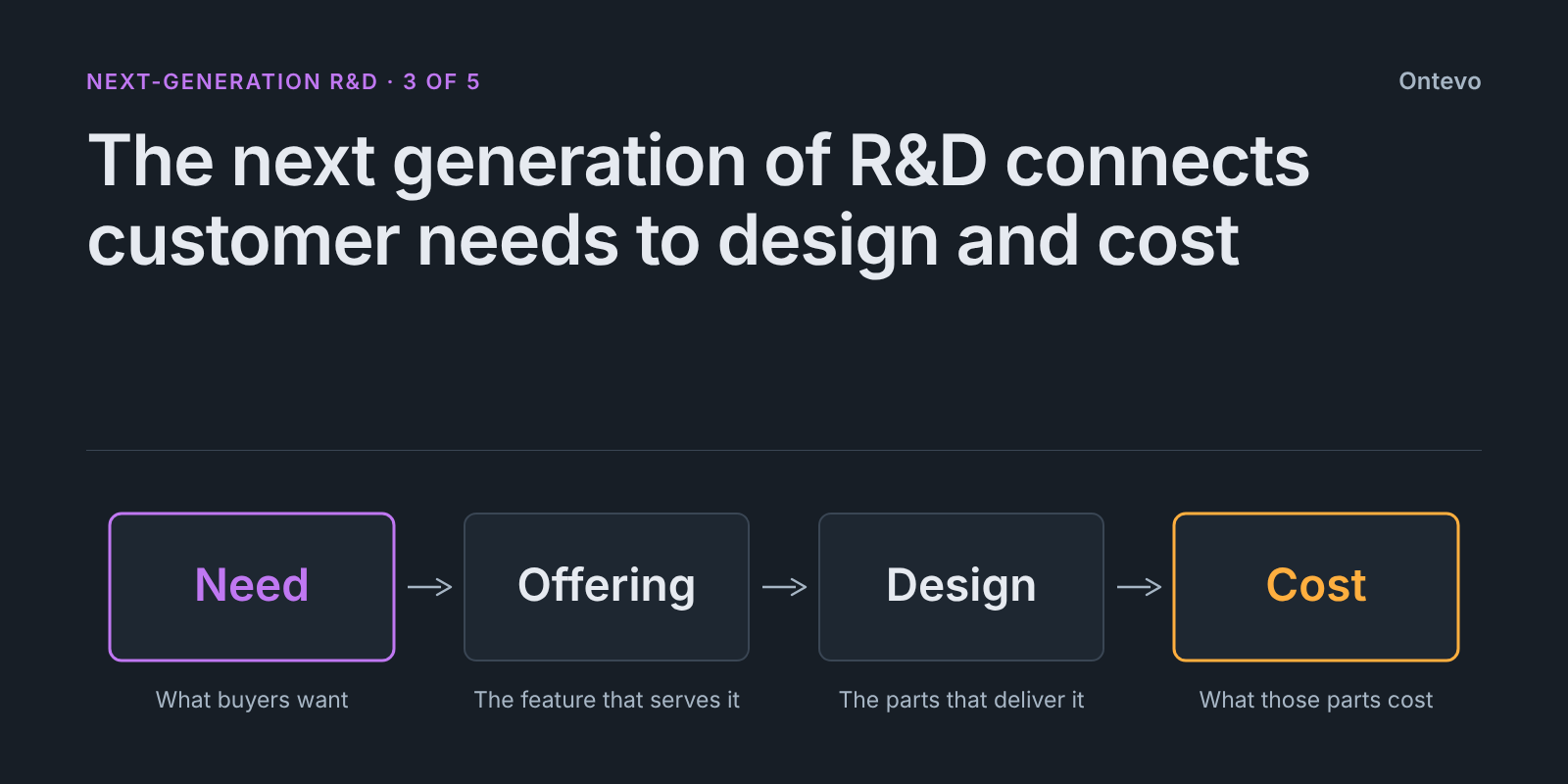
We're also building the links that tie each cost line to the feature and the need it serves, which Part 3 covers: connecting customer needs to design and cost. The page for consumer product teams shows the rest of the diagnostic.
Tell us one product. We'll show you its Full Diagnostic in a 30-minute demo. Book a Demo or see a sample report.
Ontevo Research. Where this post carries figures, they come from Ontevo's own scan corpus or are modeled from scan patterns across the category. No figure is measured from a named customer.