How to find your next winning product in market evidence

Part 1 of 5 in our series on the next generation of R&D.
The product your category is missing has usually been described already, in public, by the people who would buy it. The description sits in one-star reviews of a competitor and in the questions shoppers post under your own listing. Most teams read that material for sentiment. It is more useful read as a requirements list with a rough demand estimate attached.
Reading it that way takes three passes: what buyers are asking for, which product on the shelf already delivers it, and what closing the gap would earn after its cost. The third pass is the one that gets skipped, which is why so much review analysis ends its life as a word cloud in an appendix.
Write the need and leave out the fix
Product briefs tend to start from something the team can make. A supplier shows a new resin, a competitor launches a matte finish, and the brief gets written around the thing. The buyer's reason to care is added afterwards by whoever writes the positioning.
Anthony Ulwick argued against that order in a 2002 Harvard Business Review article. His argument was to ask customers what outcome they want and keep the solution for your own engineers. Customers are poor designers and good witnesses. Reviews are full of witness statements. "Pump got pressed in my bag and emptied itself" is one.
So the first pass is to read every text that names the product or a direct competitor and write the need behind it as an outcome. "Carry it in a bag without leaks" is a need. "Add a locking pump" is one way to serve it, and there may be cheaper ones.
Record two details with each need. One is whether the buyer asked outright ("wish the pump locked") or only complained ("leaked all over my toiletry bag"). A request means the buyer has already pictured the fix, so a product that delivers it needs less explaining on the pack. The other is who is writing. A leak complaint from someone who flies every week belongs to a different business case than the same complaint spread thinly across everyone. Part 5 of this series covers how to attach each text to a job and a segment.
Then resist ranking the list by how often each need comes up. Abbie Griffin and John Hauser tested that shortcut in "The Voice of the Customer", published in Marketing Science in 1993, and frequency of mention turned out to be a poor stand-in for importance. Use the count to decide what goes on the list, not where it ranks.
See who already does the job
For each need, take only the texts that pass judgment on it and work out, product by product, the share that say the job got done. Then open the published specifications and find what the better product does differently. In the example below it turns out to be a pump that twists to lock.
If no product does the job well, the space is open and nobody has yet shown that buyers will pay for a fix, so the next step is a cheap concept test. If one competitor does it well and you don't, demand is proven and you are losing those buyers now. If every competitor does it and you don't, the feature has become a requirement and the work is a repair. The Kano model has a line for that drift, quoted in ASQ's summary: "wows become wants become musts."
Put a number on the gap
The example is illustrative. The product, the counts and the dollar figures are invented to show the arithmetic.
A 90 ml travel pump bottle of body lotion sells 20,000 units a month. The brand nets $8.50 a unit and the cost to make and deliver one is $3.00.
Of 1,000 reviews, listing questions and social posts that name the product, 182 are about leaks in a bag: 64 ask for a pump that locks and 118 report a leak. Buyers who mention travel write 35% of all the texts and most of these 182. Among their texts that judge "carry it in a bag without leaks", this product did the job in 34%. Competitor A, which has a twist-lock pump, did it in 81%.
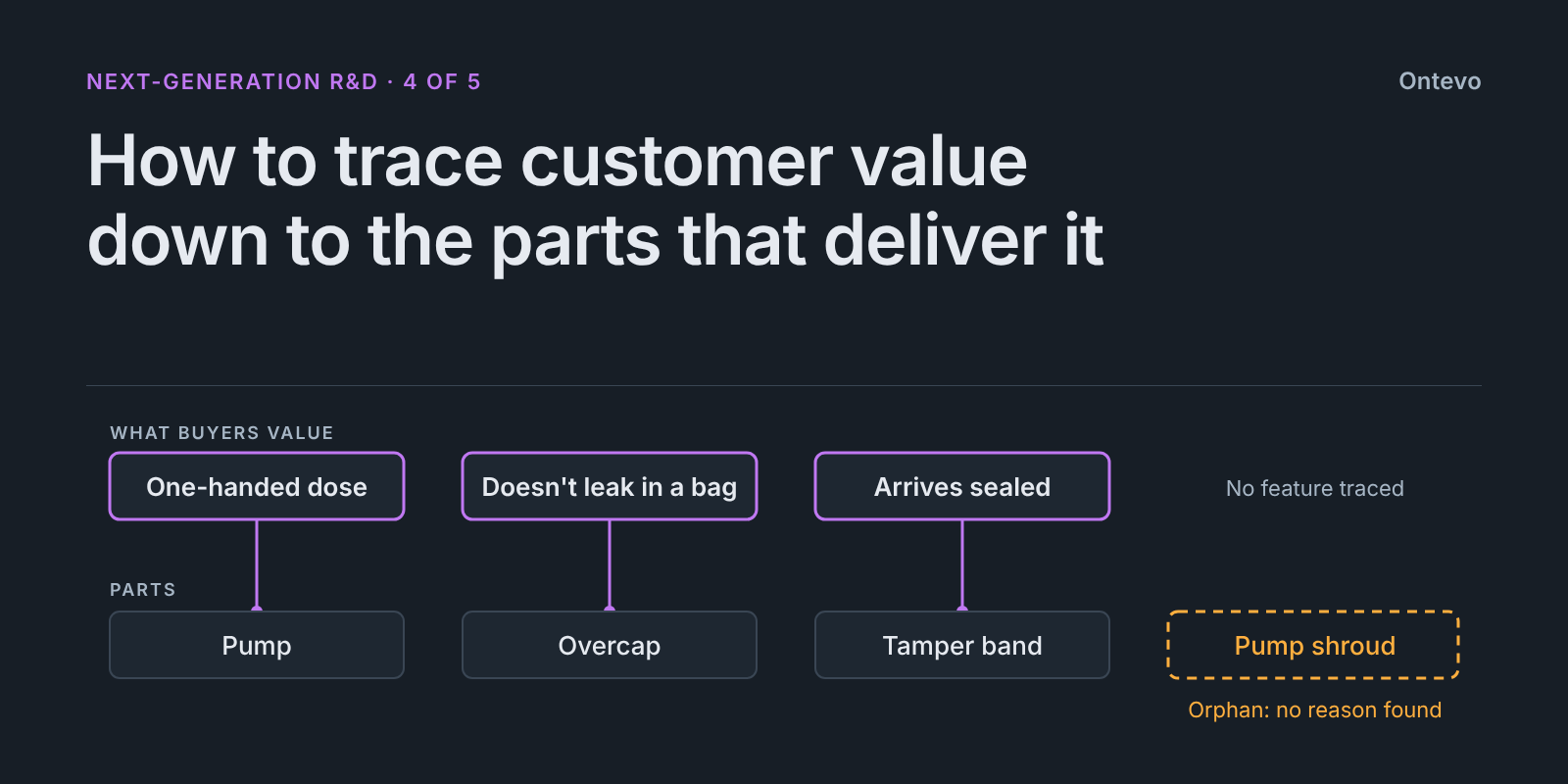
The fix is a twist-lock pump head that costs $0.08 more than the current one. Once the pump locks, the loose overcap that buyers keep losing has no job, and removing it saves $0.05. Net added cost is $0.03 a unit.
| Step | Arithmetic | Result |
|---|---|---|
| Units bought by travel buyers, assumed equal to their share of texts | 20,000 × 35% | 7,000 a month |
| Assumed lift among travel buyers | 7,000 × 10% | 700 extra units |
| Contribution per extra unit | $8.50 − $3.03 | $5.47 |
| Added contribution | 700 × $5.47 | $3,829 a month |
| Added cost on existing units | 20,000 × $0.03 | $600 a month |
| Modeled net gain | $3,829 − $600 | $3,229 a month |
One-time costs come next. Assume $18,000 to qualify the new pump: compatibility and stability testing with the formula, a transit test, a line trial and an artwork change. Payback is $18,000 ÷ $3,229, or about 5.6 months.
Two of those assumptions are soft. The 35% is a share of texts, and frequent travelers may write more reviews than they buy bottles. Halve it and the net gain falls to about $1,315 a month, with payback stretching to nearly 14 months. The 10% lift is a guess.
The number that makes the case usable anyway is the break-even. $600 ÷ $5.47 is 110 extra units a month, or 1.6% of the assumed travel volume. In the line review, the question to settle is whether the true lift could be below 1.6%, which is a shorter argument than defending 10%. It also sets the order of work before anyone spends the $18,000: size the travel segment first, then measure the lift. A choice-based conjoint with the lock as one attribute will give a firmer read on lift than further review reading, and so will running the listing with and without the lock claim once samples exist. We cover the testing sequence in test 100 ideas, shortlist 3, launch 1, and the funding decision when several cases compete in choosing product features worth funding.
What reviews can't tell you
People who write reviews chose to write. Griffin and Hauser reported self-selection bias in satisfaction measures in that same 1993 paper, and nothing about online reviews has cured it. Reviews also go quiet on anything buyers take for granted, so a need with no mentions may be one the whole category already meets. And some questions, such as whether the lock feels flimsy or can be opened with one hand, wait until a sample is in someone's hand.
Running the three passes with Ontevo
Ontevo's Full Diagnostic runs these three passes on one product against up to 10 direct competitors, in under 24 hours. Its 50-point diagnostic reads buyer wishlists, review themes, published specifications and prices for every product in the group. The Product Definition view shows who buys in the category, what each group needs the product to do, and how often each product did that job.
Each finding arrives as a Truth Card with the source evidence, the competitor comparison and the proposed change. Where revenue impact can be modeled, the card shows a monthly estimate and the assumptions behind it. Your team decides which findings deserve a closer look.
From there, Concept Studio (beta) drafts a product concept with requirements and a cost model, and Simulation Engine (beta) puts it in front of a synthetic buyer panel. Simulated feedback helps you choose which version to take to real customers, and the real test still has to happen. How Ontevo works shows the sequence, and there is a page for consumer product teams.
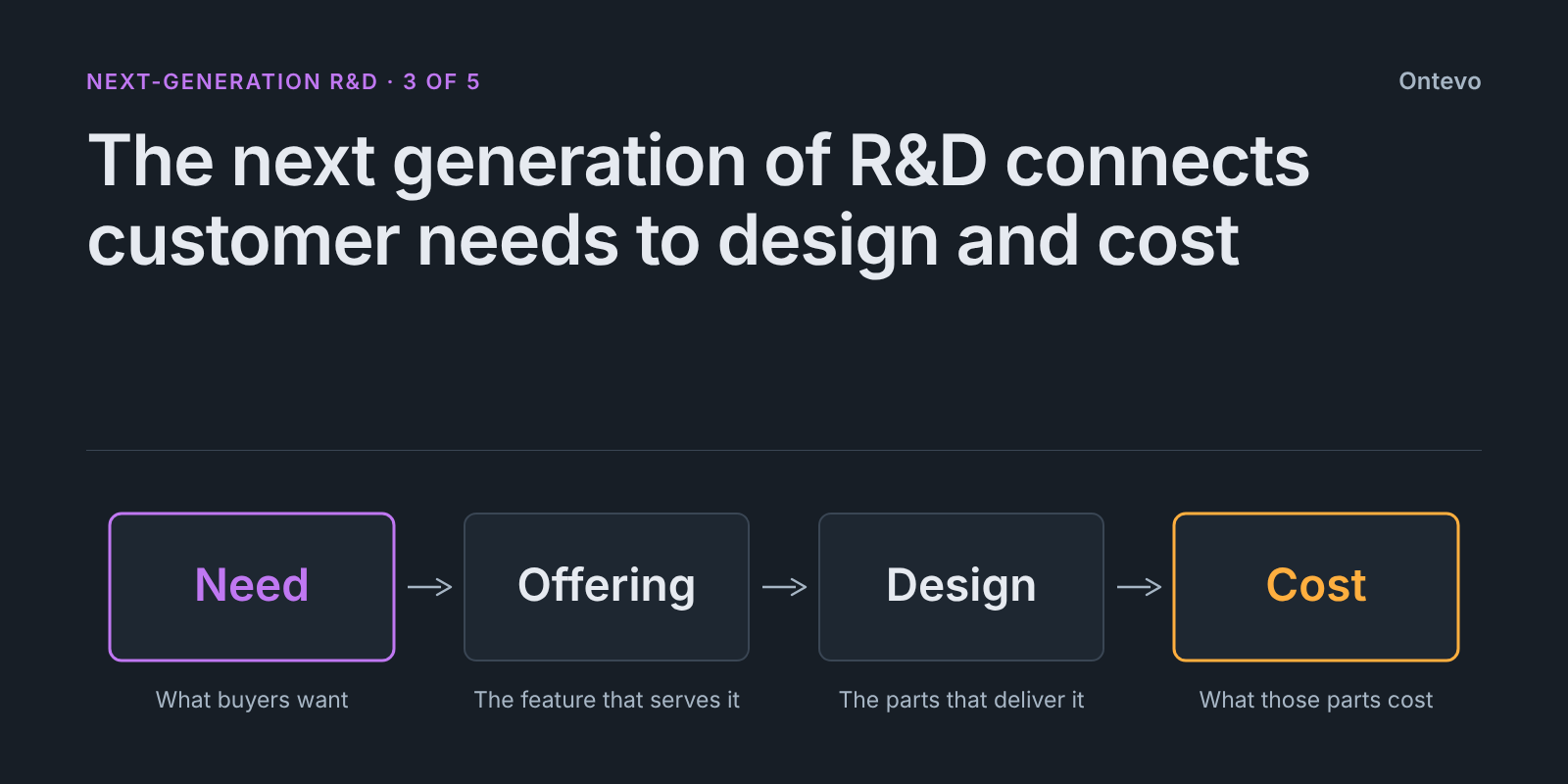
The next two parts stay with the same bottle: value engineering that starts with what customers notice, then connecting customer needs to design and cost.
Tell us one product. We'll show you its Full Diagnostic in a 30-minute demo. Book a Demo or see a sample report.
Ontevo Research. Where this post carries figures, they come from Ontevo's own scan corpus or are modeled from scan patterns across the category. No figure is measured from a named customer.