
Find the product detail that changes the choice.
Compare customer feedback, search demand and competing products to see what shoppers are missing in yours. Get recommendations on features, packaging and claims, with evidence and estimated revenue impact to help prioritize the work.
15-minute call to choose three hero SKUs.
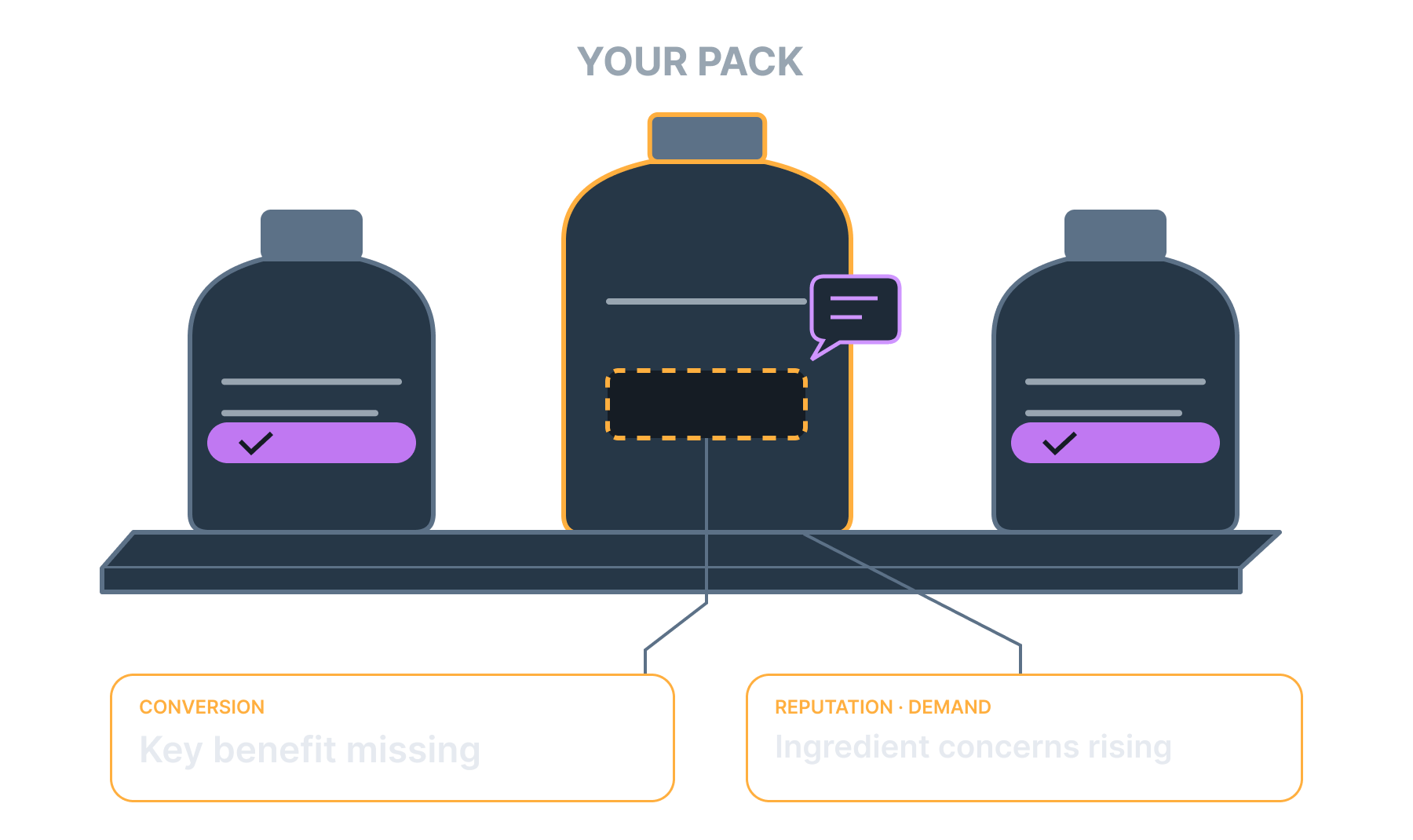
See which product changes deserve a closer look.
A 50-point diagnostic compares your offer with direct competitors and examines the customer evidence behind each recommendation.
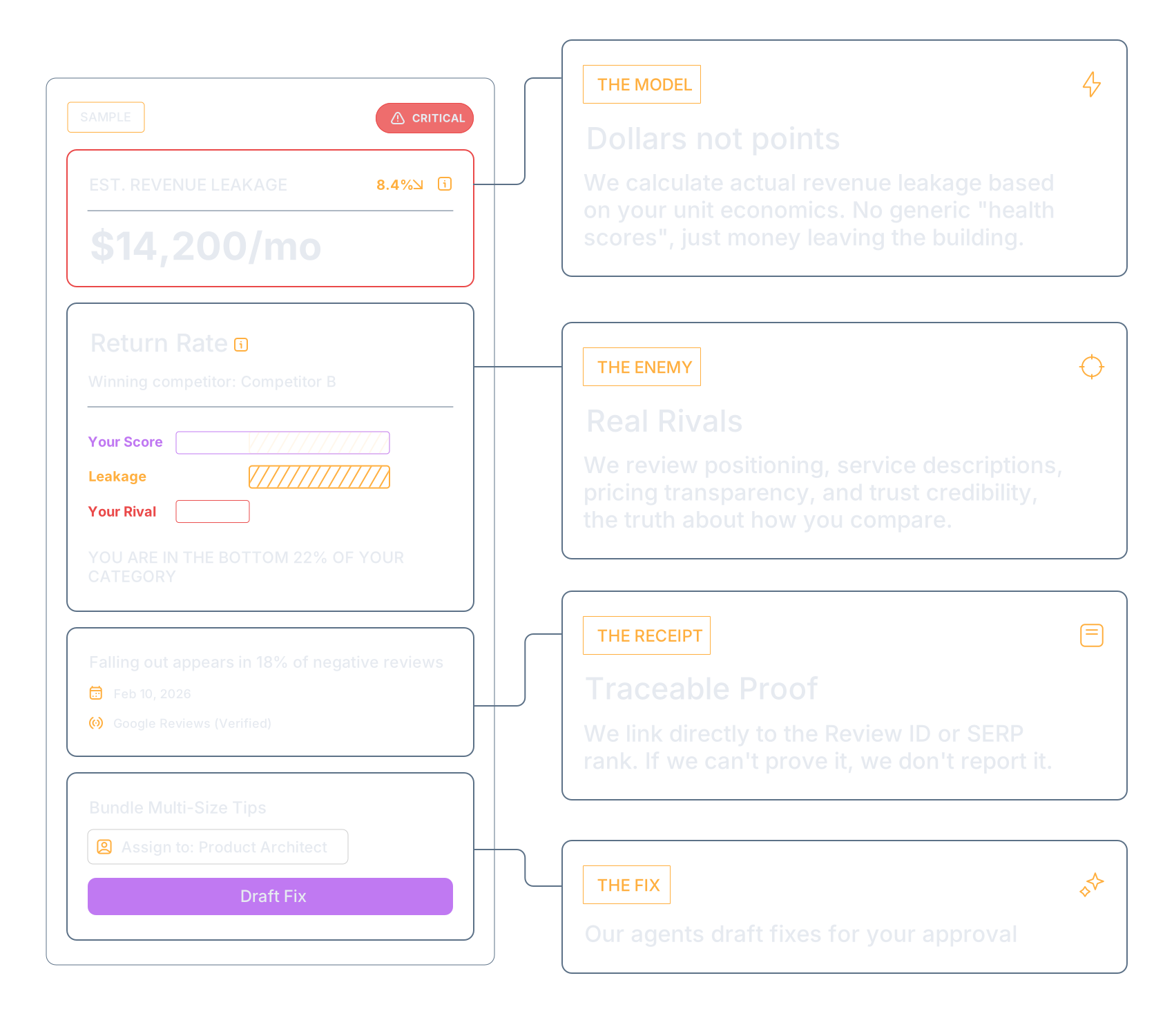
Price the leak before you raise the budget.
See which product changes customers want, why they matter and what they could be worth. Where the evidence supports an estimate, use monthly revenue impact to help prioritize the next investment.
Tear down the rival winning the comparison shopper.
Your pages line up against the rival winning the comparison shopper, claim by claim and review theme by review theme, down to the claim four of five of them make and yours does not.
Fix the listing this week.
The drafting agents write the page copy, the claim block and the review replies, and someone on your team approves before anything ships.
Catch the category shift early.
When the move happens, jar to airless pump, you see it on the competitor pages before it reaches your conversion rate.
Check the product before buying more traffic.
When shoppers keep asking for the same feature or flagging the same drawback, the offer deserves a closer look. Compare those patterns with the products they can choose instead.
Attribution tools show WHAT
Attribution tells you ROAS dropped. It doesn't tell you the jar packaging is the reason, or that a competitor's airless pump is winning the comparison.
Marketplace tools show your rank
BSR is slipping and you can see it. But neither Amazon tool diagnoses the spec gap at the listing level that's causing it.
Reviews bury the signal
The real complaint (packaging, a UX bug, a missing claim) sits in your review corpus uncategorized. Reviews tools collect them; they don't mine them.
“Tell me which specific spec gap is killing my conversion. Show me what 4 of 5 competitors offer that I don't. Quantify the dollar cost. Help me prioritize R&D over another ad-spend increase.”
- The founder's actual question. No attribution tool answers it.
Turn a product gap into a concept your team can review.
Start with a Truth Card, develop the proposed change in Concept Studio (beta), then compare alternatives in Simulation Engine (beta).
1
2
3
If your product line sits inside a multi-line house and the spec and the ad budget have two different owners, read Consumer product teams.
Why now: diagnose the tax, then build
Use reviews, search demand and competitor offerings to find a product gap, develop a concept and decide what to test with customers.
Build the case for the feature before the tooling.
Review customer demand, competing specifications and cost assumptions together. Use them to decide what belongs in the next product brief.
Spec gap, priced in dollars
See which competitor specs you are missing at the listing level, with the dollar figure that turns another Meta dollar into an R&D decision.
Simulate before you spend
Simulation Engine (beta) compares how synthetic buyers respond to each concept, helping you refine the design before real customer testing and production.
Digital concept in days
Concept Studio (beta) turns the white space into a build package: Golden Spec, photoreal plus 3D mesh, costed BOM, and supplier briefs, plus PDP and ad drafts you approve.
One week, not one year
Diagnose the tax, generate the concept, simulate the weak ones, and walk into sourcing with numbers. The loop your agency, research house, and factory each bill separately for, in one Growth plan.
See what shoppers compare before they buy.
Add product features, review themes and competing claims to the performance data your team already uses.
One entity is $245/mo on Essentials. Three is $735/mo. From the fourth entity you move to a Portfolio plan, from $1,500/mo, and we quote the exact figure on a call.
Find wasted money in 30 days, or your second month is free.
For single-business subscriptions, if we don't surface at least one gap worth more than your monthly plan, your second month is free under the 30-Day Truth Guarantee. Portfolio terms are agreed separately.
What founders and brand teams ask first
What a scan reads. Public pages, listings, reviews and competitor pages. No patient records, no client logins, no CRM connection. Nothing you or your client sends us trains a public model. Every external write is draft-only behind your approval queue. SOC 2 Type I and HIPAA readiness are in progress. Details on our Security page.
No. Attribution tools answer where the sale came from. Ontevo answers why more sales aren't happening, at the product level. It sits above your stack and doesn't replace it.
ChatGPT can summarize ten reviews. It can't benchmark your 10 direct competitors spec by spec against a 25M-record cohort, and it hallucinates on category vernacular. You realize the difference on Truth Card #3.
Both. The PDP and listing are your conversion surface; we scan both, and the Amazon corpus depth is a real advantage for negative-theme mining.
Month-to-month, standard pricing, self-serve. Onboard your SKU + ASIN inventory in about an hour.
Under 24 hours to a free Spec Gap Report on your 3 hero SKUs: the missing competitor specs and the conversion-lift math, with no login. Use “Discuss a free Spec Gap Report” to agree the scope. The Rapid Scan form above previews one business.
See how a team could use the findings.
These illustrative scenarios show how the recommendations could inform a decision.
It wasn't the funnel. One wrong spec was quietly gutting our conversion, and our attribution stack couldn't see it.
Illustrative scenario: 8-figure skincare brand
The Spec Gap Report told us where the next dollar goes: R&D, not more ad spend.
Illustrative scenario: Cookware · Shopify + Amazon
42% of our 1-star reviews were about packaging, not the formula. That reframed the whole roadmap.
Illustrative scenario: Supplements brand
Company profiles are anonymized composites drawn from real scan patterns.
Find which product detail to improve next.
Choose three hero SKUs for a free Spec Gap Report with product gaps and recommended changes to features, claims or packaging.
1. Enter one brand website and your email.
2. Get three personalized insights from the Rapid Scan.
3. Review the preview and decide what to investigate next.