Ship the hero serum in an airless pump
42% of your 1-star reviews cite packaging, not the formula; top rivals already ship airless pumps.
It is revenue that never happened, and no accounting system has a field for that. You already have analytics. What you are missing is intelligence, with a dollar figure on it.

public signals per business
Reviews, listings, local search and competitor pages, all pulled from the public record.
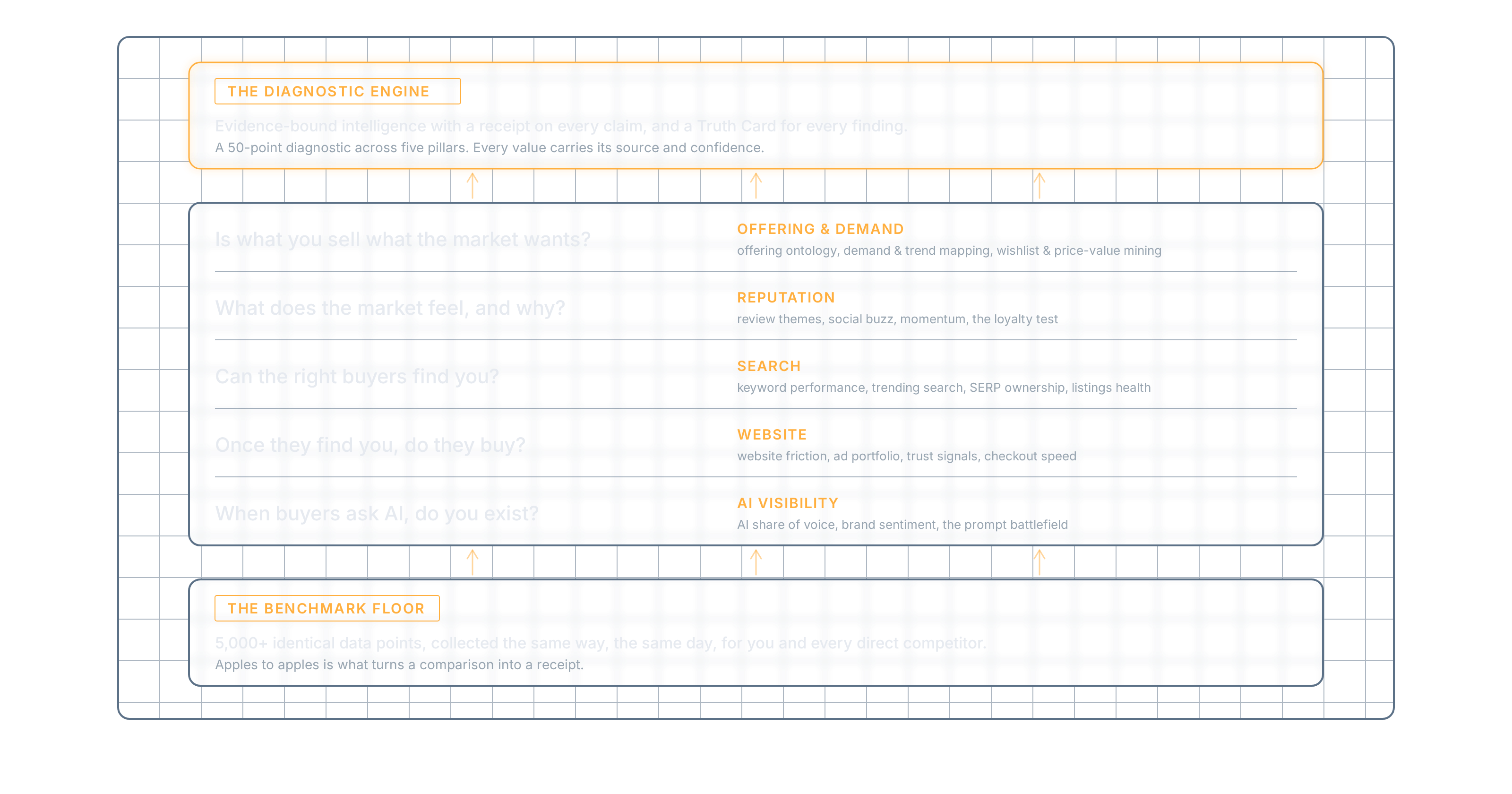
diagnostic across five pillars
Every signal is scored against Market Fit, Reputation, Visibility, Conversion and AI Visibility.
direct rivals, one cohort
Your 10 closest competitors, measured on the same signals on the same day.
gaps, one per pillar
Every gap you trail by is scored, sourced and mapped to a business KPI.
the leak, priced monthly
The gaps roll up to one monthly dollar figure: what closing them is worth to your top line.
Signal figures describe the Full Diagnostic.
Every incumbent tool measures a transaction that occurred. A sale, a click, a call, a refund. That's a real and useful thing to measure, and it's the reason your reporting stack exists.
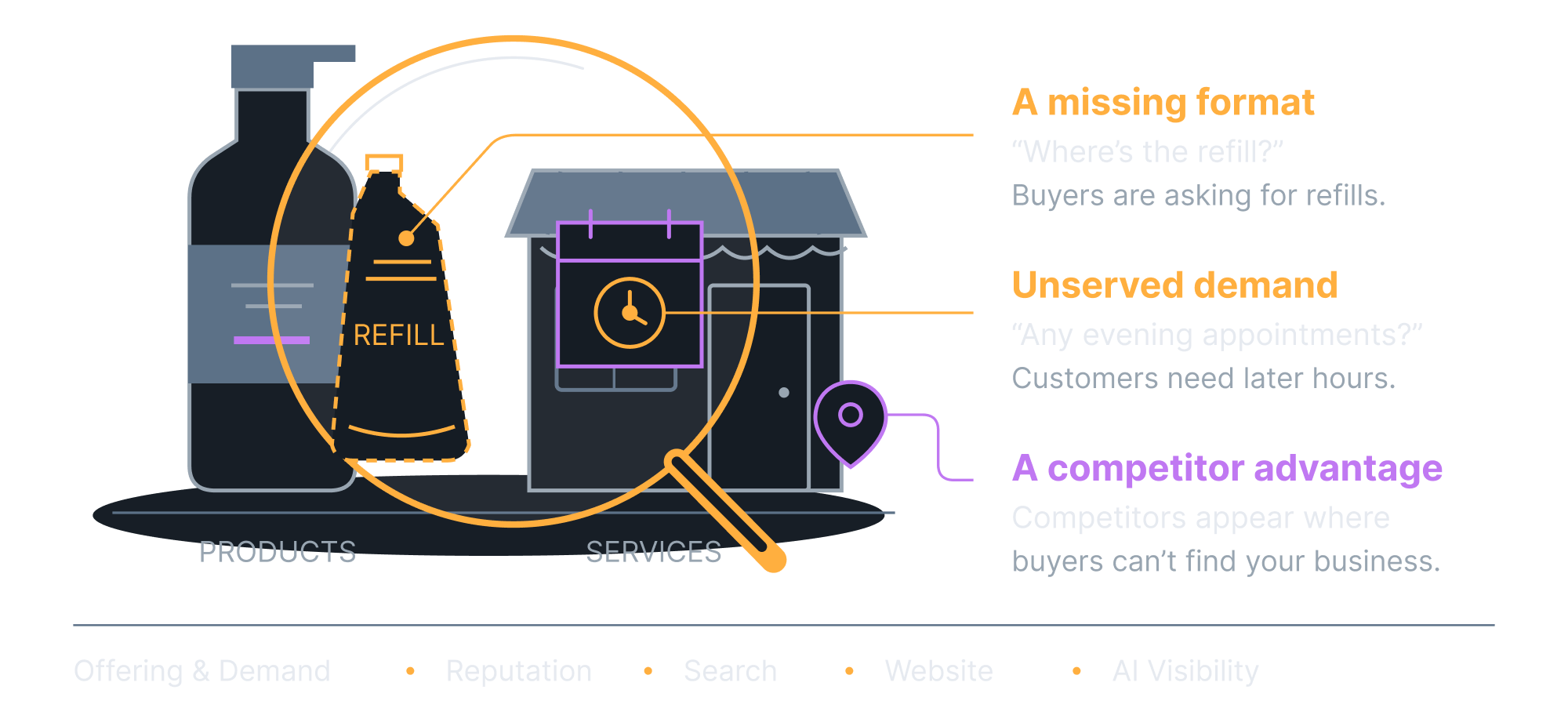
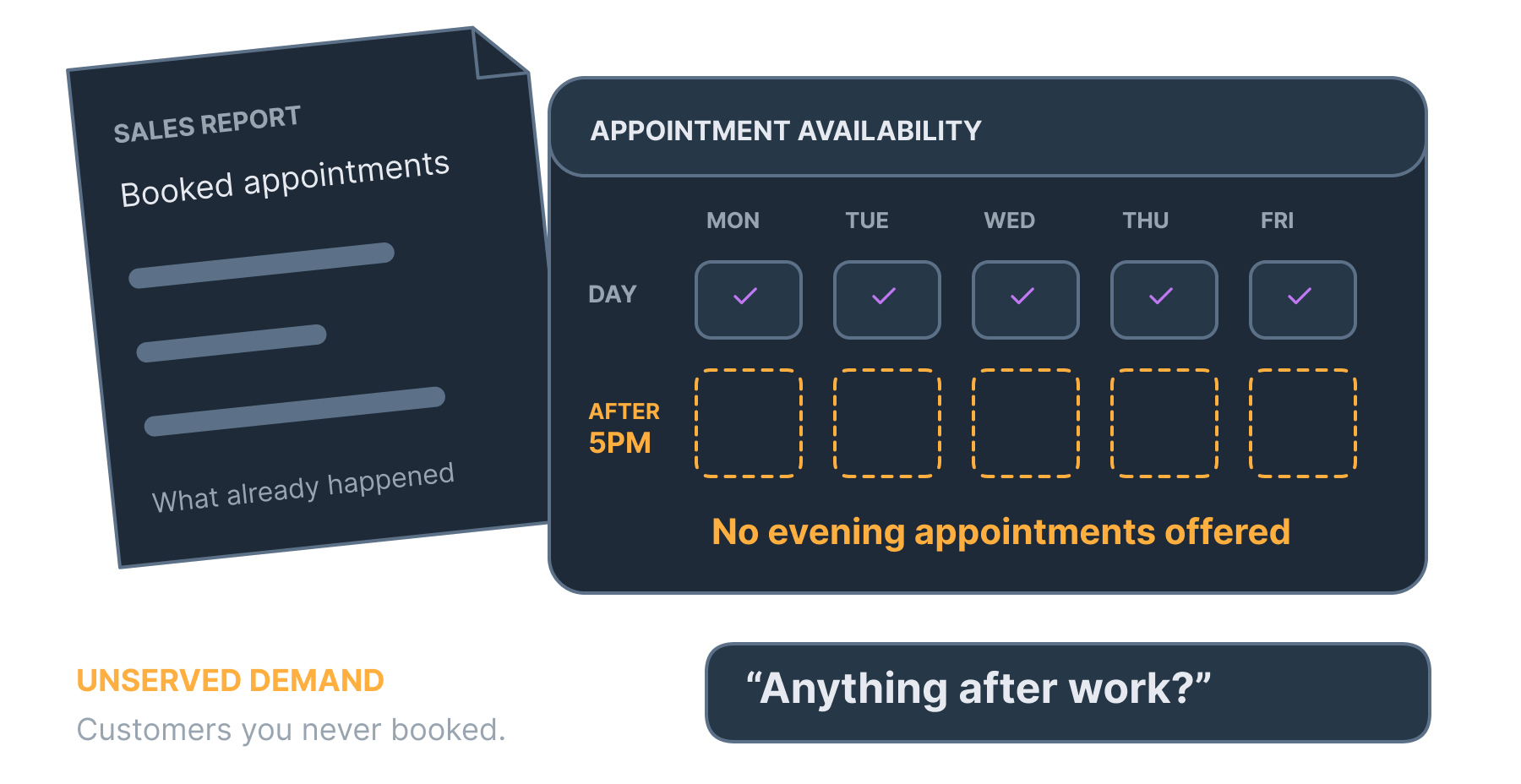
The loss that dwarfs all of it is structural. It's the service missing from your menu, the spec missing from your page, the demand that went next door and never registered anywhere in your systems because nothing happened. There's no line item for a customer who didn't arrive, and no field in any ledger for a product you didn't build.
Your dashboards were right about what happened. They were silent about what should have happened.
Revenue Leak Intelligence prints the missing line, itemized, with receipts.
Each of these had complete reporting. Each was measuring the wrong side of the problem.
Burns ad spend on a cream in a jar while the market moves to airless pumps. Conversion halves, cost per acquisition doubles, and the ad account looks like the culprit.
The finding: "42% of your 1-star reviews mention packaging, not the formula."
That sentence is a product brief, and it is sitting unread in her own review corpus.
Puts $150K into a CoolSculpting laser while local Traptox searches climb. Right numbers, wrong asset.
The finding: "Traptox runs 340% more demand than Botox in your area. Your menu doesn't mention it."
Every booking system in the practice was working perfectly. None of them knew what people were asking for.
Loses $50K bids on proposals that price the job and never mention the dust.
The finding: "Dust and communication appear in 70% of negative reviews, not workmanship."
He kept improving the craftsmanship. Craftsmanship was never the complaint.
Illustrative examples, not customer results.
The difference isn't resolution, and it isn't more charts. It's whether the output has a dollar figure attached and a name on who fixes it. Here is the same finding in both languages.
Figures shown are illustrative examples, not customer results.
A discipline is defined by what its output has to contain. Every Truth Card states three things, in order, and a card missing any of them is not a Truth Card.
Diagnosis without a cure is a report. A cure without a diagnosis is a content tool. The card is built to be forwarded to a business partner, a CFO or a financial advisor, and to survive the "so what?" test when it lands.
See the artifact rather than a description of it: the Truth Card galleryOr read what a Truth Card is, in full: the Truth Card42% of your 1-star reviews cite packaging, not the formula; top rivals already ship airless pumps.
Figures shown are illustrative examples, not customer results.
A 50-point diagnostic across 5 pillars, benchmarked against you plus up to 10 rivals.
Concept Studio (beta) drafts the fix from the same benchmark data that found the gap.
The Simulation Engine (beta) refines the concept until it survives the six default buyer personas.
13+ Evo Agents, human-in-the-loop, draft-only. Agents draft. You approve every action. Five ship today as API agents: Reputation Autopilot, Benchmark Copilot, Market Shift Radar, Lead Generator and Social Hub.
Five pillars, two scores. Four of them describe the internet you already knew about. The fifth describes the one that started answering questions on your behalf, in your category, without citing you.
Identical collection across a whole cohort on the same day is a claim no single-tenant tool can make, and it is the specific thing that turns a chart into evidence a finance person will accept. A number collected from you in March and from your rival in July is a comparison of two calendars.
identical signals, per scan
market benchmark records
direct competitors in your cohort
They track what your reviews say. Revenue Leak Intelligence prices what the reviews are saying, in dollars, and drafts the change.
They answer where the sale came from. They were never built to answer why more of them aren't happening. They tune the funnel; we validate what goes into it.
A workstream runs into six figures and takes weeks, produces a deck, and is point-in-time by construction. The same question, asked continuously, is a different kind of answer.
No cohort, no benchmark, and a confident paragraph where a receipt should be. It will invent your category's vernacular rather than admit it doesn't know it.
Your stack reports on the work. None of it is the work, and none of it produces something you can bill. Here the diagnostic becomes a client-ready artifact on your own brand: evidence, confidence, dollars. When a client challenges a finding, you show the receipt.
For agenciesAttribution tells you where the sale came from. It cannot tell you which spec gap is causing the cost per acquisition to climb. Paid spend covering for a spec problem is the most expensive way to cover for one. The budget line here is product, not martech.
For DTC brandsRead a target's commercial position outside-in while the offer is still being written, with no passwords and no data room. Then run the same diagnostic across every portco, measured the same way, against the revenue the multiple is priced on. Continuous instead of episodic.
For private equitySee every location in one view instead of one login per tool. Benchmark every location the same way, so the newest one gets compared to location three on evidence rather than on a hunch. One flat price for the group, never per location.
For multi-location operatorsTwo composites, for scale. $157,800/mo: portfolio leak across 4 groups and 35 sites. $61,200/mo: leak surfaced in a diligence read.
Company profiles are anonymized composites drawn from real scan patterns.
This is not for everyone, and the list is short. Brands with in-house data teams. Percentage-of-spend media shops. Generalist agencies covering eight or more verticals. Single-location businesses with no review corpus. Anyone who wants the fixes to ship without a human approving them.
Every value in a Truth Card carries its source and a confidence tier. A claim without evidence is nulled, not guessed. Every dollar figure carries its formula and its inputs. The first time a number wobbles in front of a client's CFO the deliverable is dead, so each one is built to survive cross-examination.
No borrowed logos, no invented testimonials. Ontevo is pre-launch. Public launch is 1 September 2026. The figures on this page are labelled for what they are.
No case study yet. We will run the engine on your own business before you pay for anything.
No autonomous execution. Agents draft, a person approves, and that is not a setting.
No system access. Outside-in, public data only. Nothing held, nothing claimed.
Security, plainly. No SOC 2 held (Type I in progress) and no HIPAA BAA. Business associate agreement support is on the roadmap.
Beta is labelled beta. Concept Studio and the Simulation Engine carry the label everywhere, including here.
A page that tells you what it cannot do yet is the same page that will not invent a number when it matters.
Rapid-scan figures are modeled from your company and competitor profiles. They are directional by design. The full 50-point diagnostic verifies every value and recommendation against your live data.
If we don't surface at least one gap worth more than your monthly plan, your second month is free. No fine print, no hoops. (Single-business subscriptions.)