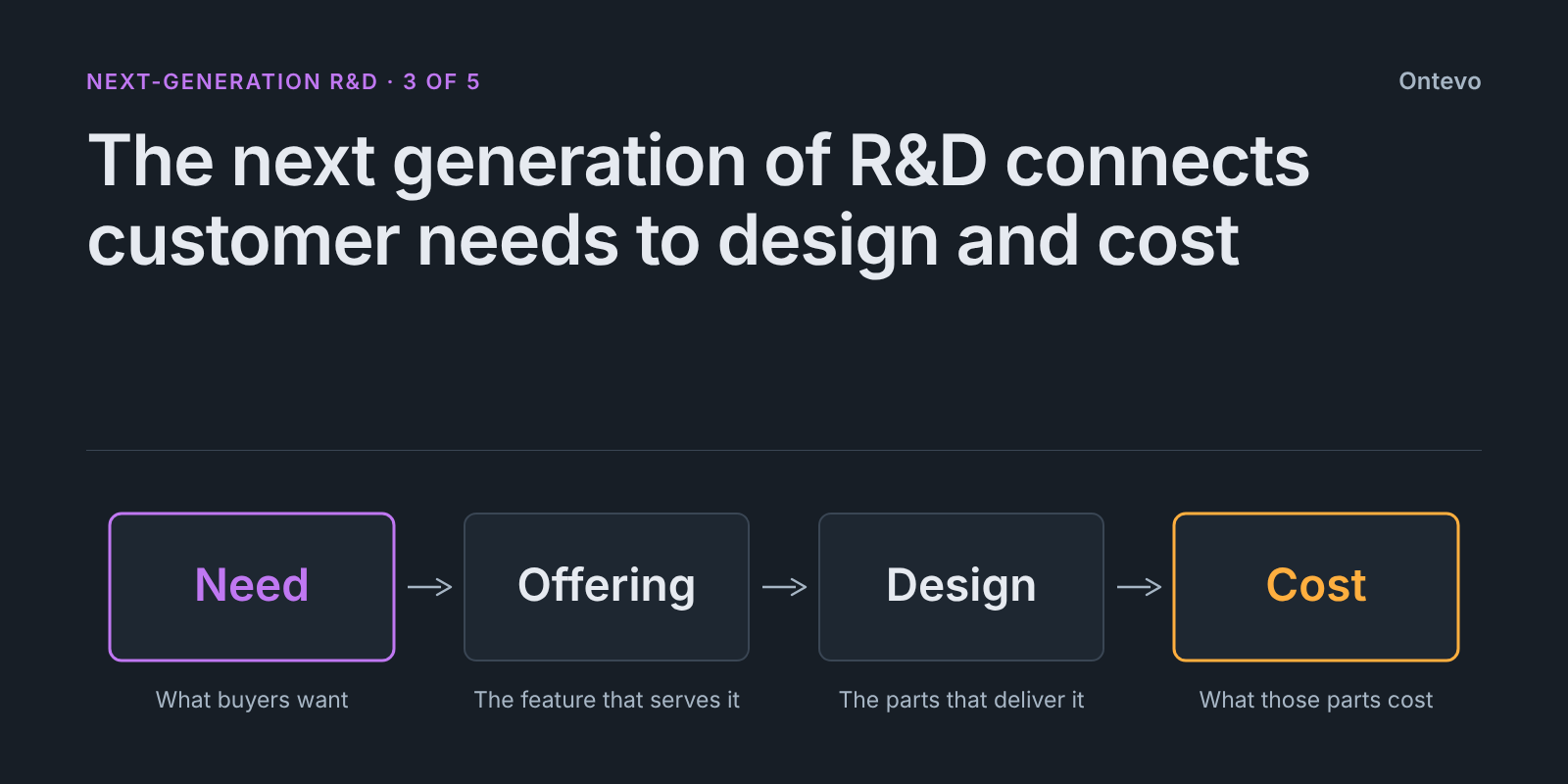
The next generation of R&D connects customer needs to design and cost
Part 3 of 5 in our series on the next generation of R&D.
Ask why a product has an overcap and the answer is spread across four documents. Research has a deck of needs and segments. Product management has the specification. Engineering has the bill of materials, and finance has the cost model. Each is accurate. None of them says which part delivers which need, or what that need costs to serve.
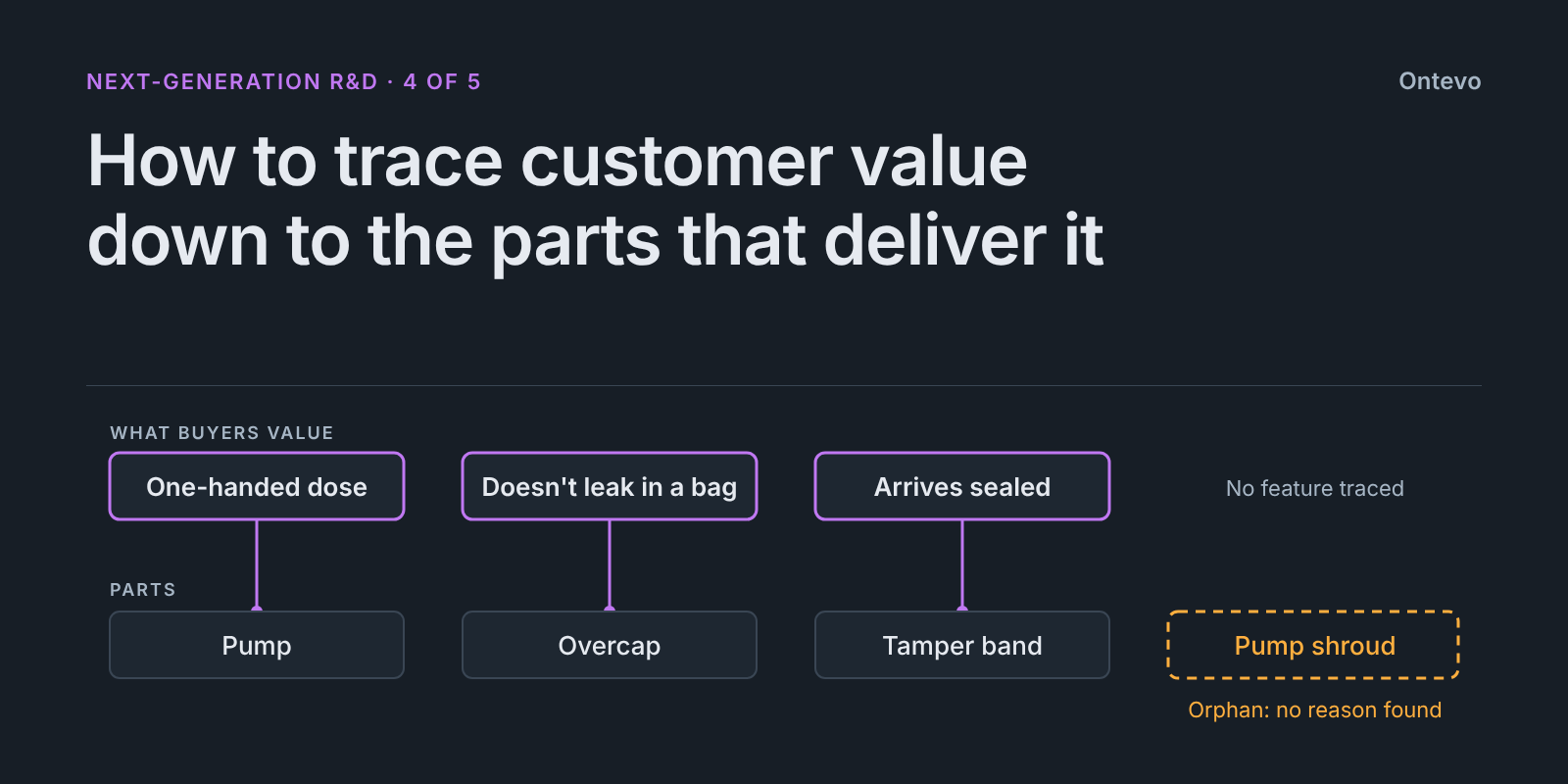
That missing layer is where trade-offs get decided, and today it lives in people's heads. Our view is that the next generation of R&D will keep it written down: every customer need linked to the features that serve it, every feature to the parts and design choices that deliver it, and every part to its cost. Requirements engineers call this traceability. Most consumer product companies don't have it.
A cost review without it
Someone proposes removing the overcap to save five cents. Engineering knows the overcap is the only thing that stops the pump being pressed in a bag. Research has a view on how many buyers care about leaks. Finance can look up the five cents. None of this is in one place, so the decision goes to whoever remembers most or ranks highest, and afterwards nobody can say what evidence settled it.
The cost shows up later: a cut that removes the one part carrying the product's most common complaint, and a company that learns about it from reviews.
The house of quality had the right idea
John Hauser and Don Clausing brought the house of quality, the central chart of Japan's quality function deployment, to Harvard Business Review readers in 1988: a matrix with what customers want down one side and the engineering characteristics that affect it across the top, so that marketing and engineering plan from the same sheet. The idea was sound and many manufacturers adopted it.
Where it faded, upkeep is the usual explanation. A house of quality was built by hand, in workshops, from one round of interviews. A few dozen needs against a few dozen engineering characteristics makes several hundred cells, each one a discussion. The finished matrix described the customer as of that quarter. By the next cost review a competitor had launched, a supplier had changed a part, and nobody had a week free to redraw it.
What has changed since is the cost of filling in the cells. Customer evidence no longer has to come from an interview round, because reviews, listing questions and social posts arrive every day. Language models can read that volume, propose which need a text expresses and which feature it concerns, and show the passage they relied on so a person can check it.
One trace, read across
Take the product this series follows, a 90 ml travel pump bottle of body lotion that costs $3.00 to make and deliver. The counts and costs are illustrative, invented to show the reading.
| Link | In this example | Basis |
|---|---|---|
| Need | "Carry it in a bag without leaks." 182 of 1,000 buyer texts: 64 requests for a pump that locks, 118 leak complaints | Counted from the texts |
| Feature | Leak protection. The specification lists a tamper band and an overcap, and no pump lock | Published specification |
| Parts | The tamper band covers the bottle until first use. After that, a loose overcap is all that stops the pump being pressed | Engineering mechanism, to be confirmed |
| Cost | Band $0.06 + overcap $0.05 = $0.11, or 3.7% of unit cost | Cost model, estimated |
Now a second trace. The printed outer sleeve links to the need "looks like a gift", which appears in 4 of the 1,000 texts. The sleeve costs $0.26, or 8.7% of unit cost.
So the product spends 8.7% of its cost behind a need four buyers mention, and 3.7% behind one that 182 mention and that the product is failing. That comparison doesn't settle anything by itself. A sleeve does its work at the shelf, before anyone is a customer, so four mentions may undercount it, and mention counts are a weak guide to importance in any case. What the two traces do is put a better question in front of the room than "should we cut the overcap": whether the sleeve is earning its 8.7%, and what three more cents on the pump would buy. That question can be tested, with a conjoint that includes sleeve and lock as attributes or with the two packs side by side in one channel. Part 2 works through the trade in value engineering that starts with what customers notice.
Traces also cross. In a cordless vacuum, a bigger battery helps runtime and hurts weight, and the record should show both links on the same part, each with its direction.
What a skeptical engineer will ask
A connected record earns trust one link at a time, and the first thing an engineer will want to know is where a link came from. A review that names the pump, a link a model inferred from meaning and a mechanism someone proposed in a meeting are different kinds of claim. The record should mark which is which, show the quotes, the specification line or the cost assumptions behind each, and say so where the original wording isn't available.
Gaps should stay visible. A need with no path to any feature is a finding: buyers want something the product doesn't address. A part with no path to any need is a question for its owner.
It will also be incomplete in a predictable way. Buyers don't write about the needs they assume, so safety, durability and regulatory requirements have to be added by engineers. A link that says a thinner wall causes dents is a hypothesis until someone tests the wall. And the record needs one named owner per product, with research, engineering and finance each answerable for their own links.
Where Ontevo is on this
Most of the raw material exists in the product today. Ontevo's Full Diagnostic reads buyer wishlists, review themes and published specifications across a 50-point diagnostic. Its Product Definition view shows the segments in a category, the jobs each one hires the product for and how often each product did the job. Its Cost Efficiency analysis breaks a product into a leveled, costed bill of materials, with modeled estimates and listed assumptions.
Connections is the view we're building to join them. It is in development. It's designed to lay out the path from each customer need through features and design items to cost share, to mark which links were found in your report and which were suggested by AI, and to show a need with no path as exactly that. Each suggested link is there for your team to confirm or reject. We're still checking how completely and how accurately it maps a product before we call it finished.
The other parts of this series work at each end of the trace: finding the next winning product in market evidence, tracing customer value down to the parts that deliver it, and using AI to attach online mentions to jobs and segments. For what the diagnostic covers today, see how Ontevo works.
Tell us one product. We'll show you its Full Diagnostic in a 30-minute demo. Book a Demo or see a sample report.
Ontevo Research. Where this post carries figures, they come from Ontevo's own scan corpus or are modeled from scan patterns across the category. No figure is measured from a named customer.