When a cheaper product costs more to deliver
By Ontevo · Published October 10, 2026
A cheaper product costs more to deliver when its purchase savings are outweighed by lower production yield, extra returns, warranty work or the costs of switching. Approve a reduction against the contribution you expect to keep after those consequences, using comparable orders, a common evaluation period and the performance customers depend on.
A lower supplier quote is a useful starting point. Treating it as the finished savings calculation creates an easy mistake: purchasing records the improvement while the warehouse, support team and customer absorb the cost.
The strongest cost reductions remove expense while preserving the reason someone chooses and keeps the product. That requires following a proposed change beyond the purchase order.
What has to stay true for the saving to count?
Set the required performance before comparing prices. A lower-cost alternative belongs in the comparison once it can meet the product's essential requirements, including reliability, safety and the customer experience promised at purchase.
For a proposed supplier switch, write the acceptance requirement before looking at the lower price. Compare alternatives that meet it under representative production and use conditions.
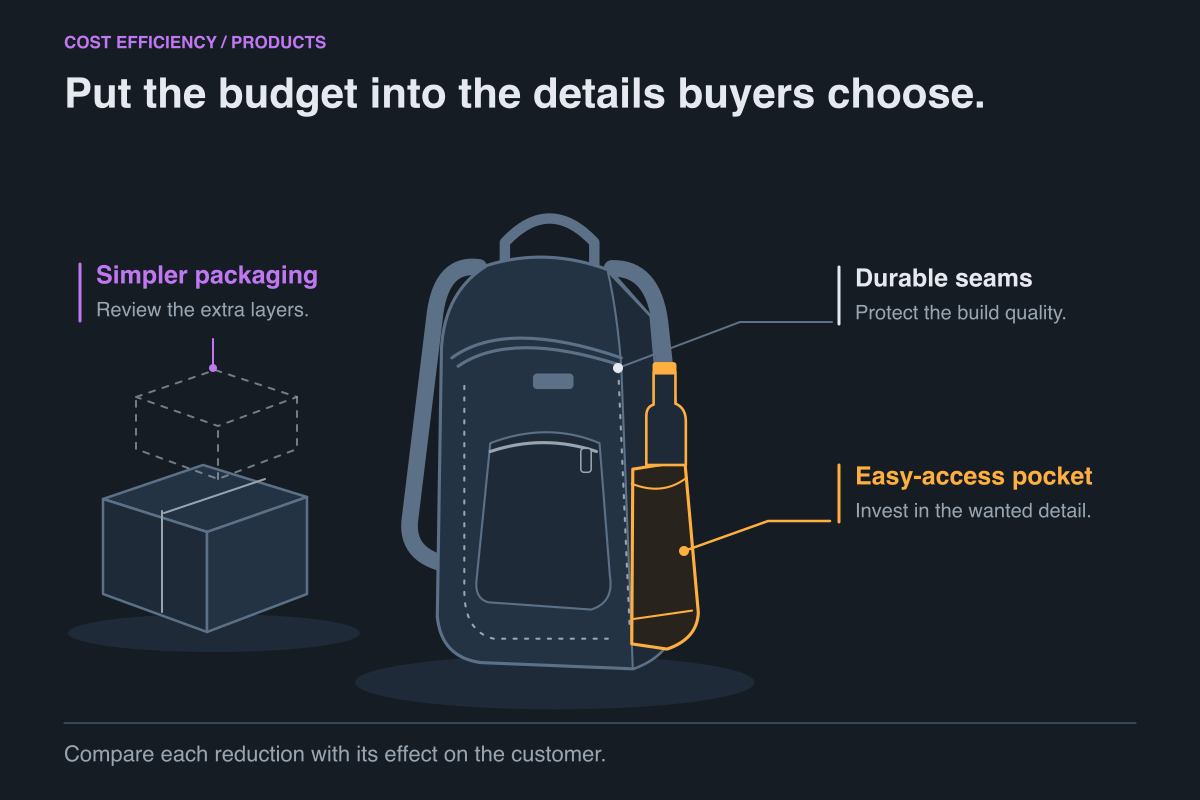
McKinsey's design-to-value research connects product spending with customer preferences and willingness to pay. Applying that principle means investigating expensive details with weak evidence of value while protecting less visible requirements that make the product dependable.
Separate an opportunity to simplify decorative packaging from a proposal to reduce protective packaging. Each needs its own evidence. A thinner shipping insert may save material and increase damage; a simpler printed sleeve may preserve the entire experience.
The same distinction applies to the product gaps that affect conversion. A change that weakens a valued attribute can affect both the next purchase and what happens after delivery.
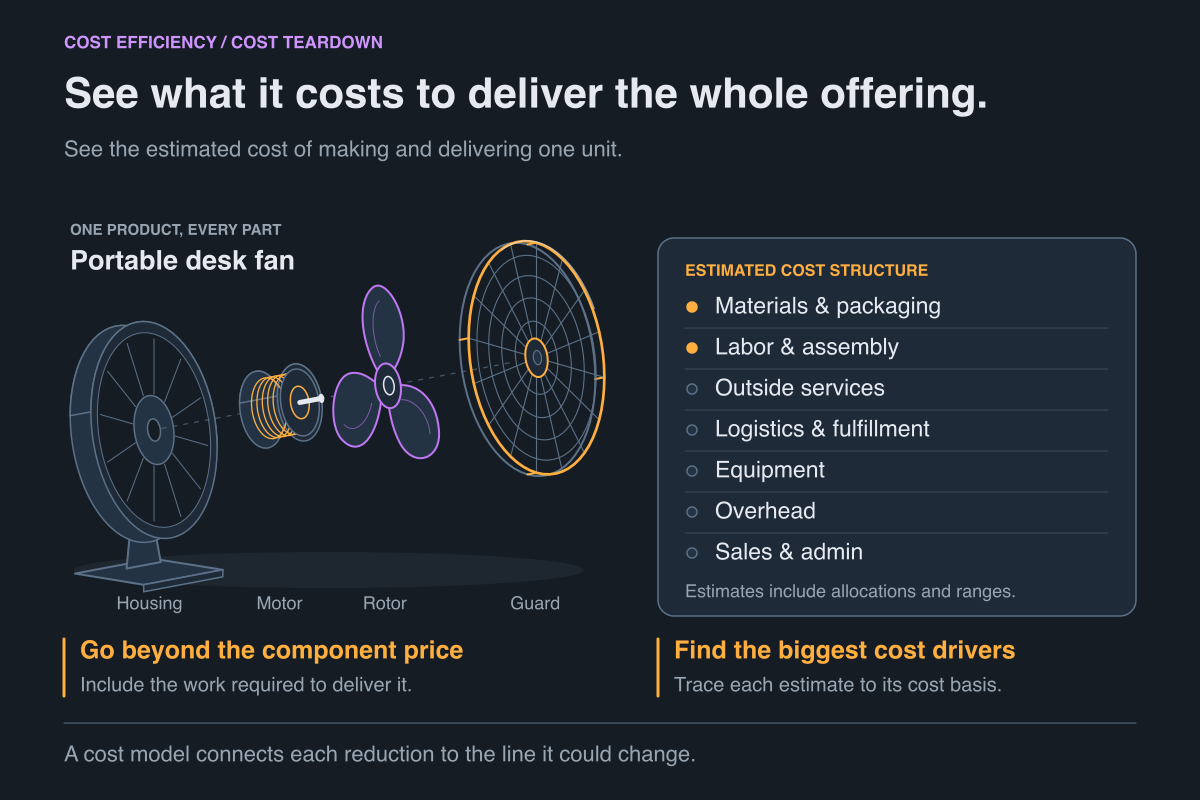
Follow the cost beyond the supplier invoice
Trace only the costs and outcomes the proposed change can affect. A focused comparison is enough to expose many false economies without rebuilding the entire product cost model.
ASQ's cost-of-quality framework distinguishes prevention and appraisal from failures found before and after delivery. That makes room for inspection, scrap and rework alongside warranty claims, complaints and returns.
Production yield deserves particular attention. A cheaper part that needs extra fitting, sorting or replacement can raise the cost of an acceptable finished unit. Ask for evidence from representative production conditions, including ordinary material variation. A carefully prepared supplier sample says little about how reliably the next batch will assemble.
After shipment, trace each failure through its actual resolution. A refund reduces net sales. A replacement adds another product and delivery cost. A repair adds parts and service time. Count each event once, using the resolution that occurred or a clearly stated assumption.
Support time can also consume capacity before payroll changes. Keep that burden visible; describe a cash saving only when spending actually falls.
A cheaper lid that loses contribution
Consider a fictional insulated bottle sold for $40. Changing its lid reduces the finished product's landed cost from $14 to $12. The following illustrative scenario compares 1,000 initial orders under each design, with the same selling price, customers and evaluation window.
Assume refunds rise from 20 to 80 because the new lid leaks. Each returned bottle incurs $10 of handling and return freight. Returned products have no salvage value, and customers receive full refunds without replacements. Other variable costs total $6,000 in either case.
| Illustrative result for 1,000 initial orders | Current lid | Cheaper lid |
|---|---|---|
| Sales before refunds | $40,000 | $40,000 |
| Refunds | $800 | $3,200 |
| Net sales retained | $39,200 | $36,800 |
| Landed product cost | $14,000 | $12,000 |
| Return handling and freight | $200 | $800 |
| Other variable costs | $6,000 | $6,000 |
| Contribution after these costs | $19,000 | $18,000 |
The purchase saving is $2,000. Additional refunds consume $2,400 and additional return costs consume $600. Contribution falls by $1,000 before any tooling or qualification expense.
For this scenario, each extra refund costs $50 in lost sales and handling. Forty additional refunds would erase the entire purchase saving. That threshold gives the test a concrete question: can the new lid stay comfortably below that increase while meeting its performance requirements?
These figures illustrate the arithmetic; they are neither customer results nor a forecast. A real comparison would include salvage proceeds, replacement behavior and any other costs that differ. Keeping the denominator at initial orders makes the lost sales visible.
Give the current product a fair comparison
Compare the proposed change with the best realistic next action for the current design. Last year's invoice can be a poor baseline if both suppliers would now offer better terms.
A commodity price decline, different order volume or negotiated freight rate may explain part of the lower quote. Attribute only the remaining difference to the redesign. Use equivalent purchase quantities and commercial terms, or price the differences explicitly.
NIST's life-cycle costing manual uses a common study period for competing alternatives and screens for required performance. Its application is federal facilities; the comparison principle is useful here: both options need the same economic horizon and an explicit account of what they deliver.
Compare returns at the same age after shipment. A new batch with little time in customers' hands can appear better simply because failures haven't arrived yet. A short pilot can reveal an assembly problem; longer-life reliability may require engineering evidence and further observation.
Also test the assumption that order volume stays constant. If customers perceive a worse finish or noisier operation, model the contribution lost at a plausible lower sales level separately. Label that demand effect as uncertain until purchasing evidence supports it.
Put the switch and its cash needs on the page
A recurring saving can be attractive while the first production commitment is unaffordable. Record the transition expense and the cash required to reach the new steady state separately.
Qualification testing, tooling changes and staff training may be necessary before the cheaper version can ship. Existing components may need to be used up, reworked or written off. Minimum orders, supplier deposits and longer lead times can tie up cash even when the quoted unit price falls.
NIST's manufacturing guidance on supply-chain risk emphasizes evaluating supplier relationships and total ownership costs. For a specific switch, that means checking delivery dependability and the fallback if the new supplier misses a shipment.
Keep the accounting clear. Extra inventory is initially a working-capital requirement; carrying costs and eventual write-offs affect economics separately. A prevented future cost increase is cost avoidance. Released employee time is capacity. Neither automatically produces a lower cash outflow this month.
Use the Savings Check before committing
The Savings Check is a short decision record for one proposed cost reduction. It names the current alternative, the performance to preserve, the recurring contribution difference, the transition expense and the cash exposure. It also records which uncertain assumption could reverse the decision and what evidence would resolve it.
| What the evidence shows | Decision | Evidence needed next |
|---|---|---|
| Required performance holds and the gain over the evaluation period exceeds affected operating and transition costs | Approve within the tested scope and cash capacity | Verify qualification, tooling and transition costs; confirm actual results after rollout |
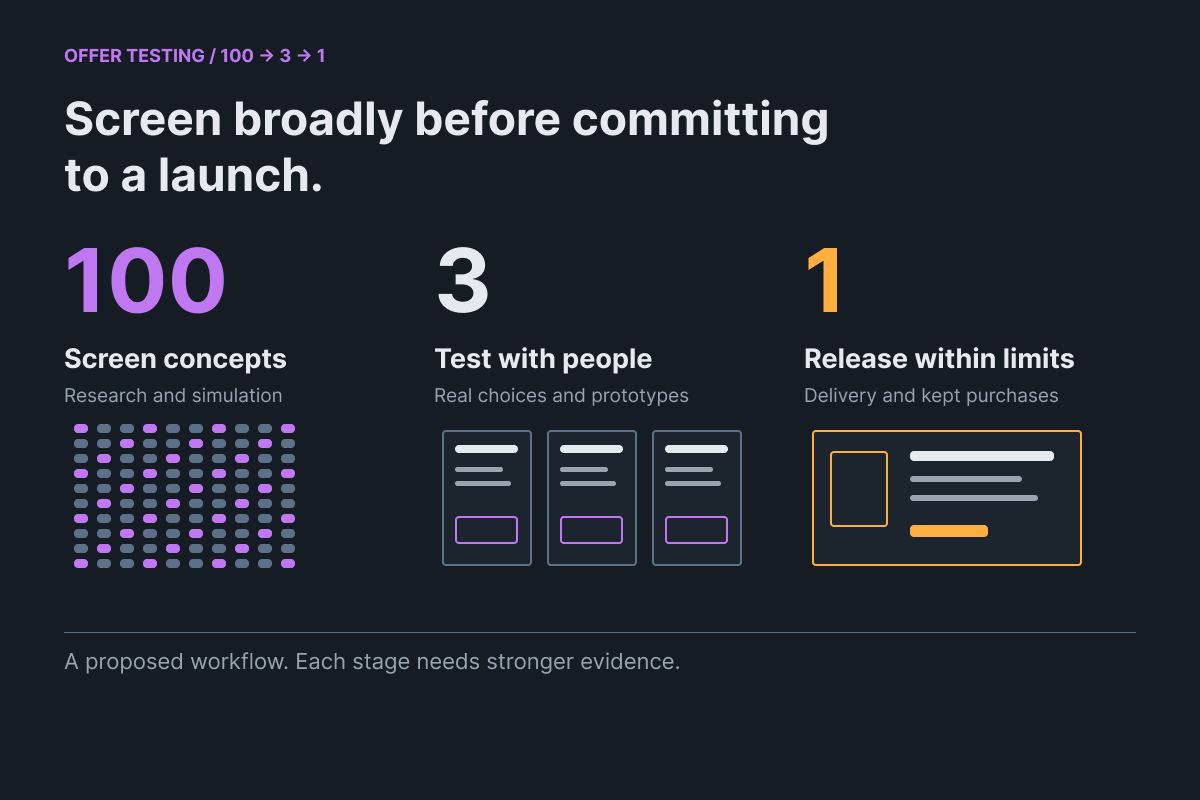
| Savings depend on an unproven failure rate or assembly yield | Run a bounded pilot | Representative production and field evidence |
| Recurring economics improve but minimum orders or tooling strain cash | Revise the switch | Smaller commitment, phased transition or better terms |
| The change weakens an essential requirement or consumes its saving | Reject or redesign | A different route to reduce the cost |
Keep one owner accountable for the whole result. A purchasing target that ends at the invoice encourages decisions that other departments have to repair.
Our guide to checking the offer before increasing ad spend addresses whether a change earns additional demand. The Savings Check addresses whether a proposed reduction leaves the business better off after delivery. Both decisions require customer evidence and actual operating consequences.
Questions about product cost reduction
Does every component change need a long field trial?
Match the evidence to the failure mechanism and consequence. Some changes can be qualified through established engineering tests. Others need field observation. A small trial with no observed failures leaves uncertainty, especially for rare or delayed failures.
Can a higher return rate still be acceptable?
Economically, a change can retain positive contribution despite some additional returns. It must also meet the product's performance requirements. Set both conditions before testing; the financial threshold alone cannot approve a defective or unsafe design.
When can savings be called realized?
When actual comparable results show the spending reduction after the affected costs. Keep quoted, modeled and observed savings separate. Continue tracking costs that emerge later, and distinguish cash savings from released capacity or avoided future spending.
Ontevo Research. Where this post carries figures, they come from Ontevo's own scan corpus or are modeled from scan patterns across the category. No figure is measured from a named customer.