
Every finding ships as a Truth Card: a receipt, not a report.
One gap, stated in the words you'd use out loud. What it's costing you every month, with the math showing. And the fix, already drafted, waiting on your approval. It's built to hold up the moment someone forwards it to a CFO.
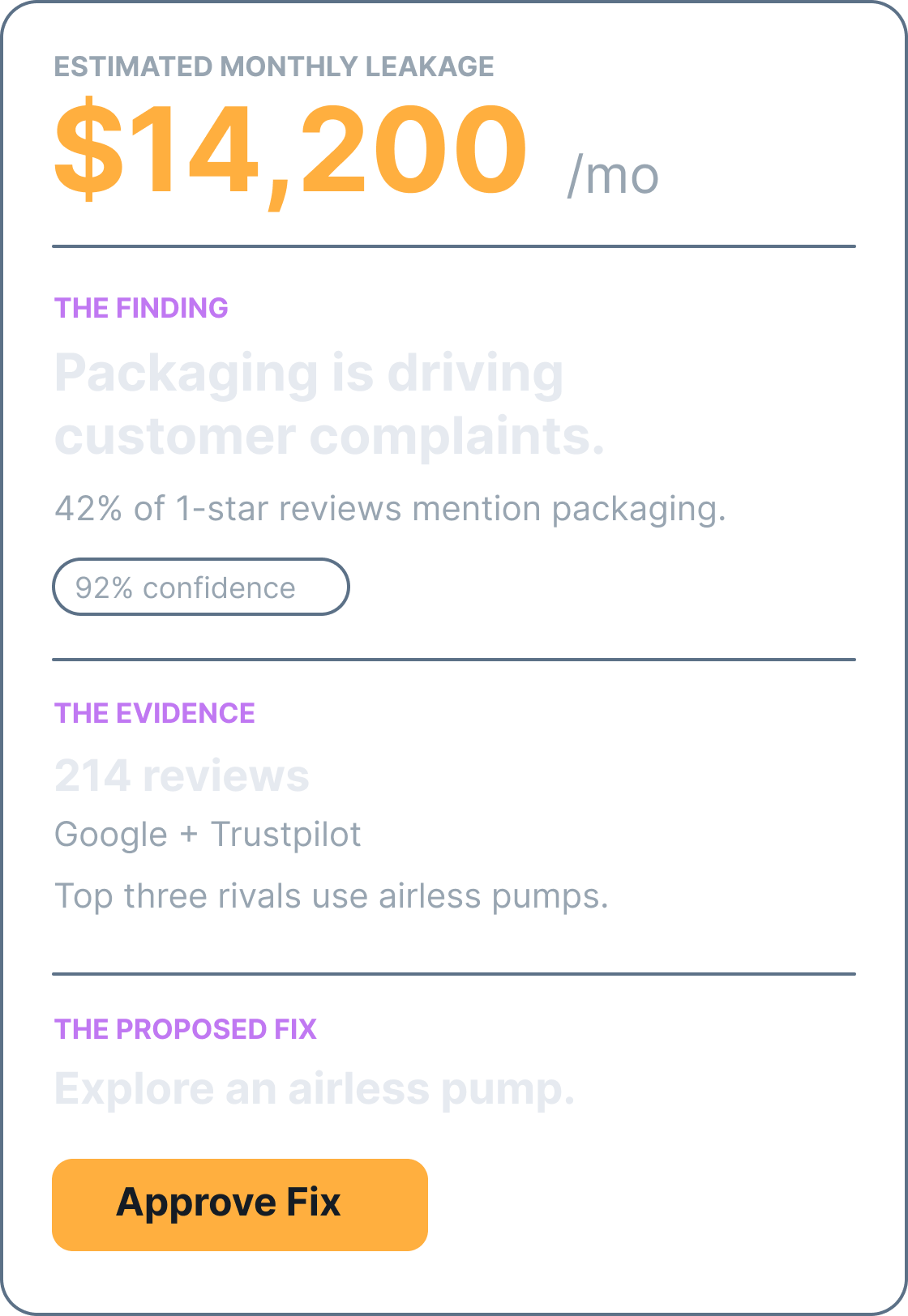
Illustrative example, not a customer result. Company profiles are anonymized composites drawn from real scan patterns.
This is what one looks like when it lands.
Three findings, three businesses, ranked by what each one costs. Every card carries its own evidence, its own math and its own drafted fix. Nothing here is a summary of something else.
Full Diagnostic figures.
Ship the airless pump before the shelf re-prices you
42% of your 1-star reviews mention packaging, not the formula. The top three competitors in your cohort ship airless pumps. You ship a jar.
Put the treatment your market is already searching for on the menu
Traptox runs 340% more local demand than Botox in your area. Your menu doesn't mention it, so you're invisible to every one of those searches.
Answer every 1-star review inside 48 hours
40% of your 1-star reviews get an owner reply within two days. Your closest rival is at 85%. Reply lag is the single biggest driver of an escalation.
A card missing any of this isn't a Truth Card.
The standard is published on purpose. It's easy to write a finding that sounds convincing and impossible to write one that survives being handed to somebody whose job is to say no. So the artifact holds itself to a fixed shape, and anything that can't fill the shape doesn't ship.
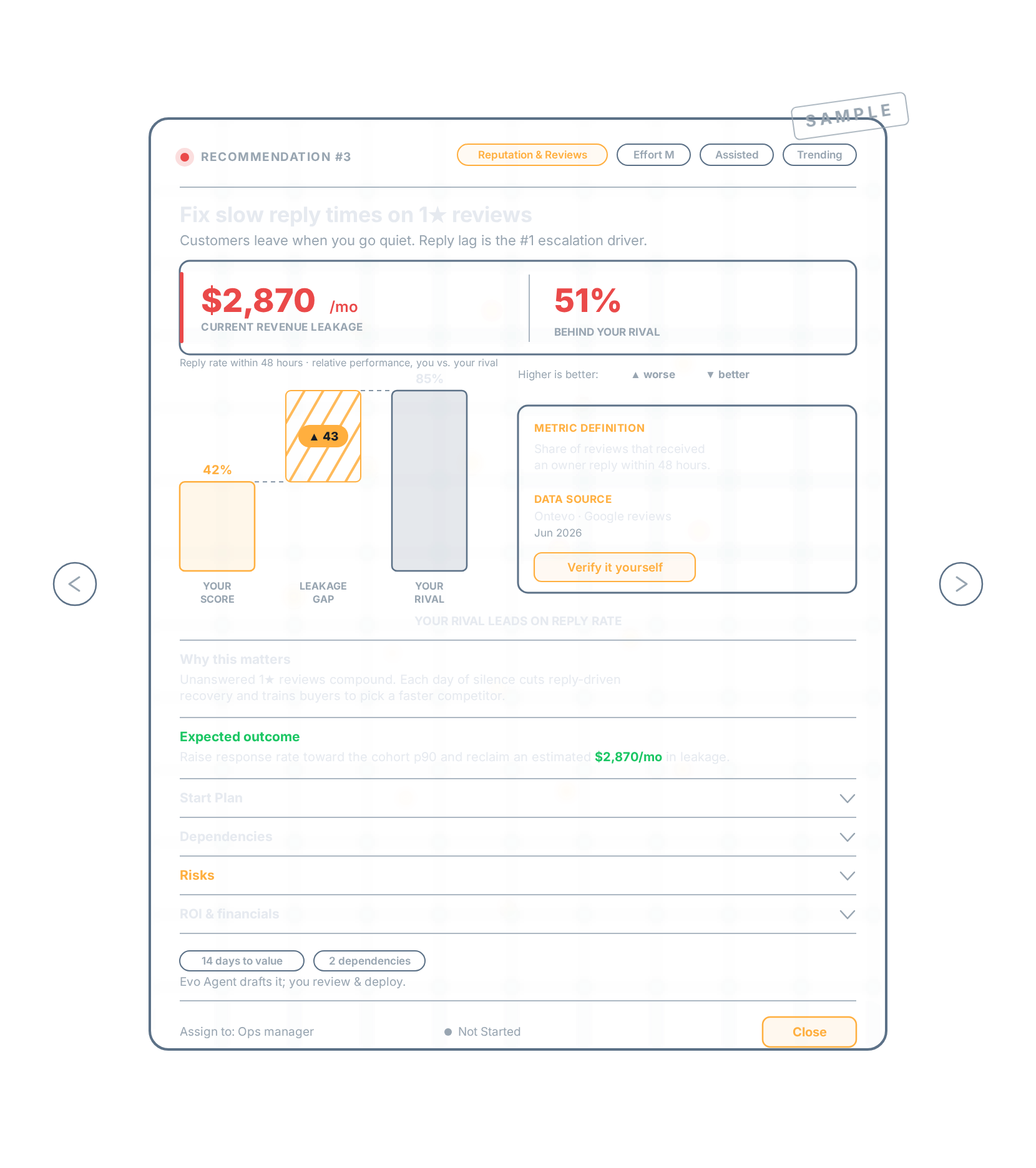
The finding
One sentence, in the words an operator would actually use. Not a category, not a score.
The smoking gun
The single data point that ends the argument. There is nothing to debate after that sentence.
The dollar
Estimated monthly impact, with the calculation and assumptions, where the evidence supports a financial estimate.
The evidence trail
Every value carries its source and a confidence score from 0 to 100. Each one can be checked without asking us.
The fix, and who drafts it
A specific action, routed to a specific Evo Agent, with an effort estimate attached.
The pillar is named plainly on every card: Offering & Demand, Reputation, Search, Website, AI Visibility. No internal instrument names, no scoring jargon, nothing you'd have to explain before the card made sense.
The most expensive line in your business has never had a number on it.
A Truth Card prints that line: one gap, priced by the month, arithmetic shown.
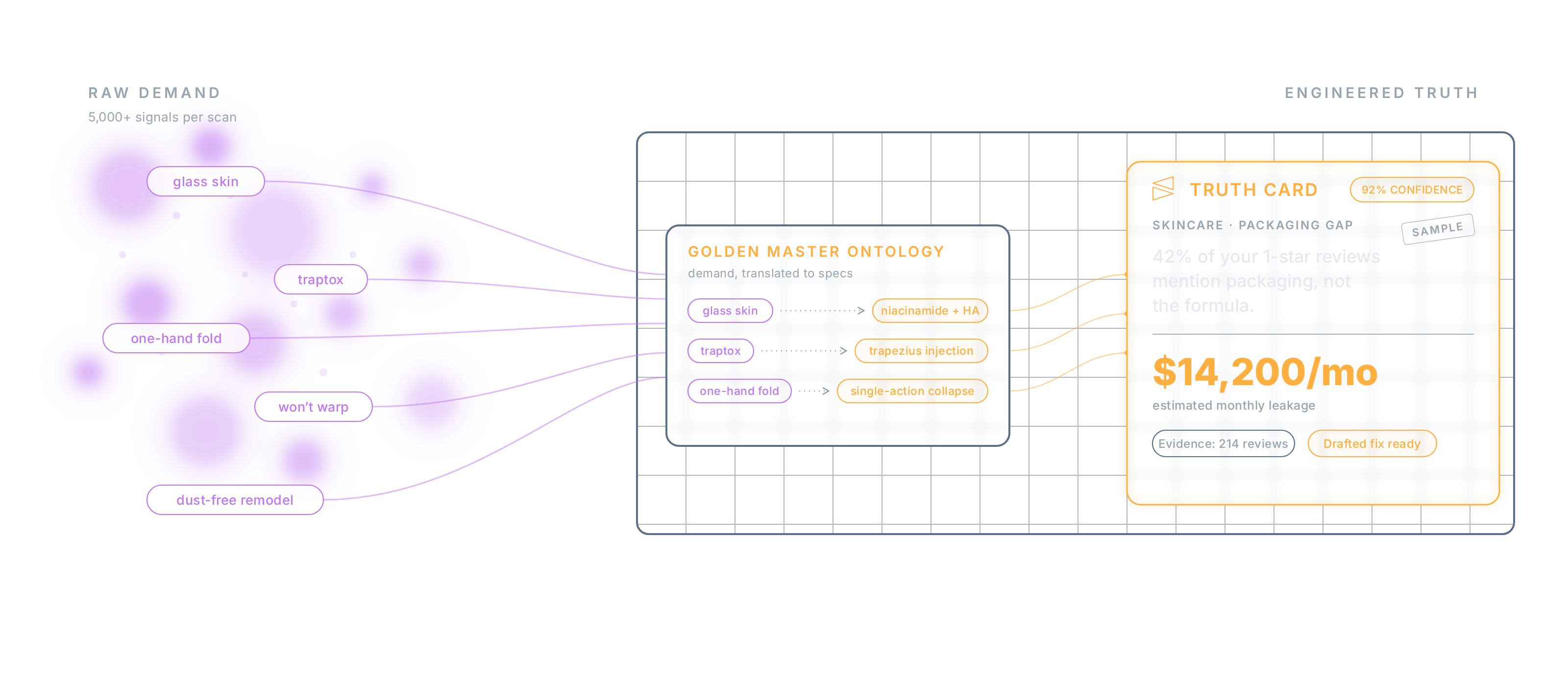
Dollar figures shown on this page are illustrative examples, not customer results.
Dollars a month, and nothing else
Every figure is $/mo. Not a score, not a percentile, not an annualized headline that flatters the pitch. One unit, everywhere, so two cards from two different pillars can be stacked and compared.
The formula is on the card
Printed on each card, and it differs by finding type. A reply-lag finding multiplies the monthly revenue baseline by the star delta by the recovery rate. If we won't show you the math, you shouldn't accept the number.
If the evidence isn't there, the claim doesn't ship.
A value without a source is nulled rather than guessed, and the card goes out shorter. Every value that does ship carries its source and a confidence score from 0 to 100.
Your rival, not a percentile
Every comparison column on a Truth Card is labelled your rival. A rival is a business you can picture. A quartile is a statistic about strangers.
THE FIX
The diagnosis and the cure are the same object.
Diagnosis without a cure is a report. A cure without diagnosis is a content tool. Both are things you've already bought. A Truth Card carries the finding and the drafted fix on the same artifact, routed to the Evo Agent that does the work, with an effort estimate attached so you can decide whether it's worth this week.
THE AGENTS
13+ Evo Agents, and they draft
Reputation Autopilot writes the review replies. Benchmark Copilot pulls the comparison. Market Shift Radar watches the category for a move. Each finding routes to whichever one owns that kind of work.
THE APPROVAL
Your team reviews the drafts
Growth agents prepare drafts for your team to review and publish. Separately scoped automation has its actions and approval steps agreed before it runs.
THE EFFORT
Effort, before you commit
Every drafted fix carries an estimate of what it takes to ship it, so a card can be triaged in a meeting instead of becoming a project that needs its own meeting.
Four people, four reasons the same card works.
1
2
3
4
Multi-location operators
It's the ops review, with evidence
Every location benchmarked the same way, so the newest location gets compared to location three on evidence rather than on a hunch. Calls, bookings, hours, GBP, service area, across the group, in one view instead of one login per tool.
Same artifact, three places.
The three best personalized findings, as Truth Cards, on screen. More arrive by email. It's an indicator scan, so it's the honest version of a first look and not a trimmed-down version of the paid product.
One card per finding across a 50-point diagnostic and all five pillars, each one benchmarked against your 10 closest competitors, each one carrying its drafted fix and the agent that owns it.
A one-page export a prospect forwards: total leakage, the primary gap, the smoking gun, the fix. Same sourcing rules as the card it came from.
See them at volume.
The Truth Card Gallery is a wall of cards drawn from real scan patterns, company by company, every leak priced in dollars, filterable by what the business is and who runs it. Company profiles are anonymized composites.
Open the Truth Card GallerySTRAIGHT ANSWERS
What we stand behind.
Three commitments we put in writing.
THE INPUT
Outside-in by design
The scan uses public market information and needs no account connections. Our Privacy Policy explains how scan data and outputs are handled.
THE APPROVAL
Your team reviews the drafts
Growth agents prepare drafts for your team to review and publish. For separately scoped automation, agree the actions and approval steps before it runs.
THE GUARANTEE
Find wasted money in 30 days, or your second month is free
If we don't surface at least one gap worth more than your monthly plan, your second month is free. No fine print, no hoops. Single-business subscriptions.
QUESTIONS
The ones that come up first.
Open any one for the short answer.
A Truth Card brings together the finding, source evidence, competitor comparison and proposed action. Where revenue impact can be modeled, it includes the monthly estimate, calculation, assumptions and confidence.
Deterministic math off a versioned KPI catalog, with the formula and the inputs printed on the card. The point of showing the math is that you shouldn't have to trust us for the number to be useful.
Then the claim doesn't ship. A value without a source is nulled rather than guessed, and the card goes out shorter. That's the rule, and it's the reason the rest of the card is worth reading.
Your 10 closest competitors, in the Full Diagnostic. Every comparison column is labelled your rival, never "benchmark" and never "top quartile", because the comparison that matters is the business your customer was also looking at.
The scan uses public data and needs no account connections. See our Privacy Policy for how scan data and outputs are handled.
White-label reports are available on an eligible Portfolio or Intelligence plan. Discuss your client-delivery scope on a call.
Growth agents prepare drafts for your team to review and publish. For a separately scoped automation, agree the actions and approval steps before it runs.