Know what to change before your next line review.
Compare customer demand with the features, claims and prices across your competitive set. Give product, category and R&D teams a shared brief on what to improve, what to develop and what needs more evidence.
15-minute call to choose three hero SKUs for a free Spec Gap Report.
Or preview one brand free
Give the line review a shared view of the market.
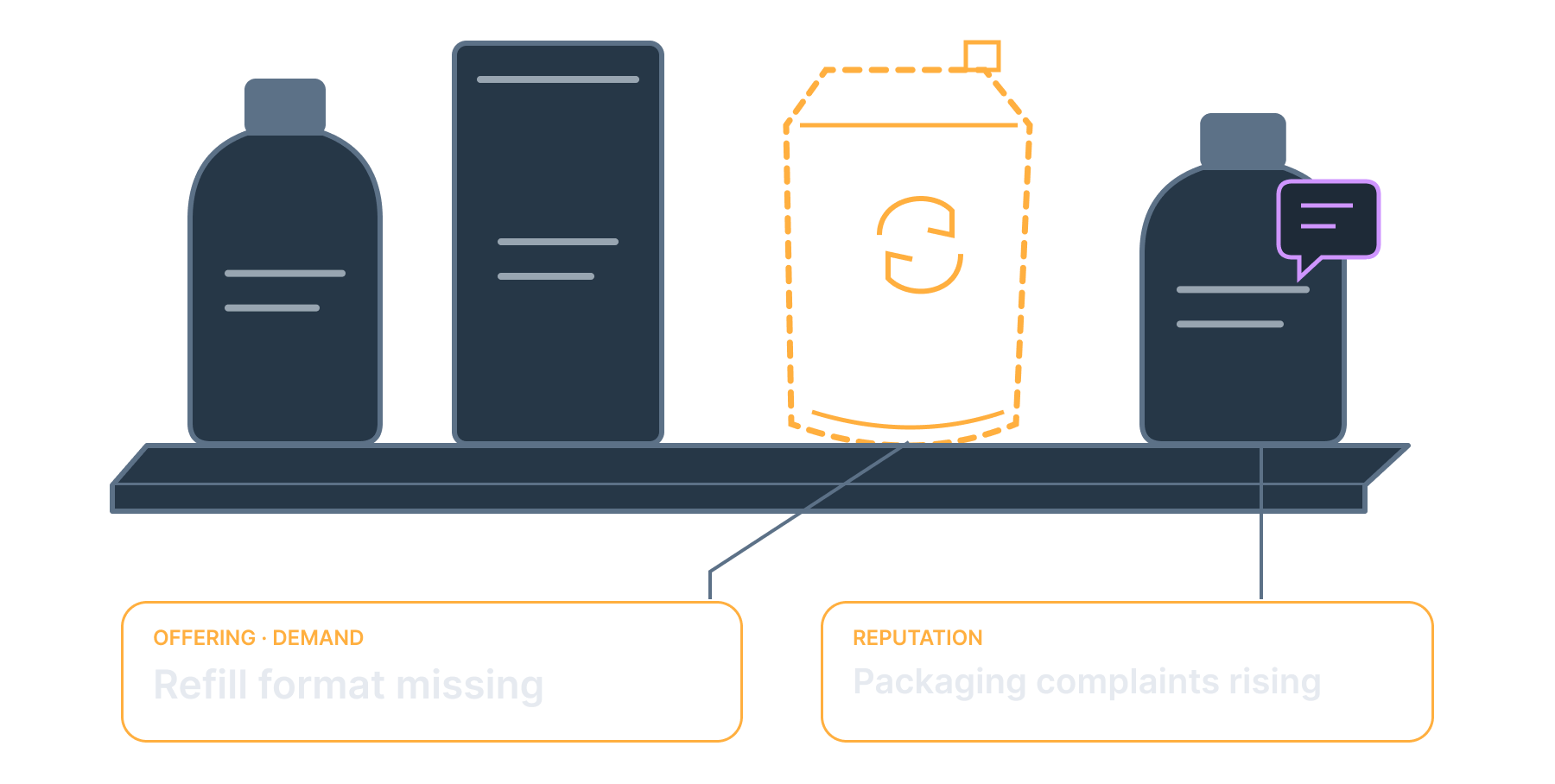
Bring customer requests, competing specifications and proposed changes into the same discussion, with sources your team can inspect.
Name the claim that moved the share.
A canonical spec matrix across up to ten rivals on the line, so the category review opens on the claim and the evidence behind it rather than on a hypothesis. Claims parity is the first column.
Price each gap at dollars a month.
One format across every line you scan, so the mix compares cleanly and the line with the biggest number goes first.
Put the next R&D dollar where the evidence is.
When the gap is a claim you can already make, the fix is page copy. When it is a spec you do not ship, the card prices the case for the roadmap.
Cost the concept before you commit tooling.
Concept Studio (beta) returns the spec, a bill of materials estimated twice, a price against the category ladder and the named risks, and the synthetic buyer panel argues with all of it first.
Check demand before the development budget is committed.
Investigate which features and claims matter to buyers while there is still time to change the brief.
Syndicated data reports the damage weeks late.
NIQ and Circana tell you share moved. The competitor claim that moved it, now sitting on the rival product pages your shopper compared, never appears in the report.
Retailer scorecards grade your pages in isolation.
The vendor portal flags your missing images and your short titles. The rival spec block converting your shopper two tiles over sits outside the portal entirely.
Review themes drift retailer by retailer.
An installation complaint clusters at one retailer and a packaging complaint at another. Each one predicts returns and lost reorders, and each one dies unread in a feed.
Slotting, tooling and MOQ get committed on a late read.
Chain authorisation, the mould and the minimum order are all decided before the first read of the shelf comes back. By then the money is spent and the line review is booked.
AI assistants now answer the category question.
When a shopper asks an assistant for the best dimmer for a smart home, the answer names a short list of brands and cites its reasons. Whether your line makes that list is a question nobody in the division currently owns.
Move from a market finding to a product decision.
Compare the evidence, inspect the recommendation and develop the concept your team wants to pursue.
1
2
3
Invest in the features customers value.
Use demand evidence to investigate what is worth adding. Review lower-cost alternatives against performance and customer requirements before deciding what can be removed.
Find the features buyers value.
Compare requests, complaints and competing specifications to identify features worth investigating.
Test where a lower-cost design will still meet the need.
Investigate material and design alternatives against performance requirements and customer value. A feature’s absence from reviews is not evidence that buyers do not care about it.
The bill of materials is a pre-quote triage estimate built from your concept spec and your category's own pricing. No supplier quote sits behind it.
Add buyer-choice evidence to your existing research.
Use direct competitor comparisons and customer feedback alongside your sales data, retailer scorecards and category research.
Pricing follows the number of lines you put on it.
Ontevo bills per entity, and for this buyer one entity is one brand or one product line.
From the fourth entity you move to a Portfolio plan, from $1,500/mo, and we quote the exact figure on a call.
We scope a paid pilot on one line on a call.
What consumer product teams ask first
Public pages only: your product pages and your rivals' product pages, the reviews under them, search rankings, the ads running in the public ad libraries, and what AI assistants answer on the category question. No logins, no portal access, no ERP or PIM connection, no customer records and no files from your systems. Everything is encrypted in transit and at rest, processed and stored in the United States, and nothing you send us trains a public model. Every external write is drafted and held for someone at your company to approve, so the blast radius of a mistake on our side is a draft nobody approved. SOC 2 Type I and HIPAA readiness are in progress.
No name we can give you. We work in stealth and we publish no customer names, no logos and no reference list, and we would rather say that plainly than imply otherwise. What we can put on the table is your own category, run live in the meeting, and the composite examples on this page, drawn from real scan patterns and labelled as composites.
No, and we are not asking for it. Ontevo reads public signals only, which is why there is no data-sharing agreement to negotiate with NIQ or Circana and no integration for your IT team to scope. The one number we ask for is the monthly revenue of the line, and that is what calibrates the dollar figures on the cards.
Amazon is read as structured data through a dedicated provider, down to the review corpus, the Q&A and the A+ content. Other retailer pages are read as pages, so we pick up the title, the bullets, the spec block, the posted price and the rating, and we do not claim the same depth there. Your own site and your rivals' sites are read the same way on the same day.
Pricing is per product line, rather than per seat. Truth Cards can be exported or shared as read-only links so the GM, R&D lead and category manager review the same evidence. Where supported, the cards include estimated revenue impact and its assumptions. We agree named users with you on the call.
Start with the free Spec Gap Report on three hero SKUs, which is read-only, deploys no agents and comes back in under 24 hours. If you want to go further, we scope a paid pilot on one line on a call: a named category, the success criteria written down on day one, and a decision date in the calendar before we start. Use “Discuss a free Spec Gap Report” to agree the scope. The Rapid Scan form above previews one business.
See how a team could use the findings.
These illustrative scenarios show how the recommendations could inform a decision.
The claim matrix was the first page of the category review. Nobody spent the first twenty minutes arguing about whose number it was.
Illustrative scenario: wiring devices, big-box and electrical
The panel argued with two concepts we had already agreed on, and it did it before the tooling conversation.
Illustrative scenario: small appliances, multi-brand house
Four of five rivals claimed metal utensil safe. We had shipped it for two years and never said it on the page.
Illustrative scenario: cookware, Target and Amazon 1P
Company profiles are anonymized composites drawn from real scan patterns.
Bring a sharper brief to your next line review.
Choose three hero SKUs from one product line for a free Spec Gap Report with competitive gaps and recommendations your team can review together.
Choose three hero SKUs from one product line on a 15-minute call.
We benchmark them against up to 10 rivals in their set across the 50-point diagnostic.
Your Spec Gap Report comes back in under 24 hours with the claim matrix, the dollar figures and the drafted fix.