How to choose product features worth funding
By Ontevo · Published October 10, 2026
Invest in product features by protecting essential performance first, then comparing the customer benefit and full cost of each proposed change. Fund improvements with credible evidence that they influence choice or keep customers. Simplify expensive details only after checking what they support. Review the allocation when customer expectations, competing offers or delivery costs change.
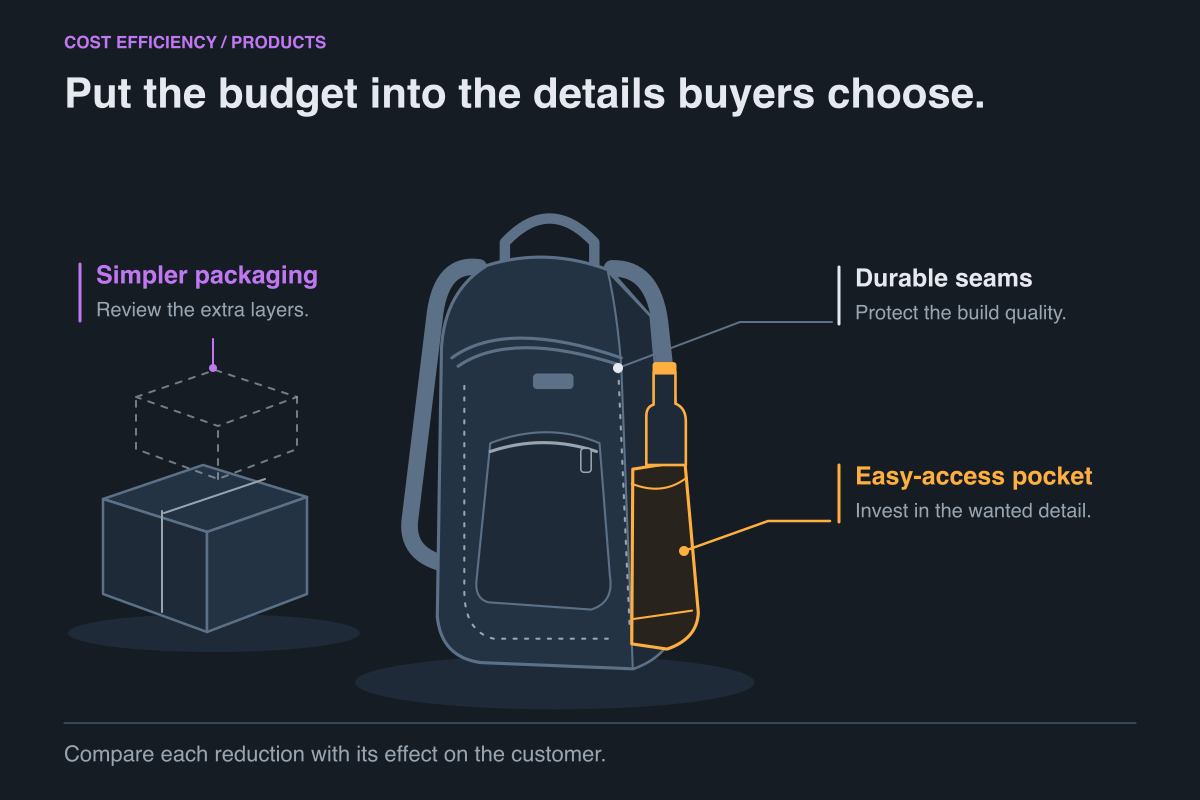
A product team can improve every specification on paper and still make the offering harder to sell profitably. A stronger motor adds weight. Another finish adds inventory. A premium box adds shipping volume. Each decision needs a reason connected to the buyer and the business.
McKinsey’s design-to-value approach considers both selective cost reductions and additional investment in attributes customers value. A component can become more expensive while the offering becomes more attractive commercially.
Our guide to testing your offer before increasing ad spend covers how to investigate a buying obstacle. Here, the decision is where to put the next development dollar once several changes look plausible.
What do you need before choosing features?
Start with one product, its intended buyer and a specific buying situation. Gather the current specification, customer evidence, relevant alternatives and the costs of making, stocking and delivering it. Bring product, operations, sourcing and finance into the decision before a preferred design hardens into a commitment.
A Feature Investment Sheet records the need a proposed change serves, the evidence behind it, the performance that must be preserved, and its full commercial cost. It keeps assumptions visible beside the decision to fund, protect, simplify or investigate, with an owner and a condition for reopening that decision.
Use one row per proposed change. Keep the current design as an option; replacing it also has to earn its cost.
1. Set the performance floor before comparing upgrades
Define what the product must continue to do, including requirements buyers assume without asking. Use product documentation, failure records and technical judgment alongside customer comments. An absence of complaints about a functioning safeguard is weak evidence for removing it.
Griffin and Hauser’s The Voice of the Customer separates customers’ desired benefits from design solutions and recognizes needs customers take for granted. That distinction matters when allocating costs: an unmentioned detail may support an essential benefit.
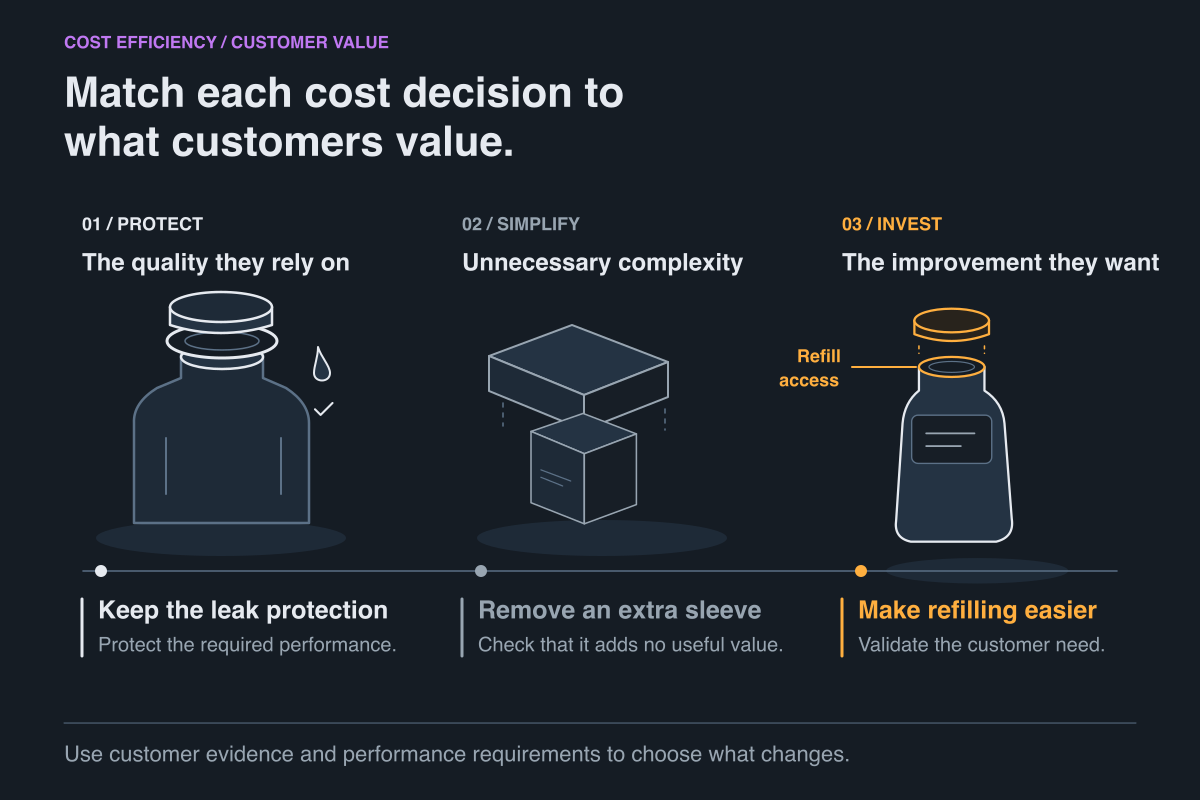
Consider a hypothetical travel-bottle brand. Preventing leaks inside a bag is part of the product’s basic job. Customers may talk more about color because they assume the lid will work. The team should define acceptable sealing performance and test conditions before discussing a cheaper closure.
Input: current requirements and failure evidence. Output: a written performance floor with a verification method. Common failure: treating low review frequency as proof of low value.
2. Classify the decision each feature supports
Separate essentials, differentiators, simplification candidates and unresolved bets. These are provisional decisions for a particular buyer and situation. A gift buyer and a commuter may place different value on the same packaging.
For the hypothetical bottle, the sheet could begin as follows. These are illustrative hypotheses, not research findings.
| Proposed change | Role to investigate | Evidence needed | Initial decision |
|---|---|---|---|
| Cheaper closure | Essential leak prevention | Equivalent performance under relevant use conditions | Protect the requirement; compare compliant designs |
| Opening that is easier to clean | Possible reason to choose | Cleaning difficulty linked to rejection, replacement or return | Investigate the benefit and feasible designs |
| Remove decorative outer sleeve | Possible avoidable cost | Effect on protection, recognition and buying choice by channel | Test simplification before removing |
| Add another finish | Possible segment appeal | Demand for the finish and effects on existing variants | Defer tooling until the segment case is credible |
Avoid averaging these into a single popularity score. An essential requirement has a different decision rule from a cosmetic extension. A modestly selling finish may also serve a valuable segment; weak total volume alone doesn't establish that removal improves the portfolio.
Input: candidate changes and buyer situations. Output: a decision class and missing evidence for every row. Common failure: letting a company-wide average erase meaningful differences between buyers.
3. Check whether the benefit survives a real tradeoff
Ask what buyers give up to get the improvement. A feature request carries more weight when it connects to an actual choice, price acceptance, repeated use or a kept purchase. A favorable survey answer establishes less.
For the bottle, ask buyers to compare realistic combinations of cleanability, capacity, weight and price. Include relevant alternatives and the ability to choose none. A larger opening may appeal until the buyer discovers that it makes one-handed drinking harder.
Choice-based conjoint research can estimate how preferences change across specified combinations. Sawtooth Software’s guidance on willingness to pay explains why calculations that omit competition or the option to walk away can overstate the premium a feature supports.
Do not add separate feature premiums into a bundle premium. Willingness to pay for a combination depends on the other attributes, alternatives and price. Test the complete offer.
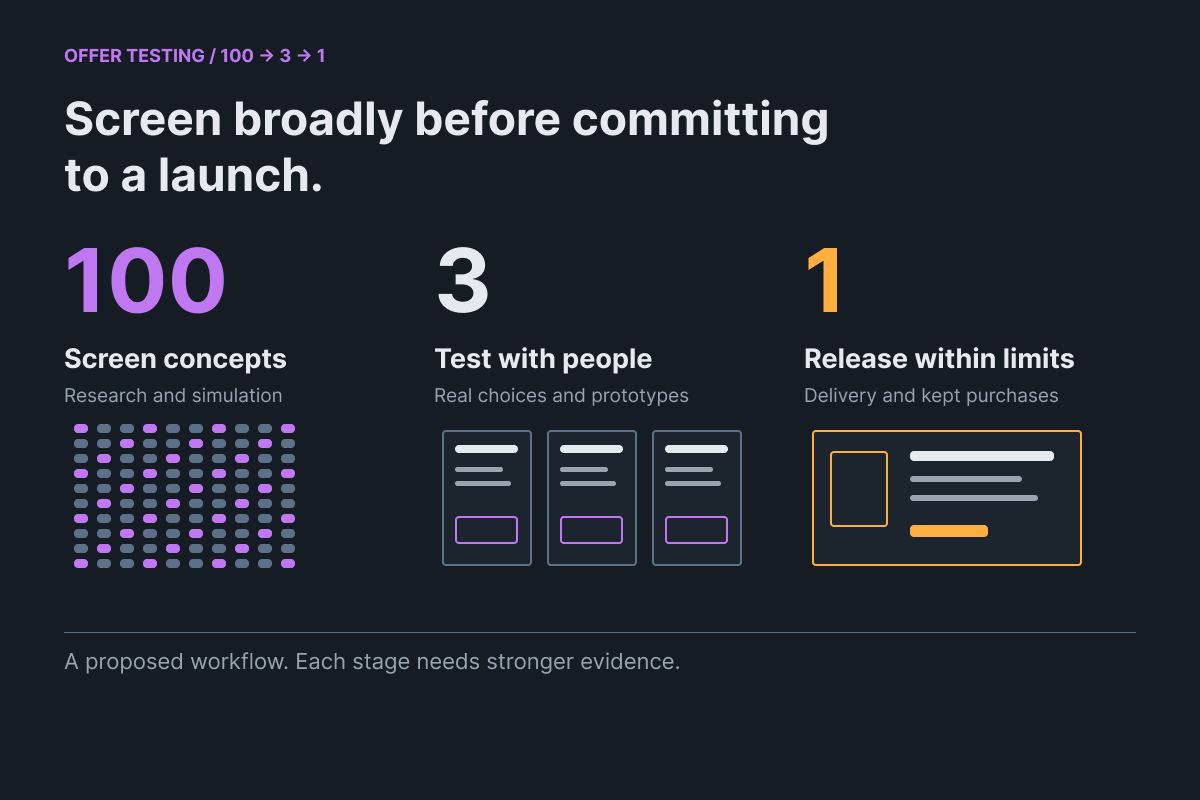
Treat survey choice as stated preference, even when the exercise feels realistic. Purchases, returns and usage provide observed behavior; attributing that behavior to a specific feature still requires a credible comparison. Use research to narrow the investment decision, then check the important assumptions through the offer-testing process.
Input: a specific benefit hypothesis and feasible alternatives. Output: evidence of the tradeoff buyers accept, with uncertainty recorded. Common failure: entering modeled willingness to pay into the sales forecast as an assured price increase.
4. Price the whole change, including its dependencies
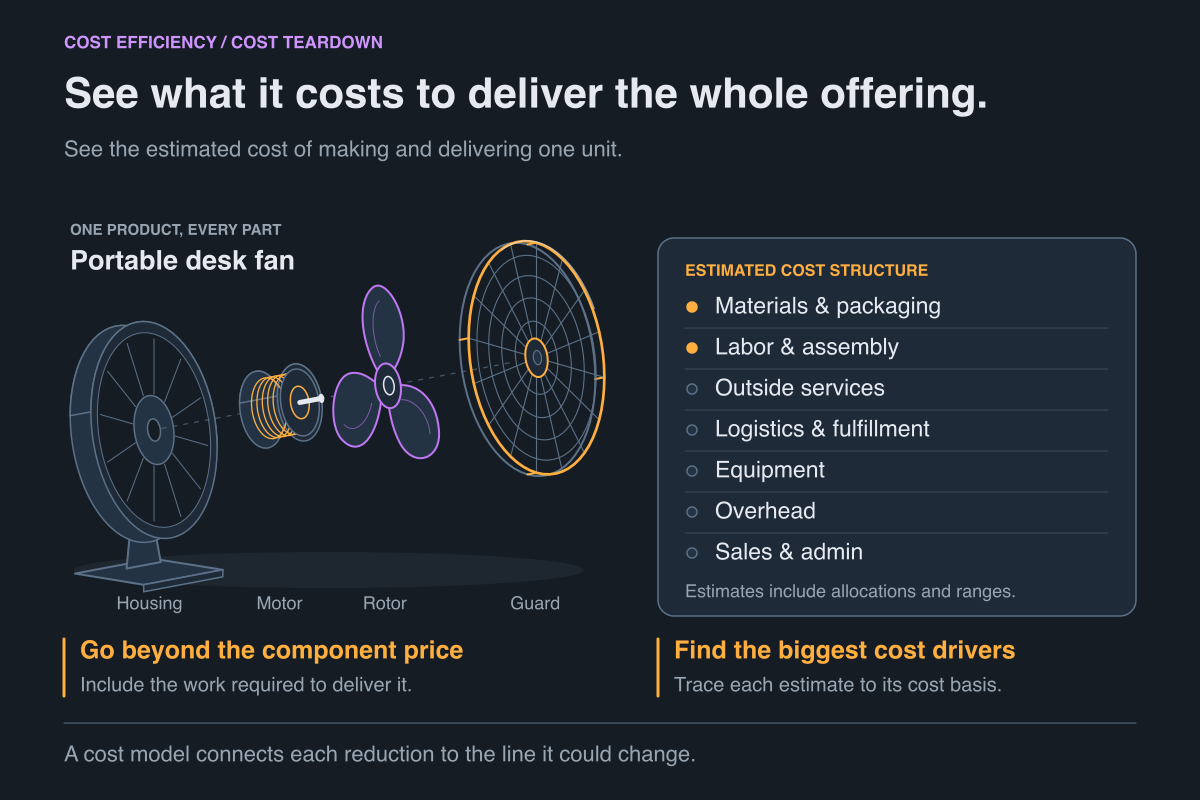
Compare the cost of delivering each feasible option under the same volume and service assumptions. Include the consequences beyond the component: assembly, packaging, shipping, stocking, quality checks and support. Keep one-time development costs separate from ongoing costs.
McKinsey’s Cleansheet cost-engineering guidance describes a bottom-up model of material, labor, equipment and overhead, followed by work to bring actual costs toward a target. Label your own entries as modeled estimates, supplier quotes or observed costs. Each answers a different question.
A quoted lower unit price may require a larger minimum order. A modeled saving may depend on equipment the supplier doesn't have. Neither belongs in the realized-savings column.
Trace shared functions, too. The bottle’s sleeve might carry instructions or protect its finish. Removing it means either preserving those functions elsewhere or accepting a consequence that belongs in the decision.
Input: feasible specifications, quotations and operating records. Output: comparable cost ranges, assumptions and dependencies. Common failure: approving the cheapest purchased part while overlooking inventory, damage or transition costs.
5. Decide what the next dollar should buy
Choose among the complete options, including doing nothing and buying more evidence. Compare changes over a common period and allow for the development capacity each consumes. A project with attractive economics can still be the wrong next project if it ties up the only engineer needed for a more valuable change.
Use this decision question: What contribution can this change add or preserve, after its full incremental costs, and what has to be true for that to happen?
For a discretionary improvement with uncertain demand, make the break-even requirement explicit. Under a constant-price, constant-mix illustration:
Extra kept orders needed = (development and transition expense + added cost across baseline orders + contribution displaced from other products − verified savings on baseline orders) ÷ contribution per additional kept order.
The denominator must already include the new feature’s variable cost and expected delivery, return and acquisition costs, including any savings on those additional orders. The added-cost and verified-savings terms cover baseline orders only, so incremental orders are not counted twice. Use a common period and a positive denominator; round the order requirement up, with a minimum of zero. If price or mix also changes, compare complete contribution scenarios instead. This is a hurdle to investigate, not a sales forecast. Essential repairs still have to meet the performance requirement.
A hypothetical allocation could protect the seal, fund a bounded cleanability prototype, defer another finish until incremental demand is credible, and qualify sleeve removal before booking savings. That puts money into a specific learning step while preserving the current product’s basic job.
Do the arithmetic once across the whole proposal. Packaging savings used to fund a better lid cannot also be counted in full as retained profit. Include switching from existing variants when evaluating a new one.
If the decision changes under plausible cost or demand assumptions, the next dollar may belong in a prototype, supplier trial or buyer study. A weak reason to choose can contribute to higher acquisition costs, but feature work earns funding through a specific commercial case.
Input: benefit evidence, full costs and constrained resources. Output: a funded action, a bounded investigation or a deliberate hold. Common failure: assigning precise scores to uncertain assumptions and treating the ranking as a fact.
6. Reopen the decision when its assumptions move
Give each funded change an owner and a review trigger. After release, compare the expected benefit and cost with actual purchases, returns, delivery performance and unit economics. Preserve the original assumptions so the team can see which ones held.
Revisit the bottle’s easier-cleaning opening if competitors make equivalent cleaning standard, the buyer mix changes or a new closure alters production cost. A former differentiator may become expected performance. Its role changes even if the physical product doesn't.
Review before the next consequential commitment, such as tooling renewal or a large reorder. Supplier terms and usable inventory determine when a simplification can produce a saving.
Input: original assumptions and subsequent operating evidence. Output: a confirmed allocation or a revised decision. Common failure: leaving a once-successful feature in the budget indefinitely without checking why it still deserves investment.
What can this method leave unresolved?
The sheet organizes a decision; it cannot establish engineering feasibility or prove demand from public comments. Some benefits require a working product to evaluate. With limited evidence, a useful outcome is a smaller commitment and a clear question for the next study.
For Ontevo’s Revenue Leak Intelligence perspective, the connection is Consumer Demand / Business Reality: what buyers need to choose the offering, and what the business must spend to deliver it. The investment decision remains accountable to evidence from both sides.
Questions about feature investment
Should every feature command a price premium?
No. Some preserve basic usability, reduce failures or keep customers. Evaluate their role before asking whether buyers will pay extra. A requirement can deserve funding without supporting a higher selling price.
When should a feature become an optional variant?
Consider a variant when a distinct buyer group values the difference enough to support its development, stocking and service costs. Compare that case with the complexity it introduces and purchases it diverts from the existing range.
How often should the sheet be reviewed?
Use the product’s decision cycle and material changes in its assumptions. Review before large commitments and when buying behavior, competing specifications or supplier conditions change enough to alter the decision.
Ontevo Research. Where this post carries figures, they come from Ontevo's own scan corpus or are modeled from scan patterns across the category. No figure is measured from a named customer.