Homeowners Ghost Unclear Estimates.
Design-build firms often lose good opportunities because proposals and early messaging fail to reduce process anxiety and clarify how the project will work.
The estimate is not just a pricing document
Many remodeling firms assume ghosting happens because the homeowner found a cheaper bid. Price can matter, but it is often not the whole story. In high-consideration home projects, the estimate is also a trust document. It signals whether the firm understands the project, communicates clearly, and can make the process feel manageable.
Homeowners are not only comparing numbers. They are comparing confidence. Which firm feels organized? Which one explains the process? Which one makes the project feel less risky?
Process anxiety is a real conversion problem
Most homeowners enter a remodel with anxiety. They worry about dust, disruption, delays, budget creep, and whether the final result will justify the stress. If your website, proposal, and follow-up do not address those concerns, the homeowner fills in the blanks alone.
That is where revenue leakage begins. The prospect may like the design. They may even believe the price is fair. But if the process still feels unclear, momentum slows and the lead quietly disappears.
Where the conversion path usually breaks
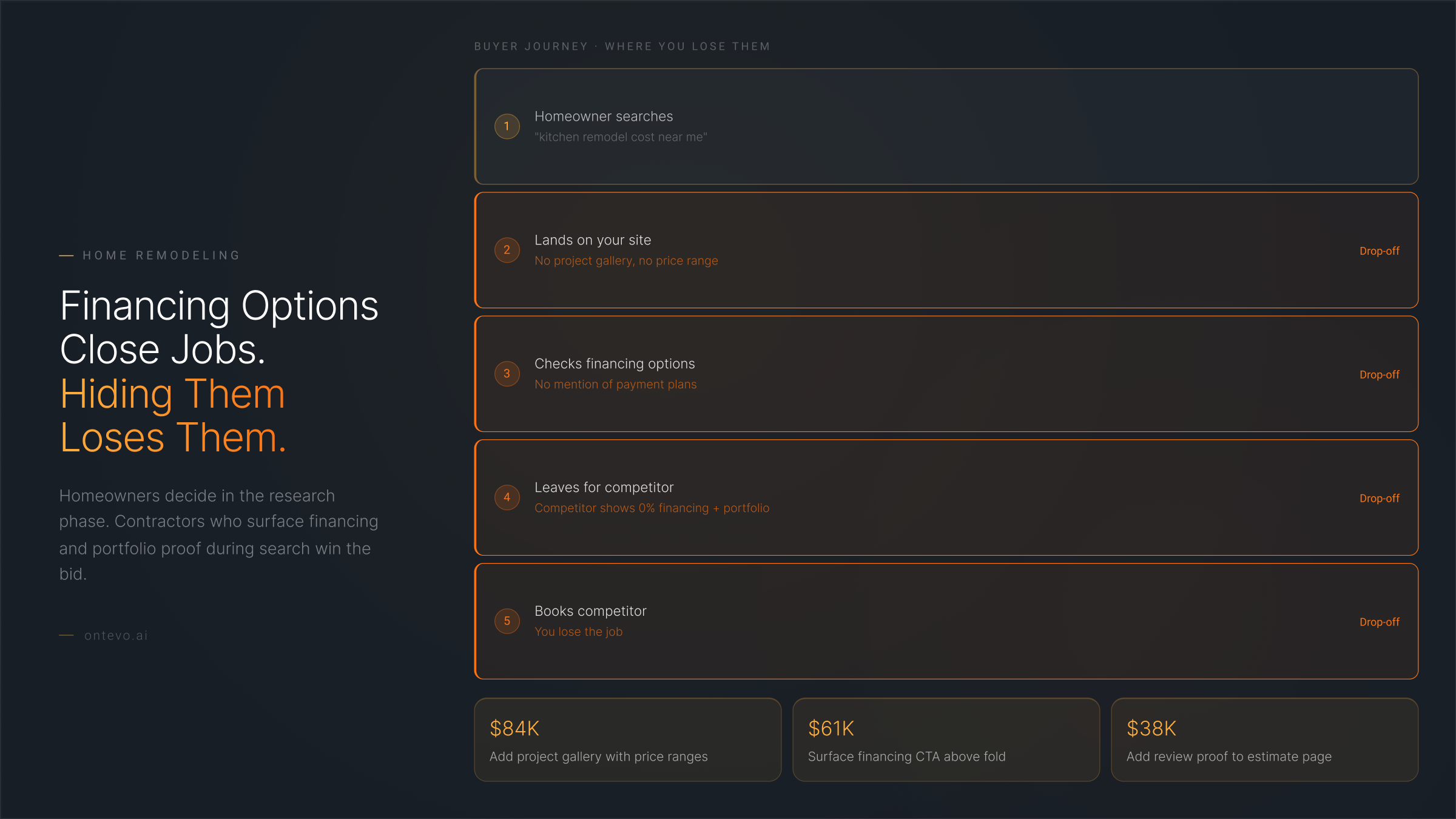
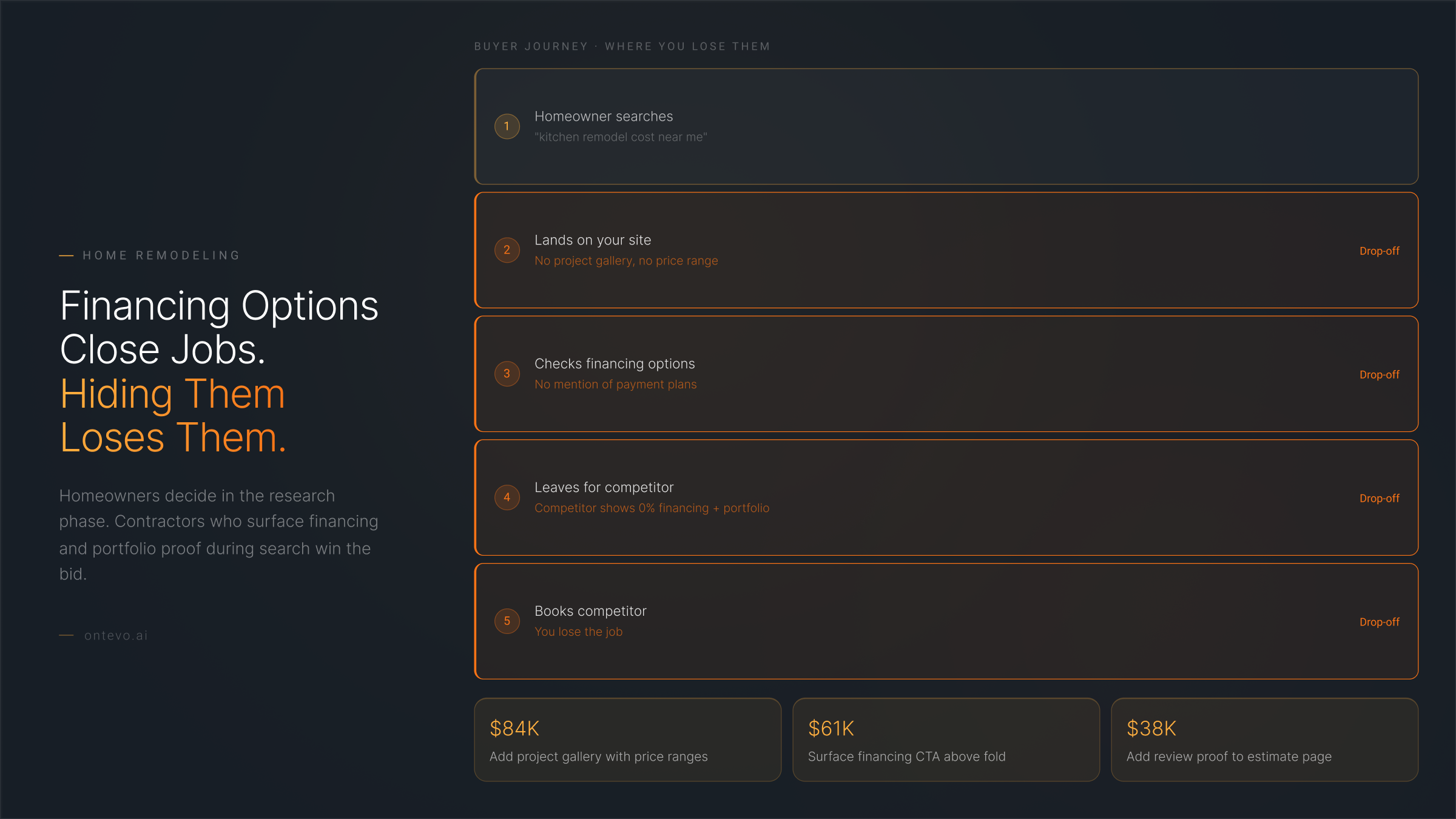
The break often appears across three stages. First, the website does not explain the firm's process clearly enough. Second, the estimate describes scope but not enough reassurance. Third, follow-up is too generic to help the homeowner make a decision.
These are not isolated sales issues. They are market signals. The business may be presenting useful information, but not in the language or sequence the homeowner needs to feel safe moving forward.
What better proposal language does
Better messaging is not hype. It is precise reassurance. For remodeling firms, that often means stronger language around project management, cleanliness, timing expectations, communication rhythm, material decisions, and what the client experience actually feels like.
The homeowner should hear the same promise across the discovery path: website, consultation, proposal, follow-up, reviews, and case studies. When that message is consistent, the firm feels easier to trust.
How Ontevo helps remodeling firms prioritize
Ontevo reads local market signals, competitor positioning, review themes, and funnel friction to show where a remodeling firm is leaking qualified demand. The Rapid Scan surfaces the highest-value gaps and turns them into Truth Cards with evidence, impact, and a drafted fix.
For a design-build firm, that could mean rewriting proposal language, improving process FAQs, strengthening proof around project communication, or making the consultation path easier to trust.
FAQ
Why do homeowners stop responding after an estimate? Usually because uncertainty remains too high. The proposal may not have answered the questions that matter most about process, trust, and experience.
How can remodeling firms improve lead conversion? Clarify the service promise, reduce process anxiety earlier, tighten proposal language, and improve proof and follow-up consistency.
What should a remodeling proposal communicate clearly? Scope, process, expectations, timing, communication approach, and why the firm is a lower-risk choice.
Conclusion
Remodeling conversion is rarely only about price. More often, it is about whether the homeowner feels safe moving forward. Run the Rapid Scan to see where proposal or process friction may be leaking revenue.
Ontevo Research. Where this post carries figures, they come from Ontevo's own scan corpus or are modeled from scan patterns across the category. No figure is measured from a named customer.