
Before you spend more on ads, check the offer
By Ontevo · Published October 9, 2026
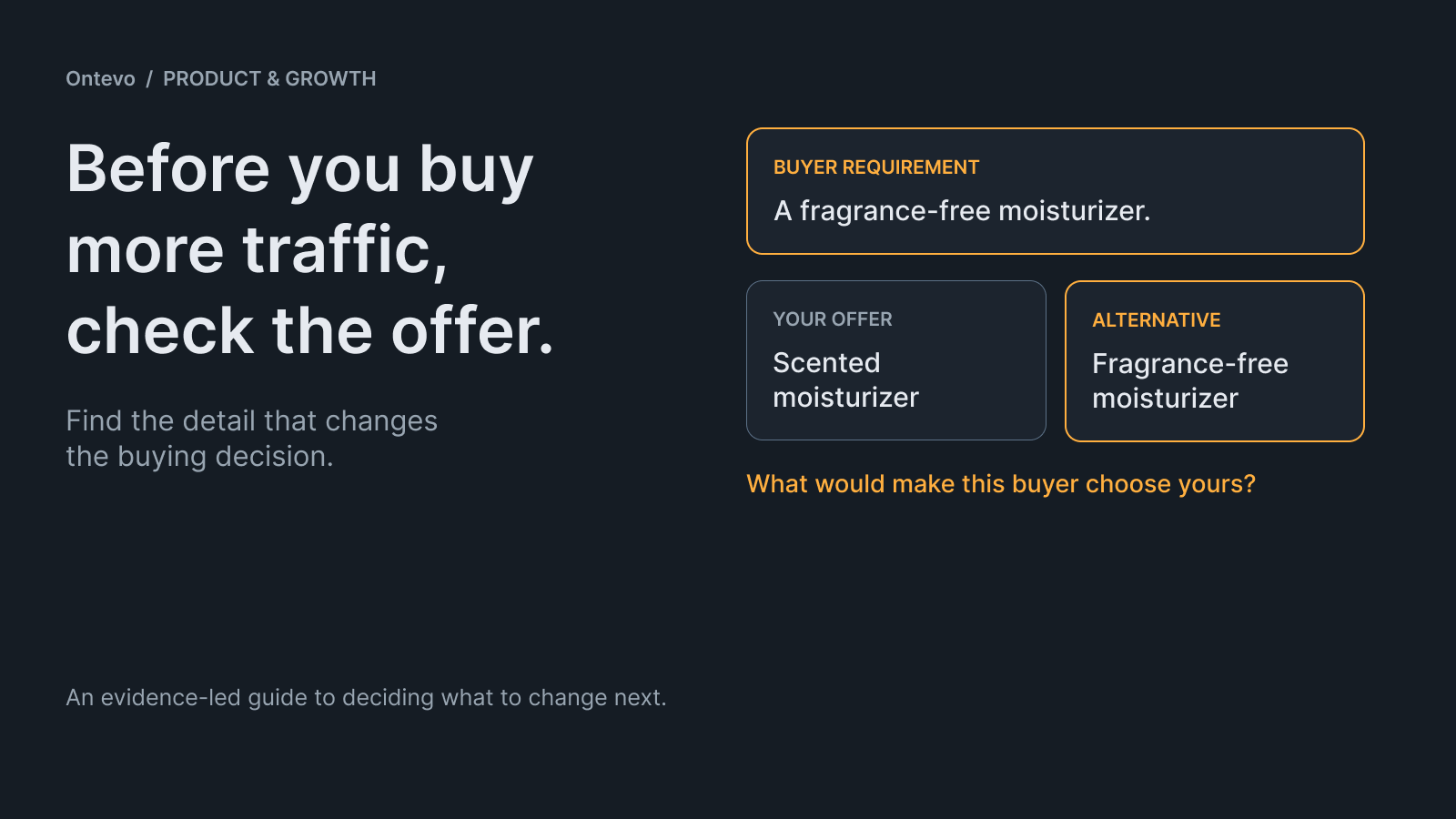
Suppose a buyer asks whether your moisturizer is fragrance-free, then leaves. Before increasing ad spend, check whether that requirement explains the lost purchase, whether competing offers meet it, and whether your offer can. Test the smallest feasible change with real buyers, then judge additional contribution after delivery and acquisition costs.
An offer includes the product or service, its price, delivery terms, proof and the experience of buying it. A missing detail can sit anywhere in that package. The hard part is deciding which detail deserves investment.
Ontevo’s approach draws on product-launch experience at McKinsey. The discipline is to make the buying decision specific enough to investigate before committing the launch budget. “Customers want more flexibility” is too vague. “Buyers need to choose a delivery date before they pay” gives the team something it can examine.
Our earlier article explains why to investigate a revenue leak before increasing marketing spend. The next decision is what, if anything, to change in the offer.
What do you need before you start?
Choose one offer, one buying situation and one decision you need to make. Gather recent customer questions, lost-sale notes, returns or cancellations, relevant reviews, competing offers, and the costs of delivering your own offer. Keep the period and source visible beside each observation.
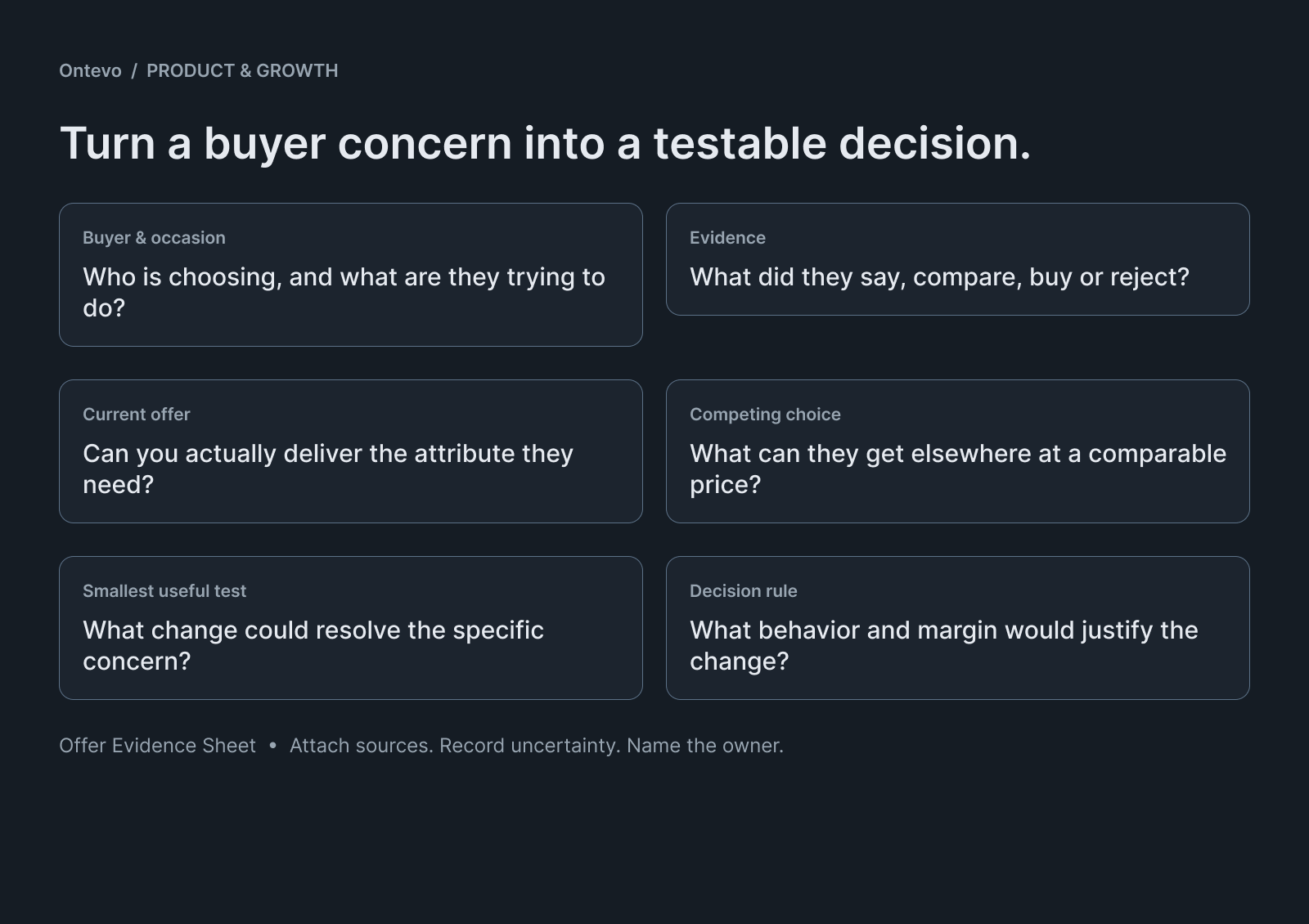
Use an Offer Evidence Sheet: a working record that connects a buyer’s need to the current offer, competing alternatives, observed behavior and a feasible test. Each row represents a decision you might change. Keep evidence and interpretation in separate columns so a plausible explanation stays open to challenge.
Use the sheet to authorize a test, revise a proposal or leave the offer alone.
1. Locate the obstacle before proposing a feature
Start with the path from qualified interest to a completed, kept purchase. Find where the evidence changes: who arrives, what they ask, what they choose and what happens after delivery. A conversion decline alone cannot identify a missing product attribute.
Read recent sales records alongside the current offer. For each stalled purchase, consider a competing explanation before deciding what to change.
| What you observe | Explanation to investigate | Useful next check |
|---|---|---|
| Inquiries regularly come from people outside your service area or intended use | Audience or targeting mismatch | Compare actual search terms, locations and use cases with the offer’s intended buyer |
| Buyers repeatedly ask about a capability you already provide | Clarity or proof gap | Show the capability clearly, with evidence buyers can inspect |
| Relevant buyers choose another offer because yours cannot meet a requirement | Missing attribute or service condition | Verify that requirement with lost buyers and examine comparable alternatives |
| Orders increase while refunds, overtime or delivery failures grow | Economics or operating constraint | Follow completed orders through delivery costs, returns and available capacity |
These explanations can coexist. Buyers may need a feature you lack and struggle to understand the features you already have. Resolve the cheapest uncertainty first.
An absent specification and a specification buried in an image can both contribute to higher acquisition costs. They require different work. Confirm what the product actually does before commissioning a redesign.
The common mistake here is naming the solution while the cause is still unknown. “We need a subscription” gets much harder to challenge once it becomes a project.
2. Read for the buying situation behind the request
Collect customers’ exact words, then record the circumstance and consequence. “Make it smaller” could mean easier storage, portability or a lower upfront price. Each interpretation points to a different offer.
Griffin and Hauser’s The Voice of the Customer distinguishes the benefit customers seek from the design choices that might deliver it. That distinction is useful when a customer names a feature: ask what they were trying to accomplish when its absence mattered.
Read positive reviews as well as complaints. Compare your own buyers with buyers of close alternatives, and keep product versions, service locations and dates separate. Remove duplicate or syndicated comments before treating repetition as independent evidence.
Record the original wording, buyer situation, consequence, source and your interpretation. In our fictional moisturizer example, “Asked for fragrance-free, then bought elsewhere” carries more decision value than “wants better ingredients.”
Review frequency still needs care. Askalidis and Malthouse’s research on online retail reviews found differences between reviews prompted by email and reviews submitted independently. Who writes and how they’re asked affects the evidence you see. A theme’s share of reviews cannot be read as its share of market demand.
For a founder-led brand, return reasons and pre-purchase questions can help connect a public complaint to a commercial consequence. For a service business, use declined proposals and cancellations alongside reviews. Keep the customer’s explanation distinct from the salesperson’s guess.
Shortlist obstacles tied to buying situations. If all you have is a repeated adjective, investigate further before pricing a fix.
3. Check the alternative the buyer could actually choose
Compare offers serving the same buyer, use case, geography and approximate price range. A premium product in another market may be interesting, but it gives weak evidence about why your buyer leaves today. Our guide to benchmarking comparable competitors explains how to choose that comparison set.
For each shortlisted obstacle, capture what your offer provides, what a relevant alternative provides, and how the buyer can verify the difference. Include total delivered price, availability and important tradeoffs. Record when you checked; a discontinued variant can make an apparent gap irrelevant.
In the fictional moisturizer example, a rival’s fragrance-free option may satisfy the buyer’s preference. Check the actual variant and its product documentation, then ask what the buyer chose and why. The rival’s claim alone cannot establish how many of your prospects would switch or what they would pay.
Speak with people who recently chose an alternative or decided against buying. Ask them to reconstruct the purchase: what prompted it, what they compared, what they ruled out, and what they eventually did. Leave your proposed feature out of the opening question.
Look for evidence against the idea, too. Buyers who encountered the same obstacle but purchased happily may reveal that it matters only in a narrow use case.
Write the hypothesis so someone else can challenge it: “For this buyer in this situation, changing this part of the offer should change this purchasing behavior.” Copying a rival’s feature without that connection risks paying for something customers barely use.
4. Find the smallest change that answers the question
Choose a test that exposes the suspected obstacle while keeping the other important parts of the offer stable. The cheapest useful test depends on whether you lack the capability, the explanation or evidence that buyers care.
If the capability exists, test a clearer demonstration or description. If it requires development, a working prototype or limited production run may answer the question before a full tooling commitment. For a service, a manually delivered booking option can reveal demand and operating cost before scheduling software is built.
If your moisturizer is already fragrance-free but the page obscures that fact, a clearer, substantiated description tests a communication gap. A scented moisturizer needs an actual product change to serve the same preference. Changing the formula, price and audience together makes the result harder to interpret.
Use behavior appropriate to the purchase. A completed order or kept appointment is stronger evidence than a like. A waitlist is useful for recruiting test participants, but its members haven’t yet accepted the price, delivery conditions and alternatives of a real purchase. Represent availability honestly.
Microsoft’s experimentation guidance recommends a clear, falsifiable hypothesis, simple changes and success metrics chosen in advance. Write down the audience, comparison, primary outcome, minimum worthwhile improvement and acceptable limits on returns or delivery strain before starting.
Where volume permits, randomly assign comparable buyers to the current and changed offer. Keep the test running for the planned buying cycle and sample requirement. With low volume, a small pilot can reveal objections and feasibility; treat its sales result as directional evidence. A quiet week doesn't establish that demand is absent.
5. Judge the change by contribution
Calculate what remains from the additional business after its additional costs. Revenue and return on ad spend leave out costs that can make a popular offer unattractive.
For the same evaluation period, estimate:
Additional contribution = additional net sales − additional variable delivery costs − additional acquisition costs.
Use net sales after refunds and price reductions. Include product or service costs, payment fees, shipping, returns handling and incremental support or labor where they apply. Account for customers switching from a more profitable existing offer. Then compare the contribution with the change’s setup costs and cash requirements.
A service that fills unused capacity can look very different once it requires another shift. A package that converts better may also cost more to ship. Put those limits in the decision before they appear in the accounts.
6. Test the next increase in spend
Keep two questions separate: did changing the offer help, and will more advertising produce profitable additional business? A successful offer test doesn’t establish the return on more media spend. Use its cost model to set a bounded budget increase and a rule for stopping it.
Blake, Nosko and Tadelis’s paid-search experiments at eBay showed that conventional estimates could overstate advertising returns because some purchasers would have arrived through other channels. That finding comes from a particular business and channel; it explains why attributed sales and additional sales require separate attention.
For the budget decision, examine marginal contribution from the proposed increment, with a holdout or controlled spend test where feasible. Blended ROAS combines activity that may have very different returns. Expand in stages, watching whether acquisition costs or fulfillment constraints change as volume grows.
When should you hold the budget?
Hold the increase when the evidence is unresolved, the change fails its worthwhile-improvement threshold, or delivery costs consume the benefit. Keep a promising test bounded when the result is encouraging but too uncertain to justify a larger commitment.
This process can identify what deserves a real customer test. It cannot turn public review themes into a market-size estimate or establish technical feasibility. It also won’t repair broken tracking, payment failures or an unreliable service operation.
Revenue Leak Intelligence brings customer demand and the business’s offer into the same investigation. Ontevo’s diagnostic process helps organize the evidence and proposed changes; actual purchasing and delivery results remain the basis for deciding what to fund.
Questions that come up before the test
How many reviews are enough?
There’s no universal count. Check coverage across relevant buyers, sources and product versions, then ask whether fresh evidence changes the explanation. Repetition helps identify a hypothesis; estimating how common a need is requires a research design suited to that question.
What if customers ask for incompatible changes?
Separate the buying situations. Portability and maximum capacity may matter to different buyers. Test whether a variant or clearer targeting serves a valuable segment before making the main offer more complicated.
Should I stop advertising while investigating?
Keep activity that produces acceptable contribution and usable evidence. You can hold the proposed increase while testing the offer with current traffic. Reduce spend where you’ve established that additional acquisition loses money or delivery cannot keep up.
Ontevo Research. Where this post carries figures, they come from Ontevo's own scan corpus or are modeled from scan patterns across the category. No figure is measured from a named customer.
