Buyers Compare Bond Repair, Not Biotin.
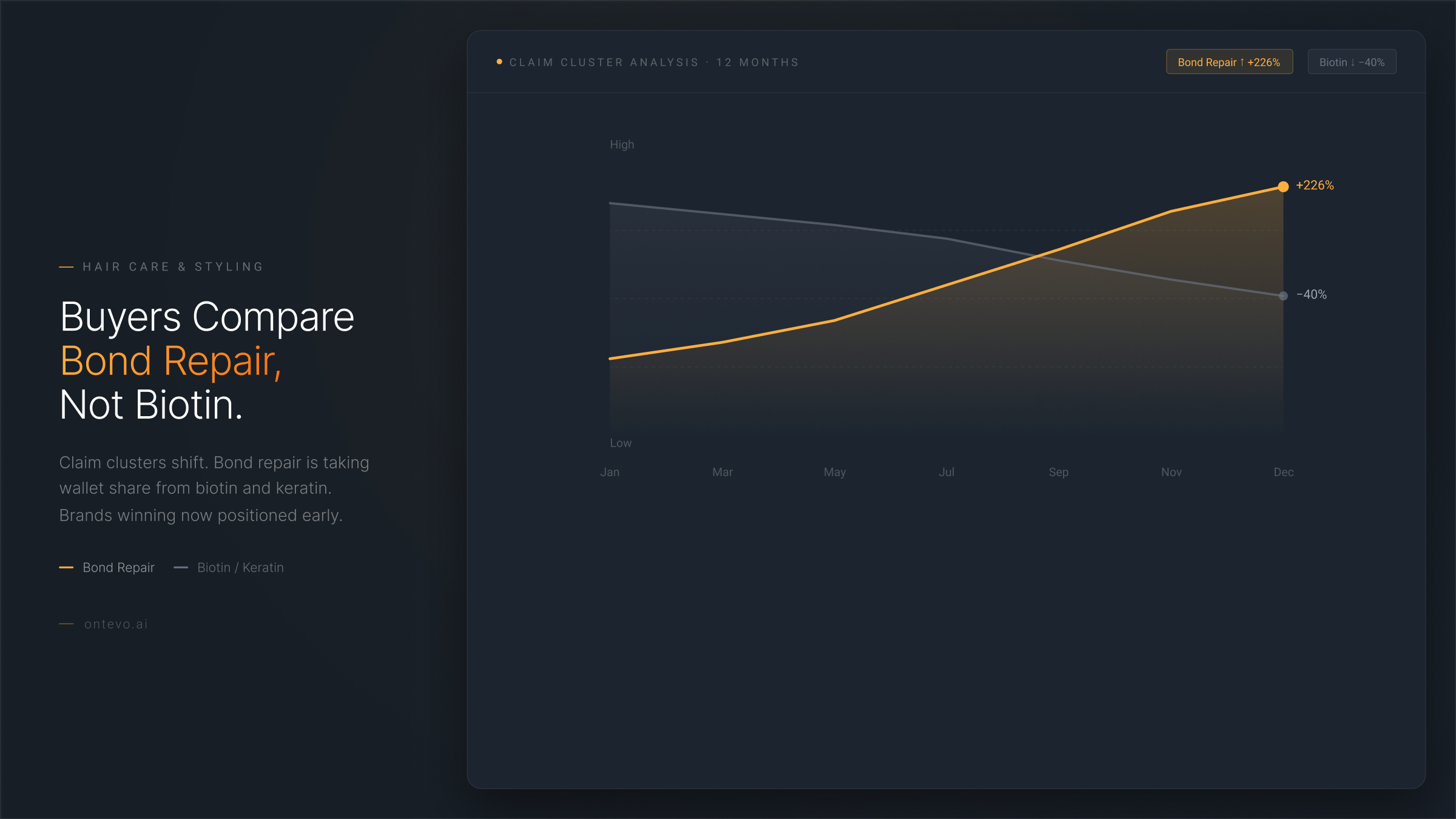
Hair care brands often lag behind buyer language, continuing to market generic claims while shoppers compare category-specific proof such as bond repair, scalp health, and visible damage repair.
The buyer-language shift most brands feel too late
Hair care markets move through claim clusters. One phase centers on growth or strengthening. Another centers on damage repair, scalp health, frizz control, or curl-specific needs. The problem is not that older claims become false. The problem is that they stop being the language shoppers use when comparing options.
If a product still leads with broad biotin-style language while shoppers are comparing bond repair and scalp proof, the product may feel behind the market even if the formula is strong.
Why claim architecture affects conversion
A hair care PDP does more than describe a product. It helps the shopper classify it. Is this for damage? Scalp balance? Breakage? Color-treated hair? The stronger that classification, the easier it is for the shopper to understand whether the product belongs in consideration.
Generic language such as “supports healthy hair” may sound positive, but it does not carry much comparative force. Shoppers want sharper proof and clearer use cases. They want to know what changed, what is different, and why the product deserves the click.
Where the leak appears on the page
The leak usually starts above the fold. If the first screen does not communicate the buyer's real use case, the product enters the comparison as a generic option. The shopper then scans imagery, bullets, reviews, and usage sections looking for confidence. If the signal is weak, the session ends.
This is why positioning and PDP structure cannot be separated. Headline, benefit order, proof modules, review highlights, and FAQ content should reinforce the same commercial story.
How to identify the next claim shift earlier
Brands fall behind when they optimize around internal language instead of the words buyers are beginning to prefer. Search demand, reviews, competitor copy, social buzz, and PDP language all reveal where the category conversation is heading.
Ontevo reads these public market signals together so product and growth teams can understand where their product story is lagging the market.
What better execution looks like
Start with one hero SKU or product family. Compare its claim hierarchy against the market. Which phrase leads the page? Which proof appears first? Which review themes repeat? Which competitor claims feel easier to understand?
From there, make a focused update. If bond repair is the current buyer frame, the PDP should not bury that language under vague strengthening copy. If scalp health is driving new demand, the page should connect formula, use case, and proof clearly.
How Ontevo helps
The Rapid Scan can surface where a hair care brand's claims, proof, reviews, and competitor positioning no longer match buyer language. Findings are returned as Truth Cards with evidence, impact, and a drafted fix.
FAQ
What claims are hair care shoppers comparing now? It depends on the subcategory, but many shoppers compare problem-specific claims such as bond repair, scalp health, breakage, and styling outcomes.
Why does buyer language matter on a PDP? Because shoppers compare products through language they already trust and understand. If the page uses weaker or older terminology, relevance and conversion suffer.
How can a hair care brand find positioning gaps? Benchmark search, reviews, competitor pages, and claim architecture together instead of relying only on channel metrics.
Conclusion
In hair care, the language is competing too. When buyer framing moves and the PDP does not, conversion erodes quietly. Run the Rapid Scan to see where the market has moved.
Ontevo Research. Where this post carries figures, they come from Ontevo's own scan corpus or are modeled from scan patterns across the category. No figure is measured from a named customer.