62% of Implant Consults Ghost, and It's Not Because of Price
The $31,400/mo Leak Nobody's Measuring
Run the numbers on your last quarter. Pull every implant, ortho, and oral surgery consult from your PMS. Count how many converted to scheduled treatment.
If you're like the ~40,214 specialty dental practices in the US, roughly 62% of those consults never came back. No follow-up call returned, no treatment scheduled, no explanation.
Here's what that looks like in dollars:
- 20 high-ticket consults/month (implants, ortho, oral surgery)
- 62% ghost rate = ~12–13 vanished patients
- $4,500 blended average case value
- Even at a 50% qualification rate, that's $31,400/mo walking out the door
Against a median specialist gross of $1,268,150/year (ADA Health Policy Institute, 2021 Survey of Dental Practice), $31,400/mo represents roughly 30% of monthly revenue: the single largest controllable leak in most specialty practices.
And almost every owner-doctor we've analyzed blames the same thing: price.
The data says they're wrong.
The Assumption That's Bleeding You Dry
Ask any treatment coordinator why consults ghost and you'll hear some version of: "They saw the number and freaked out."
Reasonable guess. Implants run $5K–$8K. Full ortho cases hit $4K–$6K. That's real money.
But when you decompose the actual language in negative reviews across specialty dental practices, a different pattern emerges:
Fear and anxiety language appears 3x more frequently than complaints about clinical outcomes.
Here are the top 5 themes in negative specialty dental reviews, ranked by frequency:
- Long wait times / feeling rushed during consultation: "I sat in the chair for 8 minutes and got a treatment plan shoved at me."
- Cost not discussed upfront / financing not offered: Not the dollar amount itself, but how it was presented. Surprise vs. transparent conversation.
- Rude or dismissive front desk / difficulty reaching the office: "Called three times. Voicemail every time."
- Pain management concerns / anxiety not addressed: "Nobody asked if I was nervous. I was terrified."
- Poor post-op communication: "Had swelling for 3 days. Nobody called to check."
Count them: 4 of 5 are experience problems, not clinical or pricing problems.
Even the "sticker shock" theme is really about the experience of learning the price: being handed a printed sheet with a $6K number and no financing discussion, no context, no empathy. The patient is rejecting the way it felt, not the price.
What Fear Friction Actually Looks Like
The ghost builds gradually rather than happening in one moment. It compounds across every touchpoint between "I need an implant" and "I'm sitting in the chair."
Pre-Consult: The Invisible Practice
72% of local dental searches include anxiety or comfort modifiers: "sedation dentistry near me," "painless root canal," "anxiety-free dental implants."
Most specialist GBPs mention zero comfort-related attributes. No sedation options, no comfort language, no anxiety acknowledgment.
The patient searching "sedation dental implants [city]" never finds you. They find the DSO competitor who optimized for exactly that term. (For a full walkthrough of what your profile should include, see our complete GBP audit checklist.)
First Contact: The 4pm Wall
Many specialty practices close at 4pm, with no online scheduling and no after-hours answering. The intake form asks for insurance information before the patient even knows the cost.
This creates abandonment at the highest-intent moment. The patient Googled you at 8pm, felt brave enough to reach out, and hit a wall. By morning, the courage is gone.
In-Office: The Cold Consult
Patient walks into a clinical environment. Fluorescent lights, no comfort signals, no blanket offered, no sedation options discussed upfront.
The consult feels like a medical evaluation, not a care experience. The treatment coordinator presents a $6K treatment plan on a printed sheet. No financing pre-qualification, no "how are you feeling about this?"
The patient nods, takes the paper, and says, "I'll think about it."
Post-Consult: The Ghost Window
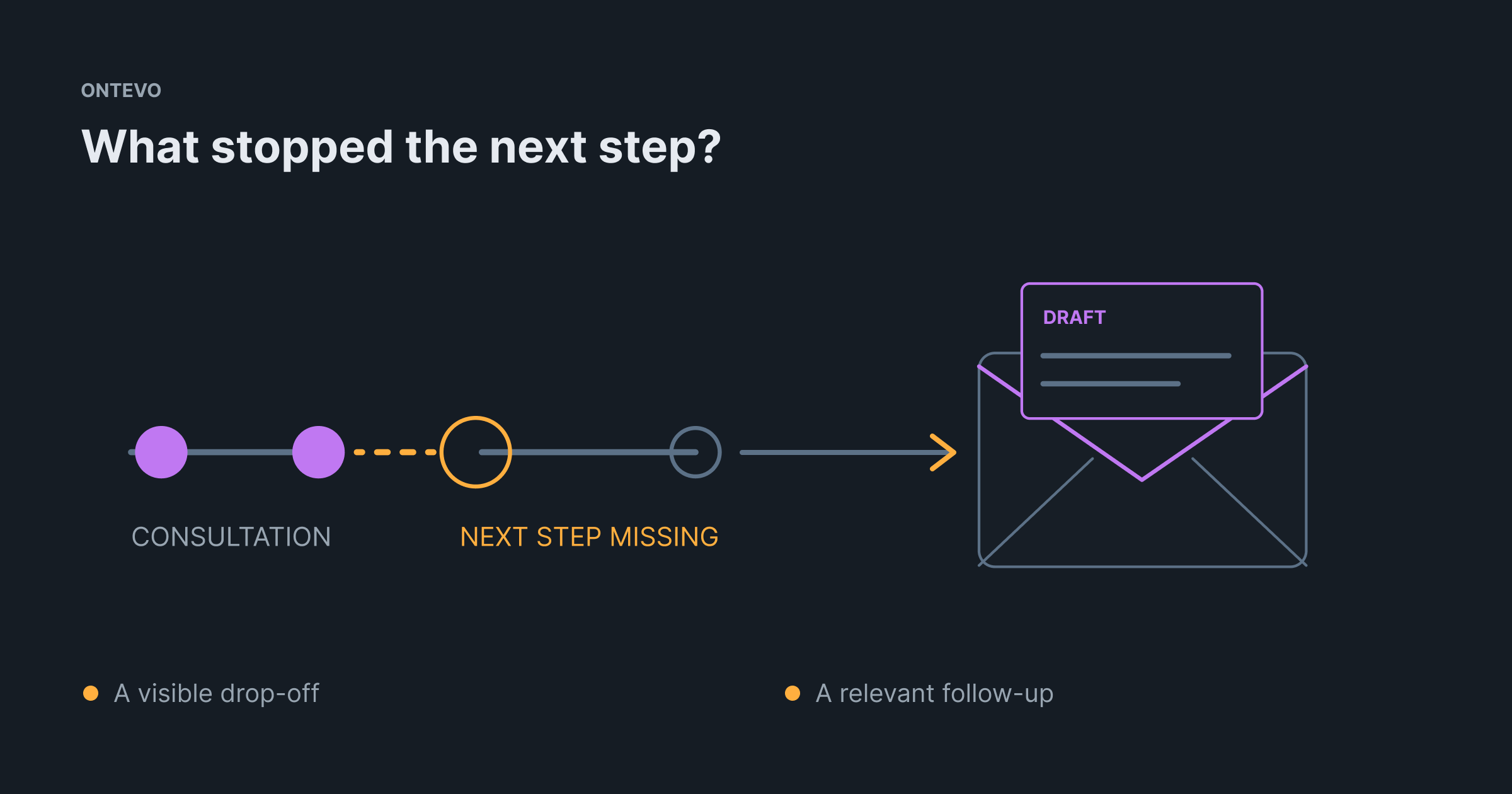
24–72 hours after the consult is when ghosting happens. The patient's anxiety compounds in silence. No follow-up call, no "how are you feeling about what we discussed?", no financing reminder.
Most practices send nothing. Or worse, a generic "Thanks for visiting!" email that reads like it was written for a hotel.
The patient's fear fills the silence. And fear always wins.
The Revenue Math Your PMS Won't Show You
Owner-doctors who hear "improve the patient experience" often file it under "nice-to-have." So let's make it a finance conversation.
- Median specialist gross: $1,268,150/year → ~$105,679/month
- Monthly consult pipeline: 20 high-ticket consults
- Ghost rate at 62%: ~13 lost cases/month
- At $4,500 blended case value, 50% qualification: $31,400/mo in addressable revenue, gone
Now compare that to what most practices spend trying to fix it: $3K–$5K/month in panic Google Ads with zero attribution to seated patients. That's $36K–$60K/year poured into a funnel that's broken at the bottom.
You're paying to fill a bucket with a hole in it.
The Practice That Cut Its Ghost Rate in Half
One oral surgery practice (we'll call them Ridgeline Oral Surgery, not their real name, but the pattern is real) reframed their entire implant consult around a single finding: the patient's first question is "will I be okay?", not "how much?"
They called it the VIP Recovery Package. Here's what changed:
- Comfort-first consult: The first 5 minutes addressed sedation options, recovery expectations, and comfort amenities (blanket, noise-canceling headphones, post-op care kit), before any clinical discussion.
- Transparent financing: Patients were pre-qualified for financing before the treatment plan was presented. The conversation shifted from "here's the number" to "here's the number, and here are three ways to pay."
- Same-day follow-up: The treatment coordinator sent a personal text within 2 hours of the consult: "Hi [name], just wanted to check in after today. Any questions I can answer?"
The result:
Consult-to-treatment conversion improved from ~38% to ~65%, effectively cutting the ghost rate in half.
They didn't change their clinical quality, lower their prices, or increase their ad spend. They changed the 12 touchpoints between "patient walks in" and "patient decides."
Meanwhile, the competition is shifting fast. DSO-backed competitors (Heartland, Aspen, OMS360, Smile Doctors) are systematically productizing the consult experience: comfort guarantees, transparent pricing, online booking, 200+ Google reviews. Solo specialists competing on clinical skill alone are losing to competitors who compete on trust.
The 3 Ghost Triggers, and How to Audit Each One
Distilled from the data, here are the three specific, fixable triggers behind most consult ghosting:
Ghost Trigger #1: The Invisible Practice
68% of local patient searches include modifiers like "sedation," "same day," or "financing": terms your GBP probably doesn't surface.
If the anxious patient can't find you searching the way they actually search, they book with whoever shows up.
Audit it yourself:
- Google your practice name + your top 3 procedures. Does your GBP mention sedation? Financing? Same-day options?
- Compare your profile to the top 3 competitors in the local pack. Count their comfort-related terms vs. yours.
- Check your website service pages. Do they address anxiety, or do they read like a clinical textbook?
Ghost Trigger #2: The Cold Consult
The consult experience feels clinical, not caring. No comfort signals, no upfront cost transparency, no sedation discussion before the clinical discussion.
The patient leaves feeling like a chart number, not a person.
Audit it yourself:
- Have a friend mystery-shop your consult. Time how long before comfort or cost is discussed.
- Review your treatment presentation. Is financing discussed before or after the number?
- Ask your last 5 converted patients: "What almost made you not come back?" The answers will be uncomfortable and invaluable.
Ghost Trigger #3: The Silent Follow-Up
The 24–72 hour window after the consult is when fear compounds. Most practices send nothing.
Audit it yourself:
- Pull your last 20 unconverted consults. How many received a personal follow-up within 24 hours? (A personal text or call, not an automated email.)
- Check your 48-hour and 7-day touchpoints. Do they exist?
- Read the follow-up messages you do send. Do they address the patient's emotional state, or just ask them to schedule?
The DIY Ghost Audit: 5 Steps You Can Do This Week
Before you spend another dollar on ads, run this audit. It takes about 2 hours and will tell you more than any dashboard.
Step 1: Calculate your ghost rate. Pull 90 days of consult data from your PMS. Total consults minus converted-to-treatment, divided by total consults. If it's above 50%, keep reading.
Step 2: Segment the ghosts. Categorize each unconverted consult: (a) never responded to follow-up, (b) said "I'll think about it," (c) explicitly chose a competitor, (d) cited cost. Most practices have never done this segmentation. The ratios will surprise you.
Step 3: Google yourself. Search your practice + your top 3 procedures. Search "sedation [procedure] [your city]." Search "financing dental implants [your city]." Note where you appear, and where you don't. (For a deeper dive, follow our complete GBP audit checklist.)
Step 4: Mystery-shop your own consult. Have a friend call and request an implant consult. Time how long it takes to reach a human. Note whether comfort or cost is discussed first. Note the follow-up, or the silence.
Step 5: Read 20 negative reviews. Yours and your competitors'. Tally how many mention fear/anxiety/comfort vs. clinical outcomes vs. price. For a deeper methodology, see our guide on how to analyze competitor reviews to find market gaps.
If you complete this audit honestly, you'll have a clearer picture of your ghost problem than 95% of specialty practices in the country.
This Is a Market Fit Problem, Not a Marketing Problem
Most practices try to solve ghosting with more marketing: more Google Ads, more SEO, more social media posts.
But if the consult experience is broken, more traffic just means more ghosts.
The real gap is between what patients need to feel (safe, informed, cared for) and what your consult actually delivers, not between your practice and Google's algorithm.
When 72% of local searches include anxiety and comfort terms but your profile mentions zero comfort-related attributes, you have a demand-to-experience mismatch. The "product" (your consult experience) doesn't match the "market" (what anxious patients need before committing to a $6K procedure).
No amount of ad spend fixes a product problem.
What the Fix Looks Like, Systematized
You just ran the audit manually. Now imagine it running continuously, across every touchpoint, with a dollar sign on every gap. This is part of a broader shift toward AI agents that draft, you approve: not replacing your clinical judgment, but eliminating the labor of execution.
Three agents are relevant here:
- Consult experience agent: Audits the full consult path (GBP → phone → office → follow-up) and drafts specific improvements: comfort menu language, follow-up text sequences, financing presentation scripts. You review every drafted fix. You approve before anything changes.
- Voice Receptionist: Covers the 4pm wall. After-hours call handling with warm, anxiety-aware language. No more voicemail at 8pm when the patient finally works up the courage to call. You set the parameters. You control the script.
- Reputation Defender: Monitors review themes in real-time. Flags when "fear" or "wait time" themes spike. Drafts responses that never confirm patient status and never overstep. You approve every response before it publishes.
Tools like Weave handle appointment reminders and review requests well, but they can't decompose review themes against cohort benchmarks or connect reputation signals to revenue impact. See how Ontevo differs from Weave for a detailed comparison.
The Regulatory Guardrail
A brief but critical note: any system that touches the patient experience must operate within state dental board advertising rules and FTC guidelines.
- Review responses cannot confirm or deny patient status.
- Before/after photos require signed patient authorization.
- "Specialist" claims may be restricted by state boards unless you hold board certification.
Generic marketing tools often ignore these guardrails. Dental-specific intelligence can't afford to. Every agent draft is flagged for compliance before you see it.
The Bottom Line: What Cutting Your Ghost Rate in Half Is Worth
If your practice cuts its ghost rate from 62% to ~35% (the benchmark set by practices using the VIP Recovery Package approach), that's approximately 5–6 additional cases per month converting to treatment.
- 5 cases × $4,500 avg case value = $22,500/mo in recovered revenue
- $270,000/year, enough to fund a full-time treatment coordinator, a practice renovation, or an associate hire
Compare that to the alternative: $3K–$5K/mo in panic Google Ads with no attribution to seated patients. That's $36K–$60K/year spent feeding a broken funnel.
You have a trust problem, not a traffic problem.
And trust is fixable.
What to Do Right Now
Three things you can do before Friday:
- Calculate your ghost rate. 90 days of consult data. Total minus converted, divided by total. Write the number down.
- Read your last 10 negative reviews, yours and your top competitor's. Tally fear vs. price vs. clinical complaints. See the 3:1 ratio for yourself.
- Redesign the first 5 minutes of your next consult. Lead with comfort, not clinical. Discuss sedation before the X-ray. Discuss financing before the treatment plan.
These three changes cost nothing. They require no new technology, no new staff, no new ad spend. They just require seeing the problem clearly, and the data says the problem isn't price.
It never was.
Ontevo Research. Where this post carries figures, they come from Ontevo's own scan corpus or are modeled from scan patterns across the category. No figure is measured from a named customer.