The Spec War: Why Your Product Wins on Quality but Loses on the Listing
Your Product Is Better. Your Listing Is Losing.
Your pan is better. Five-ply bonded construction. Genuinely non-toxic coating. Heat distribution that embarrasses the competition.
And you're losing the sale.
The listing is what's inferior, not the product. 4 of 5 top competitors in the ceramic/non-stick cookware category now explicitly claim "Metal Utensil Safe" on their hero SKU PDP. If you don't, you're the outlier. And in a high-consideration purchase where buyers visit 5–10 product pages over a 2–6 week decision cycle, outliers don't get the benefit of the doubt. They get skipped.
The cost of that skip? $8,500/mo in lost hero SKU conversions. The culprit is neither bad ads nor weak keywords; it's a listing that doesn't answer the five questions every cookware buyer asks before clicking "Add to Cart."
What Is the Spec War, and Why Did It Intensify in 2026?
The Spec War is the shift from lifestyle-driven product marketing to specification-driven purchase decisions. DTC disruptors (Our Place, Caraway, Made In) trained consumers to care about material science. PFAS-free. Ceramic vs. hard-anodized. Oven-safe thresholds with actual numbers. Legacy brands like All-Clad and Le Creuset are now forced to compete on spec transparency, not just heritage.
The result: technical buyers now compare specs side-by-side across PDPs, Reddit threads (r/cookware, r/BuyItForLife), YouTube teardown channels, and TikTok "egg slide test" videos. They're benchmarking, not browsing.
"Warped" appears in 22% of 1-star reviews across the ceramic pan category. That's a spec communication failure, not a quality defect. The buyer used the pan above its unstated oven-safe threshold. The pan held its actual spec; the listing never published it.
With approximately 15,000 DTC kitchen and cookware businesses operating in the US, the competitive density is brutal. At $80–$250 AOV and a 2–6 week consideration cycle, the listing that answers the most spec questions wins, not the one with the best lifestyle photography.
The 5 Specs That Decide the Sale
Based on competitive PDP benchmarking across the top-selling ceramic and non-stick cookware SKUs, these are the five specs buyers now treat as table-stakes or emerging differentiators:
1. PFAS-Free / Non-Toxic Certification
Moved from differentiator to baseline. Present on 80%+ of top-selling PDPs. If you don't state it explicitly, buyers assume you're hiding something. "Non-toxic" without certification language is no longer sufficient: buyers want to see the specific claim.
2. Metal Utensil Safe
4 of 5 top competitors claim it. The absence is a conversion killer because it signals coating fragility. Even if your coating can handle metal utensils, silence reads as "no."
3. Oven Safe to 500°F+
Vague "oven safe" without a temperature is now a red flag. Competitors specify "500°F" or "600°F": precision signals engineering confidence. Imprecision signals marketing hedging.
4. Dishwasher Safe (Truly, Not "Hand Wash Recommended")
31% of cast iron alternative reviews contain the wishlist signal "wish it was dishwasher safe." Convenience is a spec. If your pan is genuinely dishwasher safe, say it. If it's not, know that you're losing a third of the consideration set on this single attribute.
5. Warp-Free Guarantee
The emerging trust signal. Only 12% of brands currently offer it. First-mover advantage is real here. "Warped" appears in 22% of negative reviews, so a warp-free guarantee directly addresses the #2 complaint in the category.
For each of these, the deciding question is whether your PDP says your product has the spec, not merely whether it does.
The Conversion Math: What Missing Specs Actually Cost
Let's walk through the revenue math for a $3.5M annual cookware brand, a common profile for a mid-stage DTC player with a hero SKU driving 30–40% of revenue.
- Baseline: $3.5M annual revenue (~$292K/mo). Blended 55% gross margin. $85K/mo paid acquisition at 3.5x target ROAS.
- The spec gap: Hero SKU PDP is missing 3 of the top 5 category-expected specs. Conversion rate drops ~22% vs. spec-complete competitors.
- The compensation: To maintain the same revenue at a 22% lower conversion rate, ad spend must increase from $85K/mo to ~$108K/mo.
- The Spec Tax: That's an incremental $23K/mo ($276K/year) in wasted CAC: money spent compensating for what the listing doesn't say.
- Hero SKU share: Isolating to the hero SKU (~37% of revenue), its share of the Spec Tax is roughly $8,500/mo ($102K/year).
But the Spec Tax is only the distribution cost. There's also the inventory risk.
A single failed SKU launch that missed a spec trend by one production cycle (8,000 units at $15 landed cost) creates $120K in slow-moving inventory requiring 40% markdowns.
Total annual cost of spec blindness: ~$396K. That's 11.3% of revenue.
That's a dollar figure with an evidence trail, the kind of finding that belongs in a board presentation, not a marketing deck. This is what a Truth Card looks like: a financial validation artifact that speaks the language of the CFO, showing confidence score, revenue impact, and the evidence behind it.
Your Customers Are Already Telling You in the Reviews
Reviews are the largest unstructured product intelligence dataset most brands ignore. The intelligence lives in the specific language inside the review, not the star rating or the sentiment score.
Here are the top 5 negative review themes across the ceramic cookware category, with frequency:
- Coating peeling or chipping within 6 months: 22% of negatives
- Pan warping on high heat or in oven: 18% of negatives
- Non-stick performance degrading after repeated use: 15% of negatives
- Handle getting too hot or loosening over time: 14% of negatives (stainless steel)
- Misleading size or weight expectations vs. PDP claims
Here's the finding most brands miss: these reviews are spec communication failures as much as quality complaints.
"Warped on high heat" often means the buyer used the pan above its unstated oven-safe threshold. "Coating chipped" often means they used metal utensils on a pan that never claimed metal utensil safety. The product may not be defective; the PDP failed to set expectations.
And on the flip side, competitor reviews are full of wishlist signals hiding in plain text: "I wish this came in a 10-inch size," "needs a glass lid option," "want matching bakeware." These are demand signals: unfulfilled market gaps you can claim. For a deeper methodology on extracting these, see our step-by-step guide to mining competitor reviews for market gaps.
The PDP Audit Framework: 5 Steps You Can Execute This Week
This framework works whether or not you ever use Ontevo. It's the same logic the Spec Showdown runs at scale, but you can do it manually with a spreadsheet and an afternoon.
Step 1: Build Your Spec Comparison Matrix
Pull up the top 5 competitor PDPs for your hero SKU category. Create a spreadsheet with columns for each of the 5 key specs: PFAS-free, Metal Utensil Safe, Oven-Safe Temperature, Dishwasher Safe, Warp-Free Guarantee. Check or uncheck for each competitor. Then check your own.
If you have more unchecked boxes than your competitors, you've found your conversion gap.
Step 2: Mine Your Own Reviews for Spec Complaints
Search your reviews (Amazon + DTC site) for these keywords: warp, chip, peel, hot handle, oven, dishwasher, metal utensil, non-stick. Tally frequency. Each cluster is a spec communication gap: a place where the PDP didn't set expectations the product could meet.
Step 3: Mine Competitor Reviews for Wishlist Signals
Same keyword search on competitor reviews, but focus on phrases like "I wish," "would be perfect if," "only complaint." These are unfulfilled demands you can claim, either on the current PDP or in the next product iteration.
Step 4: Cross-Reference What You Have vs. What You Claim
This is the fastest win in the entire post.
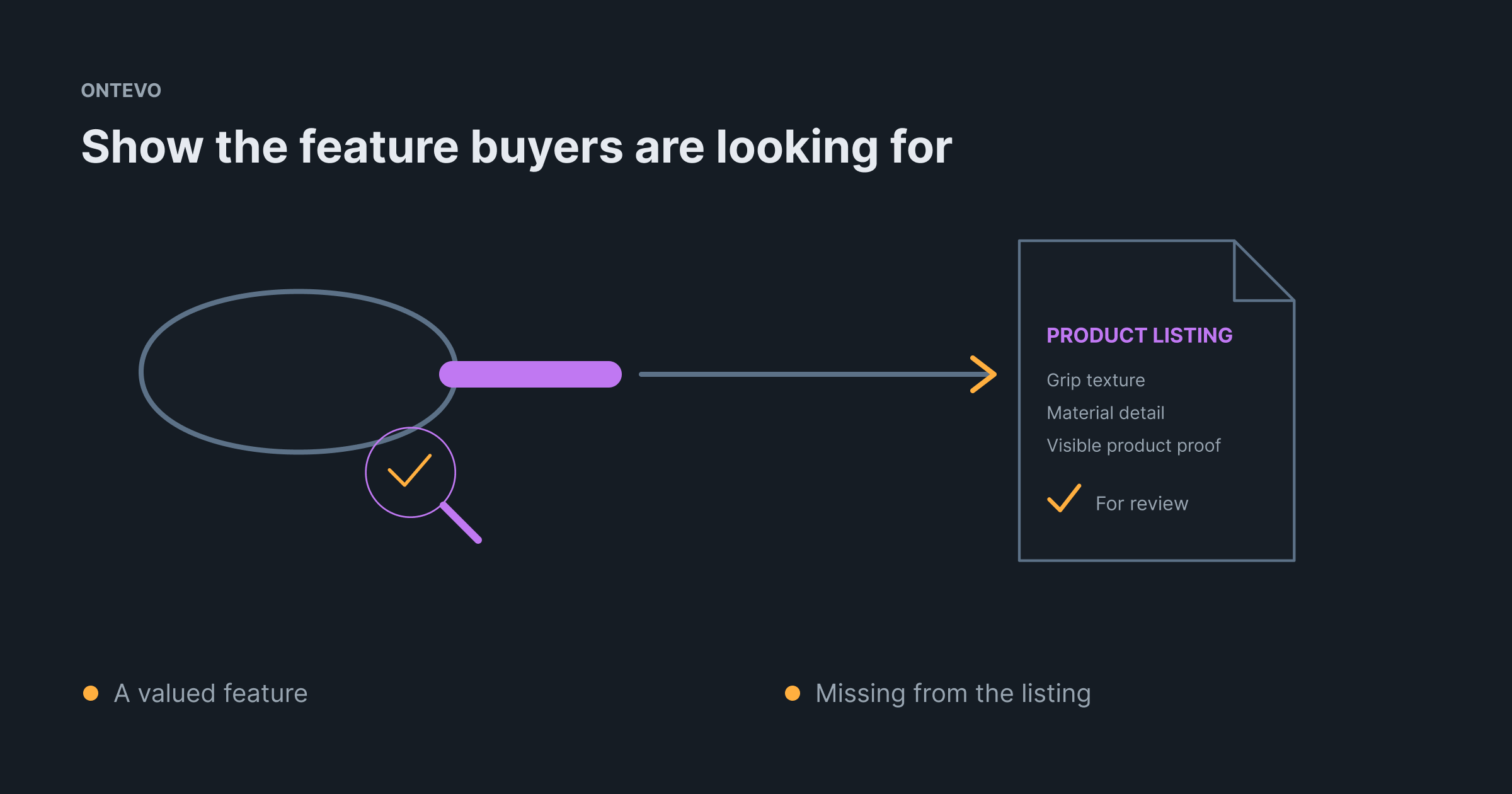
Many cookware brands actually HAVE the spec but don't STATE it on the PDP. Your pan may be oven-safe to 500°F, but if the PDP says "oven safe" without a number, you lose the comparison. Your coating may handle metal utensils, but if you don't say "Metal Utensil Safe," the buyer assumes it can't.
Zero product changes. Zero engineering. Just copy changes. Implementable this week.
Step 5: Prioritize by Conversion Impact
Rank missing specs by three criteria:
- (a) How many competitors already claim it
- (b) How often it appears in negative reviews
- (c) How often it appears in wishlist signals
The spec that scores highest on all three is your #1 PDP update. For most ceramic cookware brands in 2026, that's "Metal Utensil Safe": claimed by 4 of 5 competitors, implicated in 22% of negative reviews (coating complaints), and a top wishlist signal.
The Egg Slide Test Problem: When Social Proof Becomes a Spec Benchmark
If you sell non-stick cookware and your PDP doesn't include a video of an egg sliding off the pan, you've already lost a segment of buyers.
The "egg slide test" (popularized on TikTok and YouTube) has become a de facto spec benchmark. Far from a gimmick, it's a visual proof point that replaces the trust a buyer can't build by reading bullet points.
The same logic extends to other visual spec proofs:
- Metal utensil scratch tests: a 15-second video of a fork dragged across the cooking surface
- Oven-safe demonstrations: the pan going into a 500°F oven and coming out flat
- Warp resistance tests: heating the pan and measuring flatness with a straight edge
In 2026, specs are video-demonstrated proof points, not just text claims. A PDP without spec demonstration video is incomplete, and keyword volume tools like Jungle Scout can't tell you WHY a competitor's listing converts better. They can tell you what people search. They can't tell you what people need to see before they buy.
The CapEx Trap: When Spec Blindness Infects R&D
The PDP is the visible symptom. The deeper disease is spec blindness in product development.
Consider this scenario: A competitor launches a reformulated ceramic coating: "500°F Oven Safe + Metal Utensil Safe." Your hero SKU's Amazon conversion rate drops 15% overnight. But you've already committed to a 12,000-unit production run at your Guangdong factory. That's $180K in inventory now positioned against a spec-inferior claim.
With overseas manufacturing lead times of 3–6 months from spec change to shelf, you can't react. You can only absorb the hit.
The fix is anticipation, not faster reaction. Spec trend data (like the fact that "warp-free guarantee" is claimed by only 12% of brands but appears with rising frequency in wishlist signals) tells you what to engineer into the next production run before competitors force your hand.
This is where PDP fixes connect to product strategy. The listing audit is an early warning system for R&D, not just a marketing exercise.
What Spec-Complete Brands Do Differently
The brands winning the Spec War run a system rather than getting one thing right:
- Every hero SKU PDP has a spec comparison table, not just lifestyle copy. Buyers can see at a glance what the product claims, with specific numbers.
- Spec claims are substantiated with third-party lab testing, especially for PFAS-free, given increasing FTC scrutiny on unsubstantiated non-toxic claims.
- PDPs include video demonstrations of key specs: egg slide, metal utensil scratch, oven test. Visual proof, not just verbal claims.
- Review responses address spec-related complaints with specific data: "We're sorry to hear about warping. Our pans are tested to 500°F. Were you using a burner above medium-high?" This turns a negative review into a spec education moment.
- Product roadmaps are informed by competitive spec benchmarking, not just internal engineering preferences or gut-feel trend calls.
This is an ongoing practice, not a one-time fix. New spec claims emerge every quarter. A brand that audited its PDPs six months ago and hasn't looked since is already falling behind.
For brands that want this system without hiring a competitive intelligence team, this is exactly the kind of work AI agents replace: the labor of competitive intelligence, without replacing your judgment. Ontevo's diagnostic engine and agents continuously monitor competitor PDPs, flag new spec claims, and draft updated listing copy. You approve every change. Your voice, your brand, informed by data you didn't have to collect manually.
The Fastest Win: Claim What You Already Have
If you take one thing from this post, let it be this:
Audit your hero SKU PDP against the 5 specs above. For each one, ask: does our product have this capability? And does our listing say so?
In our analysis, the most common finding is a listing missing the spec, not a product missing it. The pan IS oven-safe to 500°F; the PDP just says "oven safe." The coating CAN handle metal utensils; the PDP just doesn't mention it.
That gap is the single fastest conversion lift available to any cookware brand. No reformulation, no new tooling, no production run: a copywriter and an afternoon.
The broader Spec War (the one that touches R&D, inventory planning, and competitive positioning) requires ongoing intelligence. But the first battle is won on the listing page, this week, with information you already have.
$8,500/mo on the hero SKU. $396K/year across the business. 11.3% of revenue.
That's a product intelligence problem with a marketing symptom, not a marketing problem.
Ontevo Research. Where this post carries figures, they come from Ontevo's own scan corpus or are modeled from scan patterns across the category. No figure is measured from a named customer.