Menu Stagnation Is Costing MedSpas $10K+/mo: Here's the Data
The $10,400/mo You Can't See on Your P&L
Picture a med spa doing $100K/mo, right at the $1.2M median annual revenue for the industry. New-patient volume is flat. Ad spend keeps climbing. The owner assumes it's a marketing problem and throws another $3K at Meta.
Another $3K at Meta won't fix it.
The problem is the menu. Specifically, it's a language problem: a gap between what the practice lists on its Google Business Profile and website, and what patients actually type into a search bar in 2026.
That gap costs the median med spa $10,400 per month in addressable revenue that goes to the practice two miles away. The one whose GBP lists "Traptox," "Lip Flip," and "Prejuvenation Package" while yours still says "Botox Cosmetic" and "Dermal Fillers."
This figure is the result of modeling local search demand gaps against GBP service listings across med spa cohorts, not a theoretical guess. The range is 8–12% of monthly revenue; the midpoint is $10,400. And it compounds every month you don't fix it.
The Language Gap: Why "Botox" Isn't Enough Anymore
Patients search for outcomes and trends, not FDA product names.
"Traptox": trapezius Botox for shoulder slimming. "Lip Flip": a micro-dose technique for the upper lip. "Baby Botox": low-dose preventive treatment for the under-35 crowd. "Prejuvenation": the entire category of starting treatments before visible aging.
These are the dominant search language in local med spa markets right now, not fringe terms.
"Traptox-related search demand has grown 340% compared to generic 'Botox' queries in local markets."
- Ontevo local demand analysis across med spa cohorts
Here's what makes this insidious: you already perform these treatments. Traptox is just botulinum toxin injected into the trapezius. A Lip Flip is the same molecule, different placement. You have the skills, the product, and the license. You just don't have the words on your menu.
The technical reality: consumer language ("Traptox") maps to clinical specs ("Trapezius Neurotoxin Injection"), and if your menu and GBP don't bridge both, you're invisible to the patient and confusing to Google's local algorithm. Over 40% of local injectable search demand now uses trend-specific terminology that most med spa menus don't include.
The Invisibility Audit: What Your GBP Actually Says vs. What Patients Search
You can test this right now. It takes two minutes.
- Open your Google Business Profile. Look at your listed services.
- Open a new incognito browser tab.
- Search: [your city] + traptox
- Search: [your city] + lip flip
- Search: [your city] + GLP-1 weight management
Are you in the results? Or is it your competitor?
Across Ontevo's med spa cohort analysis, 60% of local competitors already list "weight management" or "GLP-1" as a named service on their GBP. If you don't, you're excluded from that entire demand stream, not because you can't offer it, but because Google doesn't know you do.
This is what we call service-level SEO. Each treatment needs its own GBP service listing, its own landing page, and its own review corpus to rank for high-intent local searches. A single "Injectables" category on your GBP is doing the work of what should be 8–12 individual service listings.
The 3-Layer Menu Audit
For any treatment you offer, check these three layers:
- Layer 1 (GBP Services List): Is the treatment listed by its consumer-facing name?
- Layer 2 (Website Menu Page): Does it have its own landing page with the clinical name, the consumer name, expected results, and a booking CTA?
- Layer 3 (Review Mention Frequency): Do your reviews mention this treatment by name? (If not, patients aren't associating your practice with it.)
If a treatment you offer doesn't appear in all three layers, it's functionally invisible. For the full tactical breakdown on optimizing your GBP, see our complete GBP audit checklist for service businesses.
The Demand Map: Which Treatments Are Growing, Which Are Dying
Your menu should be a living demand document, not a static list of equipment you own. Here's what the demand velocity data shows in 2026:
Growing
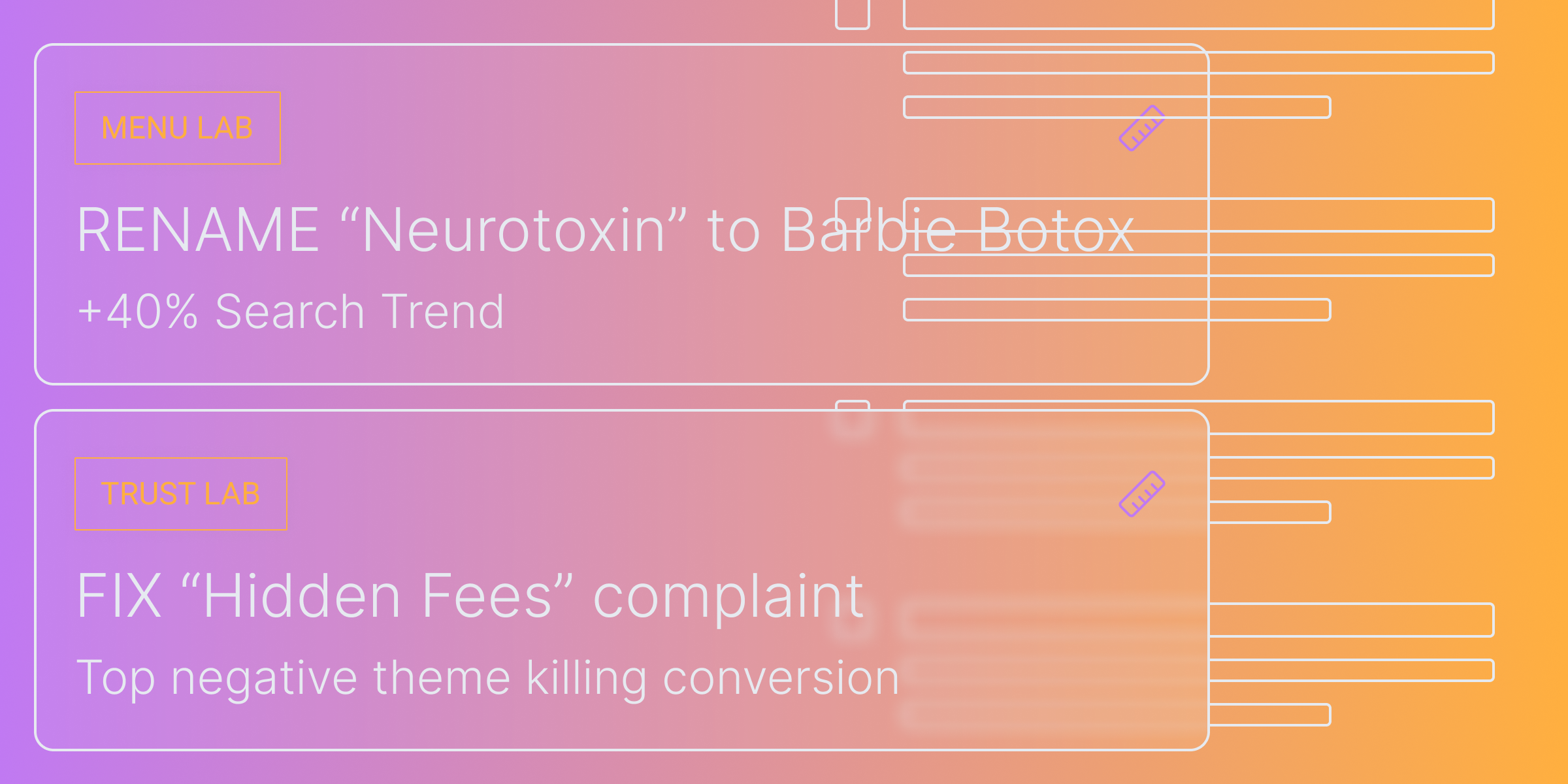
- Traptox / Barbie Botox: 340% demand growth in local search. The single biggest naming gap in most menus.
- Morpheus8 combination protocols: +45% YoY. Practices bundling Morpheus8 + PRF into named protocols ("Regenerative Glow") are capturing higher AOV.
- GLP-1 weight management: New category entirely. 60% of cohort already listing it. If you're not, you're ceding a high-value patient segment.
- Lip Flip & Prejuvenation packages: Targeting the 25–35 demographic entering the market for the first time.
Declining
- CoolSculpting: -20% YoY in local search demand. That's a statement about shifting local search demand, not about the technology, and if you just signed a 48-month lease, you need to know it.
Stable but under-used
- Morpheus8 (standalone): Demand is strong, but utilization at many practices sits around 40% because they haven't built landing pages or GBP listings using the terms patients actually search. The device is there. The patients are searching. The bridge is missing.
Read that last point again. You may already own a device generating less than half its potential revenue, not because of clinical limitations, but because of a naming and positioning gap.
The CapEx Trap: How Device Reps Exploit Menu Blindness
Every quarter, a device rep walks into your practice with a $120K–$180K machine and cherry-picked ROI projections. The pitch is compelling. The before-and-afters are stunning. The financing is "easy."
You sign. $4,500/mo for 48 months. $216,000 total commitment.
What the rep didn't show you: whether local search demand for that modality is growing or saturated. Whether 6 competitors within 5 miles already offer it. Whether the device you bought last year is sitting at 40% utilization because you never built the landing page.
"CoolSculpting demand is down 20% YoY. Morpheus8 is up 45%. The rep selling CoolSculpting Elite won't tell you that."
Now compound the costs:
- $10,400/mo in menu stagnation losses
- $4,500/mo in a device lease for declining-demand equipment
- = $14,900/mo = $178,800/year in combined waste
Even at the conservative low end ($8,000 menu loss + $4,500 lease), that's $150,000/year. For a $1.2M practice, that's 12.5% of annual revenue evaporating into a gap between what you offer and what the market wants.
The Demand-First CapEx Checklist
Before signing any device lease, run these five checks:
- Local search volume trend: Is demand for this modality trending up or down over 24 months?
- Saturation check: How many competitors within 5 miles already offer it?
- Utilization audit: What's the current utilization rate of devices you already own? Are you at 40% on Morpheus8 before buying Emface?
- Demand test: Can you build demand with a landing page and paid search before committing to a lease?
- Breakeven math: How many sessions/month to break even, and does local demand support that volume?
The best CapEx decision might be $0: invest in positioning the devices you already own.
The Competitor Benchmark: What the Practice Down the Street Already Figured Out
When you run a competitive menu audit (comparing your service offerings, pricing structure, and package design against the top 5 practices in your local market), patterns emerge fast.
Example finding #1: 4 of 5 local competitors bundle Morpheus8 + PRF into a "Regenerative Glow" protocol at $2,800/session. Your practice sells Morpheus8 à la carte at $1,200. The bundled protocol has higher AOV and ranks for more search terms.
Example finding #2: 3 of 5 competitors offer membership tiers and bridal packages. You sell only à la carte, leaving recurring revenue and high-AOV event packages on the table.
The point is understanding what the market has already validated so you can differentiate intelligently, not copying competitors. If everyone offers a "Glow Package" and you don't, you're being invisible, not unique.
The Review Signal: Your Patients Are Already Telling You What to Fix
Even a perfectly aligned menu won't convert if the patient experience creates negative reviews on the wrong themes. Here are the top 5 negative review themes across medical aesthetics:
- Felt rushed: assembly-line consult experience
- Pushy upselling or bait-and-switch pricing
- Results didn't match expectations set during consult
- Impossible to reach for rescheduling or post-treatment questions
- Long wait times despite having an appointment
Notice what's missing: none of the top 5 complaints are about clinical skill. They're about experience design. The fix is operational, not clinical, and it's entirely within the owner's control.
Practical takeaway: read your last 50 reviews and your top 3 competitors' last 50 reviews. Categorize by theme. The themes that appear most frequently in competitor negatives are your positioning opportunity. The themes in your negatives are your conversion leak.
The Fix: Menu Architecture as a Revenue Strategy
Reframe your menu. It's a demand-aligned revenue architecture, not a "list of things we do."
Three concrete steps you can take this week, zero spend required:
1. Rename to Match Demand
Add "Traptox," "Lip Flip," "Baby Botox," and "Prejuvenation" as named services on your GBP and website. These are treatments you already perform, just listed under generic names. The rename takes 15 minutes. The revenue impact starts the day Google re-indexes your profile.
2. Build Service-Specific Landing Pages
Each high-demand treatment gets its own page with: the clinical name, the consumer name, expected results, recovery timeline, and a booking CTA. This is free to do on any website platform and directly impacts local search visibility. For a step-by-step walkthrough, see our GBP optimization guide.
3. Bundle for AOV
Create 2–3 combination protocols that bundle existing treatments into named packages at higher price points. "Morpheus8 + PRF Regenerative Glow" at $2,800 is more compelling (and more searchable) than "Morpheus8" at $1,200 à la carte.
None of these require new equipment, new staff, or new certifications. They require repositioning what you already have.
How This Gets Automated
Everything above (the demand mapping, the GBP audit, the competitor benchmark, the review theme analysis) can be done manually. We just showed you how. But it takes 20+ hours, it's outdated the moment you finish, and nobody on your team has the bandwidth to repeat it quarterly.
This is where Ontevo's Menu Architect agent comes in. It cross-references local search demand spikes against your GBP service listings, website menu, and review mention frequency to produce a Truth Card: a financial validation artifact showing exactly which treatments to add, rename, or bundle, with revenue impact estimates attached.
The output is a decision document, not a dashboard. "Add Traptox as a named service: estimated $3,200/mo in captured demand. Confidence: 87%." You approve. It updates. That's it.
For context on how AI agents automate the analysis behind menu decisions, the broader framework applies across verticals, but the med spa implementation is where the semantic bridge between consumer language and clinical specs matters most.
Compare this to the current stack: the average med spa spends $1,149/mo across 3–4 siloed platforms (EHR at $550, patient communications at $400, marketing automation at $199), and none of them can answer the question: "Which treatment should I promote next month, and why?"
Birdeye and Podium handle review solicitation. PatientNow and Aesthetic Record manage clinical workflows. None of them track demand velocity at the treatment level. None connect review sentiment to treatment-level revenue. None flag menu gaps. The intelligence layer is simply missing, which is why 50 dashboards for yesterday, zero systems for tomorrow remains the default state.
And for a deeper look at why this agent model replaces the $5K/mo marketing agency, see why the next wave of AI replaces labor, not dashboards.
The Math That Should Keep You Up Tonight
Let's put it all in one place:
- $10,400/mo in menu stagnation losses: revenue going to competitors who name treatments the way patients search
- $4,500/mo (potential) in device lease payments for declining-demand equipment
- = Up to $178,800/year in preventable waste
For a $1.2M practice, that's 15% of annual revenue, gone not to clinical errors or bad creative but to a menu that doesn't speak the language patients use to search.
Your injectors are skilled. Your facility is beautiful. Your ads are running. But if your menu says "Botox" while your market searches "Traptox," you're funding your competitor's growth.
Pull up your GBP right now. Search [your city] + traptox.
Are you there?
Ontevo Research. Where this post carries figures, they come from Ontevo's own scan corpus or are modeled from scan patterns across the category. No figure is measured from a named customer.