Your Competitor Wins on Trust, Not Price: The $22,800/mo Proposal Gap
A 4.6-Star Remodeler Just Lost a $95K Kitchen to a 4.2-Star Competitor
The homeowner's reason wasn't price, portfolio, or Yelp reviews.
It was this: "They showed us exactly what the process would look like."
That single sentence represents a $22,800/mo revenue leak for the average remodeling contractor. The work is excellent. The leak comes from the proposal, which fails to communicate what the homeowner actually needs to hear before signing a $50K+ contract to let strangers into their home for 12 weeks.
We decomposed the review data, benchmarked proposals across local cohorts, and built the math line by line. Here's what we found, and a framework you can implement tonight.
What 70% of Negative Reviews Actually Say
We separated negative remodeling reviews into two buckets: complaints about the outcome (craftsmanship, design, materials) and complaints about the process (dust, communication, schedule). The split wasn't subtle.
The top 5 negative review themes:
- Dust and debris left in living spaces: the #1 complaint, by a wide margin
- Project ran weeks or months behind schedule
- Poor communication and unreturned calls
- Subcontractor quality and no-shows
- Hidden costs and change-order surprises
Count them. Four of the top five complaints are about process, not product.
Homeowners are writing "we couldn't live in our house" and "nobody called us back for three days," not "the tile work was crooked."
"Dust and communication appear in 70% of negative remodeling reviews. Craftsmanship almost never does."
- Ontevo Review Decomposition Analysis, Q1 2026
This is the data your proposal ignores. And it's the data your competitor has already weaponized.
The Proposal Your Competitor Is Already Sending
The losing proposal looks like this: line items, material costs, labor breakdown, a start date, and a signature line. It's a spreadsheet with a logo on top.
The winning proposal looks like this:
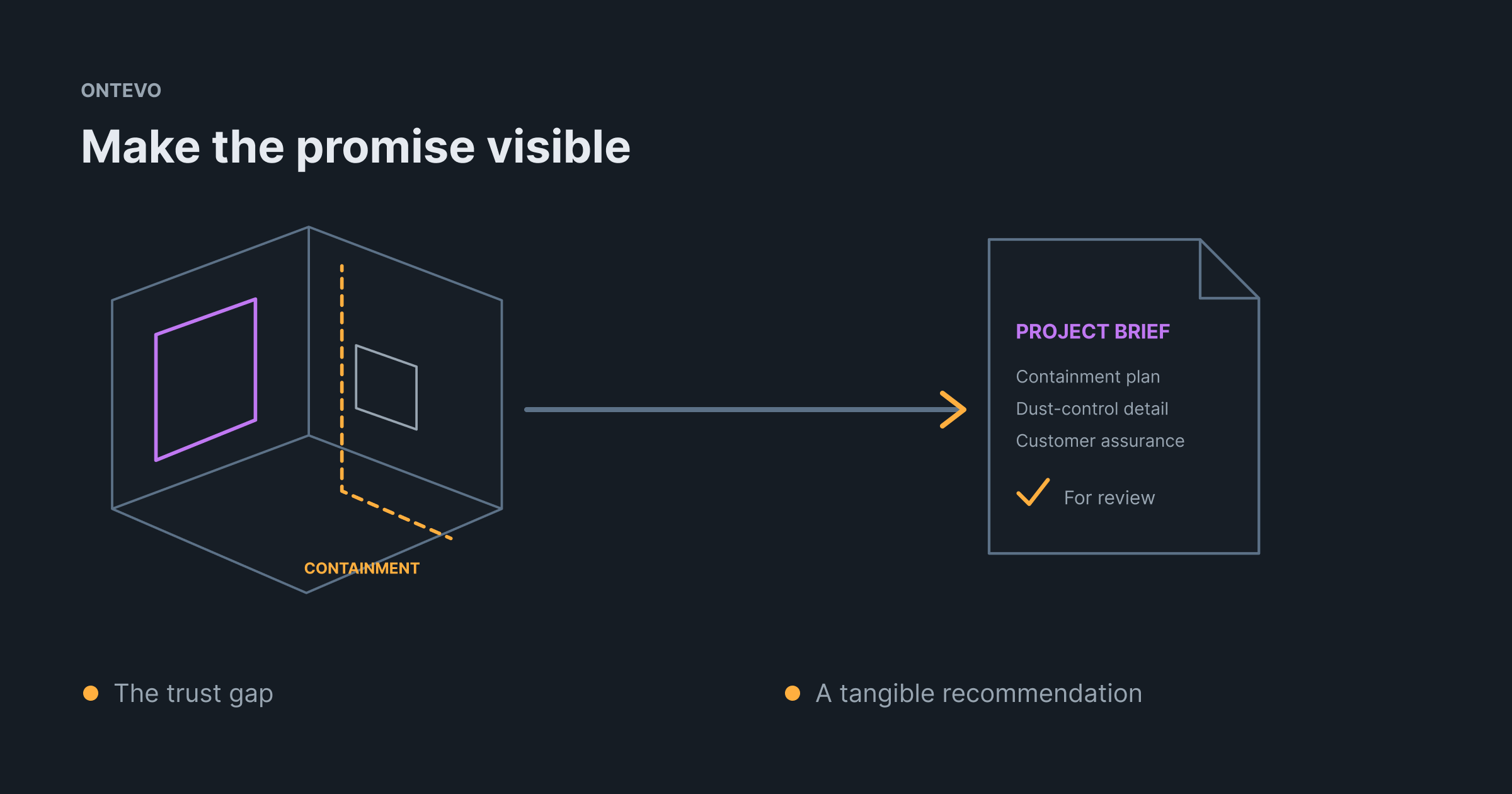
- A "Livable Remodel" guarantee with dust containment barriers and negative air pressure machines
- Daily photo updates sent by 4 PM every workday
- A timeline guarantee with financial penalties for overruns
- A dedicated project manager's cell phone number, not a general office line
- A "What to Expect Week by Week" visual timeline walking the homeowner through every phase
60% of the local remodeling cohort already advertises dust-free remodeling, financing options, or 3D design visualization. These are table stakes now, not premium differentiators. If your competitor's proposal mentions dust containment and yours doesn't, you've already lost before the homeowner compares prices.
The Side-by-Side: Price-Tag Proposal vs. Process Proposal
Same $85K kitchen remodel. Two completely different documents.
- Price-Tag Proposal: "Demolition & Framing: $12,400. Includes removal of existing cabinets, countertops, flooring. Framing for new layout per approved plan."
- Process Proposal: "Weeks 1–2: Controlled Demolition & Framing. Before any demo begins, we install full dust containment barriers between the kitchen and your living spaces. Demo debris is removed same-day, with no dumpster sitting in your driveway over the weekend. Your project manager sends a photo update each afternoon showing progress. By end of Week 2, you'll see the new layout framed and ready for mechanicals."
Same price. Same scope. Completely different emotional response.
Why Homeowners Ghost $50K+ Proposals
A kitchen remodel is an invasion, not a transaction.
Strangers in your home for 8–12 weeks, dust on your baby's crib, no kitchen for Thanksgiving. The anxiety is about the disruption, not the money. And that anxiety compounds every single day of the sales cycle.
40%+ of remodeling proposals are ghosted. The homeowner requests a bid, receives it, and never responds.
The average deal cycle in remodeling is 45 days from initial inquiry to signed contract. That's 45 days of anxiety compounding. Every day without a trust signal is a day closer to ghosting.
Homeowners ghost because the proposal didn't address their actual fear, not because they found someone cheaper. And their actual fear is living through the process, not paying for the outcome.
Look at what homeowners actually Google before they ever request a bid:
- "dust-free remodeling"
- "how long does a kitchen remodel take"
- "remodeling horror stories"
Process anxiety drives search behavior. It drives the bid request. And when the proposal arrives as a line-item spreadsheet with zero process guarantees, the anxiety wins.
The Review Gap: Your 5-Stars Say "Great Work." Theirs Say "Clean Jobsite."
When we separated review themes into "outcome" mentions (quality, design, craftsmanship) and "process" mentions (cleanliness, communication, schedule adherence), a pattern emerged:
- A typical remodeler's reviews score 4.6 on craftsmanship, but "dust" and "behind schedule" appear in 38% of their 3-star reviews
- The top competitor has "clean jobsite" appearing in 55% of their 5-star reviews
The competitor is better at three things, not necessarily at keeping a cleaner jobsite:
- Promising it: in the proposal, with specific containment protocols
- Delivering it: with ZipWall barriers and same-day debris removal
- Harvesting it: by prompting reviews that mention the experience, not just the result
It's a full-cycle trust operation. And it works: one remodeler who productized their process and prompted experience-focused reviews generated 23 new 5-star reviews in 60 days, not by doing better work but by making the work visible.
The Math: How 2 Lost Bids Per Quarter Becomes $22,800/mo
Here's the revenue math, line by line, so you can plug in your own numbers.
- Median annual revenue for a remodeling contractor: $1.1M/year (~$91,700/mo) (Source: NAHB 2022 Cost of Doing Business Study)
- Lost bids from proposal ghosting: 2 mid-range kitchen remodels per quarter ($50K–$75K each) = ~$62,500/year = ~$5,200/mo
- Unattributed lead spend: $500/mo on Angi/Houzz with no close-rate tracking = ~$500/mo wasted
- Stale GBP lead loss: 72-hour review response time vs. cohort median of 18 hours, missing photos, no posts = ~$300/mo in lost leads
- Suppressed referrals: Process-related negative reviews suppress word-of-mouth. Each lost bid costs 1–2 downstream referrals worth $75K+. Compounding effect: ~$2,200/mo
Baseline leak from reputation drift and attribution blindness: ~$8,200/mo. Add the compounding referral loss from process complaints, and the total reaches $22,800/mo.
That's the gap, in real dollars, between what you're billing and what you'd bill if your proposal matched your actual capability.
Want to see the exact number for your business? Run a free Rapid Scan →
The 5 Process Guarantees That Close Bids
Each guarantee maps directly to a top negative review theme, and each one can be added to your proposal template tonight.
1. Dust Containment Protocol
Neutralizes: #1 negative theme (dust and debris)
Proposal language: "We install ZipWall barriers and run negative air pressure machines before any demolition begins. If dust migrates to your living space, we credit $500 off your project."
The $500 credit clause is the key. It's about the signal, not the money. You're so confident in your containment that you'll put cash behind it.
2. Daily Photo Updates
Neutralizes: #3 negative theme (poor communication)
Proposal language: "You'll receive a photo update by 4 PM every workday via text. No wondering what happened today."
This costs you nothing. A foreman takes 3 photos and sends a text. But in the proposal, it transforms "we communicate well" (which every contractor claims) into a specific, verifiable commitment.
3. Timeline Guarantee with Teeth
Neutralizes: #2 negative theme (schedule overruns)
Proposal language: "Your project completion date is [X]. For every business day we exceed it, we credit $200/day."
The financial penalty is the trust signal. Most homeowners will never invoke it. But its presence in the proposal says: we plan properly and we stand behind our schedule.
4. Single Point of Contact
Neutralizes: #3 and #4 negative themes (communication + subcontractor issues)
Proposal language: "Your project manager is [Name]. Here's their cell: [number]. They respond within 2 hours, or you hear from me directly."
A name and a cell number: not "our team will be in touch," not a general office line, but a human being who is accountable to this homeowner.
5. Change Order Transparency
Neutralizes: #5 negative theme (hidden costs)
Proposal language: "Any change to scope requires your written approval with the exact cost delta before work proceeds. No surprises on the final invoice."
This is standard practice for good contractors. But most proposals don't say it. And if the homeowner is comparing your proposal (which doesn't mention change orders) against a competitor's (which guarantees transparency), the competitor wins on trust before you ever discuss price.
Audit Your Own Proposal in 30 Minutes
All you need is 30 minutes and honesty; no software required.
- Pull your last 5 proposals. Count how many mention dust containment, communication cadence, timeline guarantees, or change order process. (Most contractors find: zero.)
- Read your last 20 Google reviews. Categorize each mention as "outcome" (quality, design) or "process" (cleanliness, communication, schedule). Calculate the ratio.
- Read your top competitor's last 20 reviews. Do the same. Compare the process-mention ratio.
- Check your GBP. When was your last post? Last photo? What's your average review response time? The cohort median is 18 hours; if you're at 72+, you're losing local SEO and trust simultaneously. (Here's the complete GBP audit checklist for service businesses.)
- Compare your GBP service list to your competitor's. Are they listing "dust-free remodeling" or "3D design visualization" and you're not?
This audit will reveal exactly where your proposal gap lives. What you do with the findings is the difference between $22,800/mo in leakage and a closed bid.
From Spreadsheet to Story: More Before/After Examples
Communication Section
- Before: "We pride ourselves on clear communication throughout your project."
- After: "Every Friday at 3 PM, your project manager sends a weekly summary: what was completed, what's scheduled for next week, and any decisions we need from you. You'll never wonder what's happening in your own home."
Timeline Section
- Before: "Estimated completion: 10–12 weeks."
- After: "Your completion date is March 14, 2026. Here's the week-by-week breakdown: [visual timeline]. If we exceed this date, we credit $200/business day. We've hit our completion date on 94% of projects in the last 2 years."
Same contractor. Same capability. The only difference is that the second version tells the homeowner what they actually need to hear to sign a $50K+ contract.
Your GBP Must Match Your Proposal
Here's where most contractors break the chain.
You rewrite the proposal. It now promises a "Livable Remodel" experience with dust containment, daily updates, and a timeline guarantee. But then the homeowner Googles you and finds:
- A GBP with no photos of dust barriers or containment setups
- No posts about your process, just finished kitchen glamour shots
- Reviews that mention craftsmanship but nothing about the experience
- A 72-hour average review response time with generic "Thanks for the review!" replies
There's now a credibility gap between what your proposal promises and what your digital presence confirms. The homeowner notices.
The fix:
- Update your GBP service list to include the process guarantees you now offer
- Post jobsite photos showing containment barriers, not just finished results
- Respond to every review within 24 hours, referencing specific process elements
- Reduce your booking friction: remodelers averaging 5+ clicks to request an estimate lose mobile leads to competitors with a 2-tap form
Your proposal, your reviews, and your GBP are one system. The proposal creates the experience. The experience generates the review. The review validates the proposal for the next prospect. The GBP amplifies the signal. Break any link, and the chain fails.
What This Looks Like at Scale
Everything above works. A remodeler can read this post tonight, rewrite their proposal template by 10 PM, and send a better bid tomorrow morning.
But doing this systematically (mining reviews for process complaints, translating them into proposal language, keeping GBP aligned, responding to every review with keyword-rich replies) is 3–5 hours per week. And the typical remodeling contractor's day starts at 6:30 AM on the jobsite and ends at 9 PM answering emails. Those hours don't exist.
This is where AI agents start to make sense: not as a chatbot giving generic advice, but as a team that works autonomously on the tasks you can't get to.
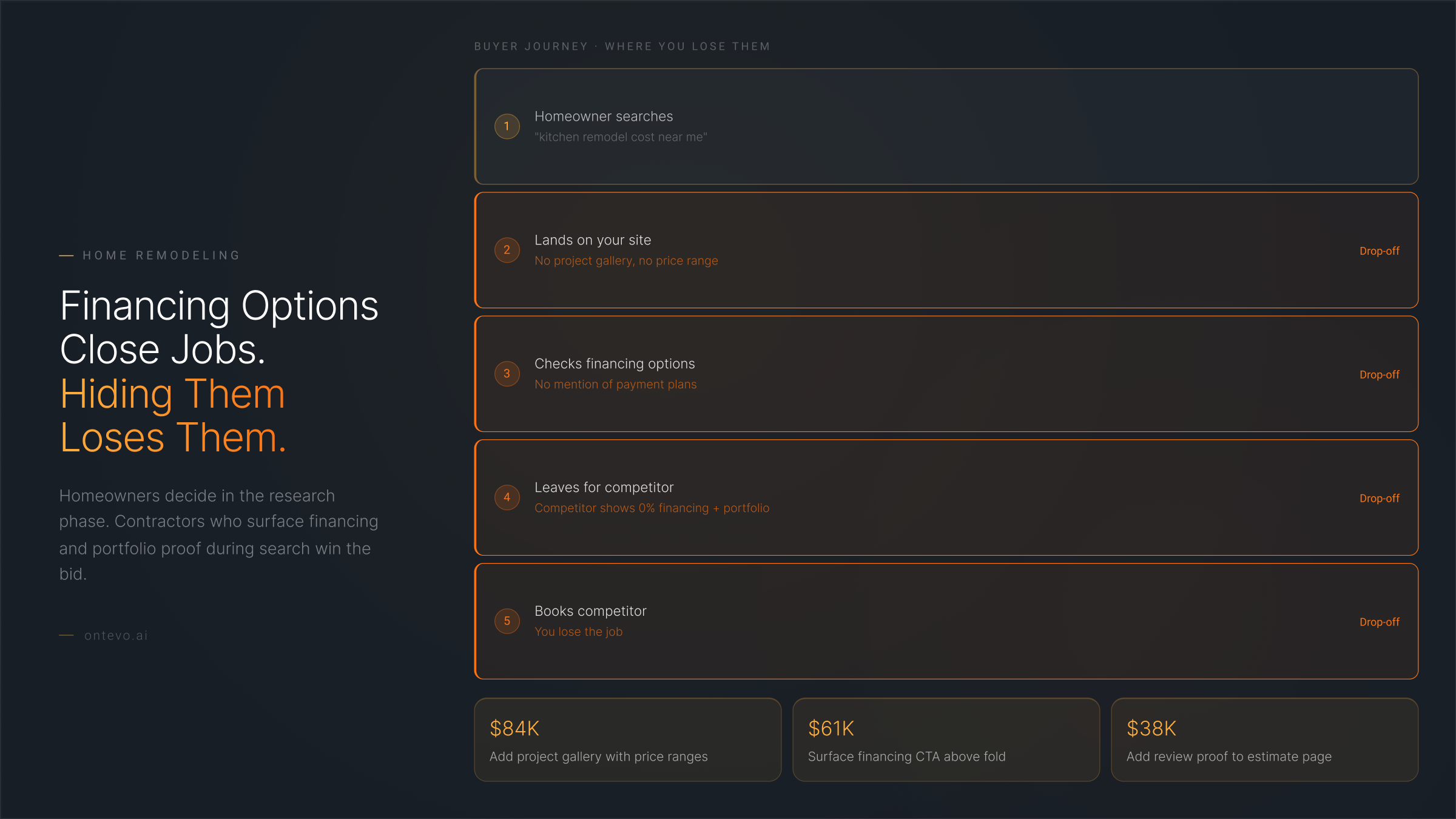
An agent that drafts process-guarantee language from your actual review data. A Reputation Defender that drafts a response to every review within hours, in your voice, referencing specific project details. You approve, it publishes. A Voice Receptionist that captures leads at 2 AM when a homeowner is Googling "kitchen remodel near me" and your office is closed.
The average remodeler spends $1,299/mo on their tech stack: Buildertrend Pro at $799/mo plus $500/mo in lead gen spend. None of that stack connects review sentiment to proposal language to marketing copy. It manages projects. It doesn't win bids.
That's the gap between project management software and strategic intelligence. The next wave of AI replaces labor, not dashboards, and for remodelers, the labor it replaces is the 3–5 hours per week you're not spending on the trust signals that close deals. (Curious how this compares to what you're already using? Here's how Ontevo compares to project management platforms like ServiceTitan.)
The Takeaway, Even If You Never Click the CTA
Your proposal is the problem, not your craftsmanship.
The data is unambiguous: homeowners reject process, not product. They ghost proposals that read like spreadsheets. They sign with contractors who show them what the next 12 weeks will look like, even when that contractor charges more.
The five process guarantees above are free to implement. The 30-minute audit requires nothing but your phone and your competitor's Google listing. And the before/after proposal rewrite is something you can do tonight.
Your last proposal lost on trust, not price. The next one doesn't have to.
Ontevo Research. Where this post carries figures, they come from Ontevo's own scan corpus or are modeled from scan patterns across the category. No figure is measured from a named customer.