The CAC Tax: Why Your Ad Spend Isn't the Problem (Your Formula Is)
You're Subsidizing a Product Gap with Ad Dollars, Not Overspending on Ads
Somewhere right now, a DTC skincare founder is staring at a Triple Whale dashboard, watching ROAS decay from 3.5x to 2.1x, and reaching the same conclusion every founder reaches: we need better creatives.
They'll test UGC. They'll try a new hook. They'll A/B test the hero image. They'll hire a new media buyer.
None of it will work, because the problem is the product sitting at the end of the funnel, not the funnel itself.
The math is brutal. A 25% PDP conversion gap vs. category benchmark costs a $3.5M skincare brand roughly $876K per year in unrealized revenue, approximately $14,200/mo in lost margin after blended acquisition cost adjustment. At $45-65 CPMs in the beauty category, every impression that lands on an underconverting product page is money incinerated.
We call this the CAC Tax: the compounding cost premium a brand pays on every single acquisition because the product itself (not the ad, not the landing page, not the offer) fails to convert at category benchmark rates.
Most brands don't even know they're paying it.
What the CAC Tax Actually Looks Like
Here's the mechanism. PDP conversion benchmarks in the DTC skincare serum subcategory run 2.5-4.5%. Say your hero SKU converts at 2.5% while a spec-aligned competitor converts at 3.5%.
That 1-point gap means you need 40% more traffic to hit the same revenue number. At $45-65 CPMs, that traffic premium is pure waste: money spent compensating for a product that doesn't close.
Quick math:
- Your spend: $195K/mo on paid acquisition at $32 CAC → ~6,094 customers/mo
- Competitor's spend: Same budget, but 3.5% PDP conversion vs. your 2.5% → ~8,531 customers/mo
- The gap: 2,437 customers/mo you're leaving on the table, not because your ads are bad, but because your product page can't close
- The tax: ~$14,200/mo in lost margin, compounding every month you don't fix the root cause
Triple Whale will tell you ROAS dropped. Northbeam will show you the attribution path. Neither can tell you why, because the diagnosis lives in the product spec, not the ad platform.
The Smoking Gun: 42% of Your 1-Stars Mention Packaging, Not Formula
Here's the data point that should change how you think about product development.
Across the $30-45 serum subcategory, 42% of 1-star reviews cite packaging-related failures rather than formula efficacy. Not "this didn't work for my skin" or "broke me out," but packaging.
The breakdown:
- Oxidation / color change in jar packaging: 23% of negative reviews
- Fragrance / irritation: 19%
- No visible results: 17% (a significant portion attributable to oxidation-degraded actives in jar packaging)
- Tiny bottle / overpriced: 14%
- Pilling under makeup: 11%
Packaging + size complaints account for 37% directly. Add the oxidation-driven efficacy complaints (customers saying "didn't work" when the real culprit is L-Ascorbic Acid degrading in a jar) and you're at 42%.
Brands reformulate actives when the real conversion killer is the delivery system. A $4.25/unit jar is cheaper than a $5.80 airless pump, but the jar is costing you $876K/year in unrealized revenue.
A concrete scenario: A Vitamin C serum in jar packaging accumulates 47 reviews mentioning oxidation in 90 days. The listing's organic rank on Amazon tanks. The brand blames the algorithm.
The algorithm is just reading the reviews.
The Wishlist Signal You're Ignoring
Reviews are R&D intelligence hiding in plain text, not just reputation data.
40% of reviews in the $30-45 serum segment contain explicit, unfulfilled demand for barrier repair ingredients: Ceramides, Centella Asiatica, Madecassoside. But only 18% of brands in the competitive cohort actually include them.
That's a 22-point gap between what customers are asking for and what brands are delivering.
You can see it in the raw review text:
- "I wish this had Ceramides for barrier repair"
- "Would be perfect if they added Peptides"
- "Need a pump not a jar"
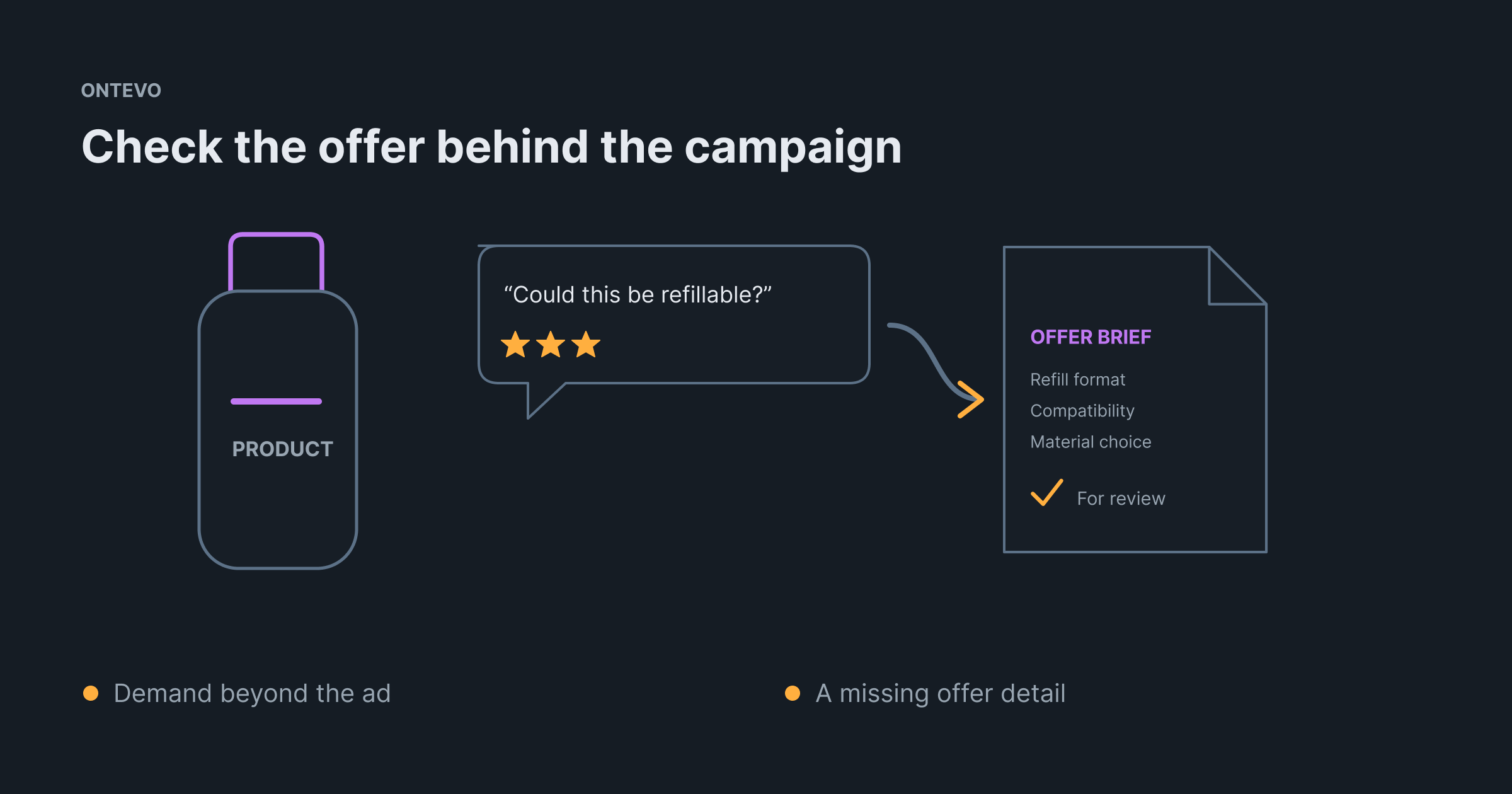
These are product briefs, not star ratings, written by your customers for free and at scale.
Spate tells you Bakuchiol is trending +40% YoY. Yotpo collects your reviews. Neither connects the trend to YOUR ingredient deck, YOUR customer complaints, or YOUR competitor's spec sheet. The intelligence loop is broken.
Any brand can start here today: Export your Sephora or Amazon reviews, run a keyword frequency analysis on ingredient mentions, and cross-reference against your top 10 competitors' ingredient decks. The gap between what customers ask for and what you offer IS your CAC Tax. For a detailed walkthrough of this process, see our step-by-step guide to mining competitor reviews for market gaps.
The Spec War You're Losing Without Knowing It
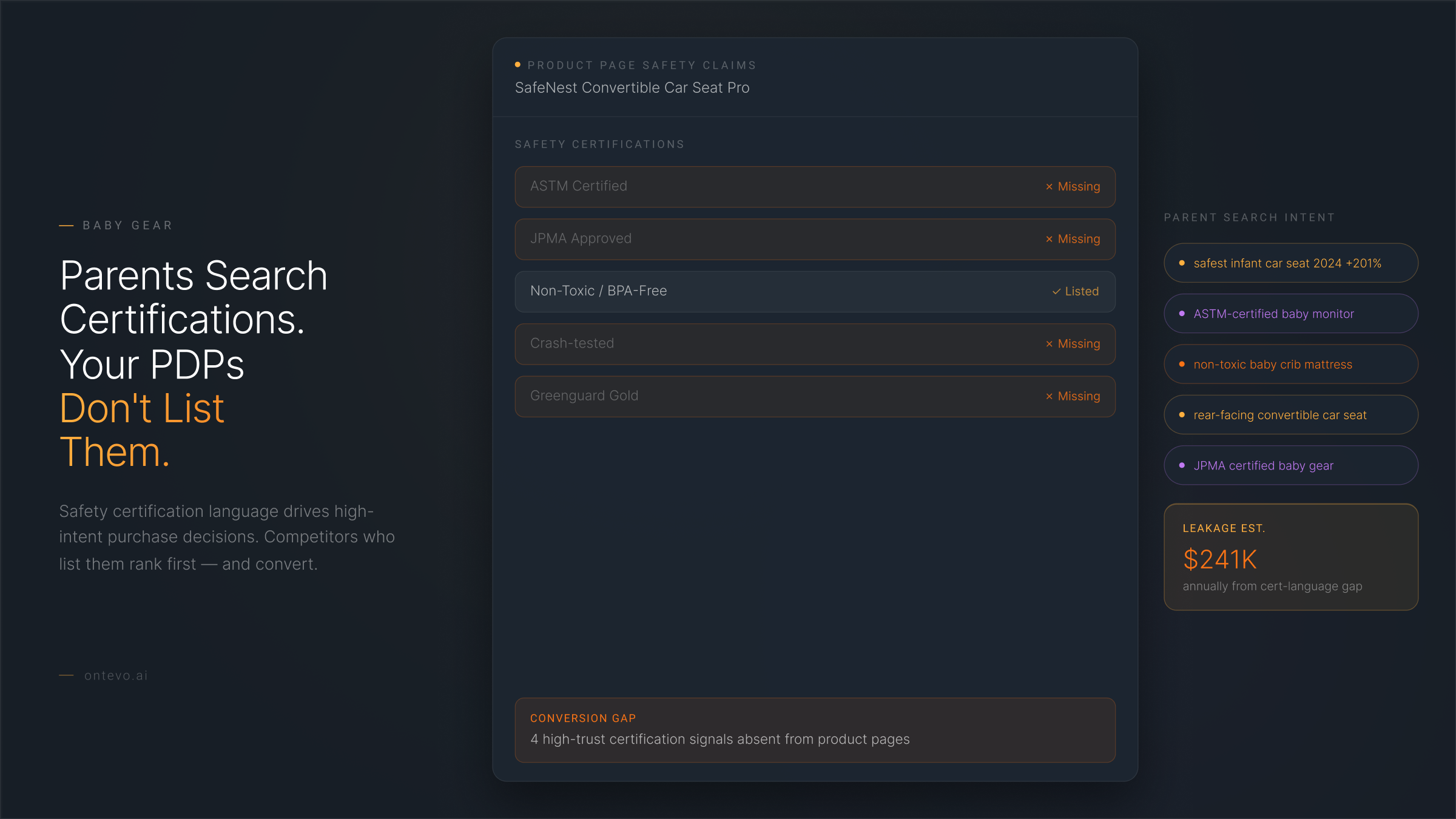
In skincare, the spec war is fought on ingredient decks, packaging formats, concentration claims, and certifications, not on ad platforms.
Here's what the competitive set actually looks like in the serum subcategory:
Table Stakes (Must-Have)
- Fragrance-free: 72% of top-performing serums
- Cruelty-free: 89% of top-performing serums
- Vegan: Rapidly approaching table stakes
Emerging Differentiators
- Microbiome-friendly: Only 8% of the cohort, but growing 60% YoY in search
- Bakuchiol: 12% of the cohort, +40% YoY search growth: a quantifiable whitespace
Competitive Liabilities
- Jar packaging: 65% of top-performing serums now use airless pumps
- Missing barrier repair actives: The 22-point demand-supply gap
The conversion data on packaging alone should end the debate: airless pump formats convert at 2x jar packaging in the serum subcategory. This is a conversion multiplier, not a design preference, driven by consumer trust in product stability and oxidation prevention.
Try this exercise: List your hero SKU's specs in a spreadsheet. List your top 5 competitors' specs. Columns: active ingredients, concentrations, packaging format, size options, certifications, clinical claims. Highlight every cell where you're missing a table-stakes feature or a trending differentiator.
That spreadsheet is your CAC Tax invoice.
When the CAC Tax Becomes an $85K Write-Off
The CAC Tax is a ticking clock on every production run, not just a monthly bleed.
Here's the scenario we see play out repeatedly: A founder greenlights 20,000 units of a Vitamin C serum in jar packaging at $4.25/unit. That's $85,000 committed before a single unit ships.
Post-launch reality:
- The market has moved to airless pumps
- Competitors own the $18-22 price point with stabilized L-Ascorbic Acid
- 2-star reviews citing oxidation tank the Amazon rank
- The brand negotiates with a liquidator at 30 cents on the dollar
Result: $25,500 recovered; $59,500 in gross margin gone.
And while that $85K sits in a ShipBob warehouse, the brand is still paying $6,125/mo in SaaS stack costs (Shopify Plus at $2,300, Klaviyo at $1,300, Yotpo at $750, Recharge at $1,775) to operate a funnel that underconverts at the product level.
The cost of launching without spec intelligence is $85K/batch, not $32/customer.
The Price-Value Dead Zone
DTC skincare pricing has consolidated into three tiers, and one of them is a graveyard:
- Mass-market ($8-15): The Ordinary wins on radical transparency and price. You can't out-cheap them.
- Clinical premium ($80-170): SkinCeuticals wins on clinical substantiation and dermatologist endorsement. You can't out-credential them without the investment.
- The sweet spot ($28-38): Peach & Lily, Cocokind, Naturium: they win on ingredient story + perceived value.
Then there's the dead zone: $40-55 without clinical substantiation or a compelling ingredient narrative. Too expensive for the value buyer, too cheap to signal clinical authority, and lacking the spec story to justify the mid-premium position.
You can see this in the reviews. Customers explicitly make competitor comparisons:
- "Basically a dupe for SkinCeuticals CE Ferulic at 1/4 the price"
- "Overpriced for 0.5oz when Naturium gives you 1.7oz"
These price anchors are set by competitors, not by your COGS. And the data shows a cliff: conversion drops 30% above $45 in the serum subcategory unless the brand has clinical claims or a cult ingredient story to justify the premium.
If you're priced at $42 without that story, you're in the dead zone, and your CAC reflects it.
How to Calculate Your CAC Tax (Step-by-Step)
This framework works whether you use Ontevo or not. It's the diagnostic process any DTC skincare founder should run before spending another dollar on ads.
Step 1: Pull Your PDP Conversion Rate
From Shopify Analytics or Amazon Brand Analytics. Compare to the 2.5-4.5% category benchmark for serums. If you're below the midpoint (3.3%), you have a product-level conversion problem, not a traffic problem.
Step 2: Export Your Last 500 Reviews (and Your Top 3 Competitors')
From Amazon, Sephora, or Yotpo. Run keyword frequency analysis on: ingredient requests, packaging complaints, price comparisons, sensory issues (texture, scent, pilling). For a detailed walkthrough, see our guide to analyzing competitor reviews for market gaps.
Step 3: Build a Spec Comparison Table
Your hero SKU vs. top 5 competitors. Columns:
- Active ingredients and concentrations
- Packaging format (jar, dropper, airless pump)
- Size options
- Certifications (cruelty-free, vegan, fragrance-free)
- Clinical claims (dermatologist-tested, clinical studies)
Step 4: Quantify the Gap
(Category benchmark conversion rate − Your conversion rate) × Monthly PDP traffic × AOV = Monthly revenue leak.
Example: (3.3% − 2.5%) × 150,000 monthly visitors × $48 AOV = $57,600/mo in unrealized revenue.
Step 5: Identify the Top 3 Fixable Gaps
Is it packaging? A missing trending active? A price-value mismatch? A certification gap? Rank by estimated conversion impact and implementation cost.
This framework is genuinely useful as a standalone diagnostic. But doing it manually across 50,000 reviews and 25 competitors is exactly the kind of labor that takes a team of analysts weeks, or AI agents that execute the fix, not just surface the finding, in under 24 hours.
What Closing the Gap Actually Looks Like
The output of a proper spec-gap analysis is a reformulation brief, a PDP messaging overhaul, and a price-point repositioning, not "spend more on ads."
Example scenario:
- Brand adds Ceramides + Centella Asiatica to their hero serum
- Switches from jar to airless pump (cost increase: ~$1.55/unit)
- Adds "Fragrance-Free" and "Dermatologist-Tested" to PDP
- Repositions from $42 to $34, exiting the dead zone into the sweet spot
Result: PDP conversion lifts from 2.5% to 3.5%. Effective CAC drops from $32 to $24. ROAS lifts from 3.0x to 4.0x, without a single additional ad dollar.
The math: a 25% conversion lift recovers ~$876K/year in revenue. The reformulation + new packaging run costs ~$30-40K. ROI: 20x+ in year one.
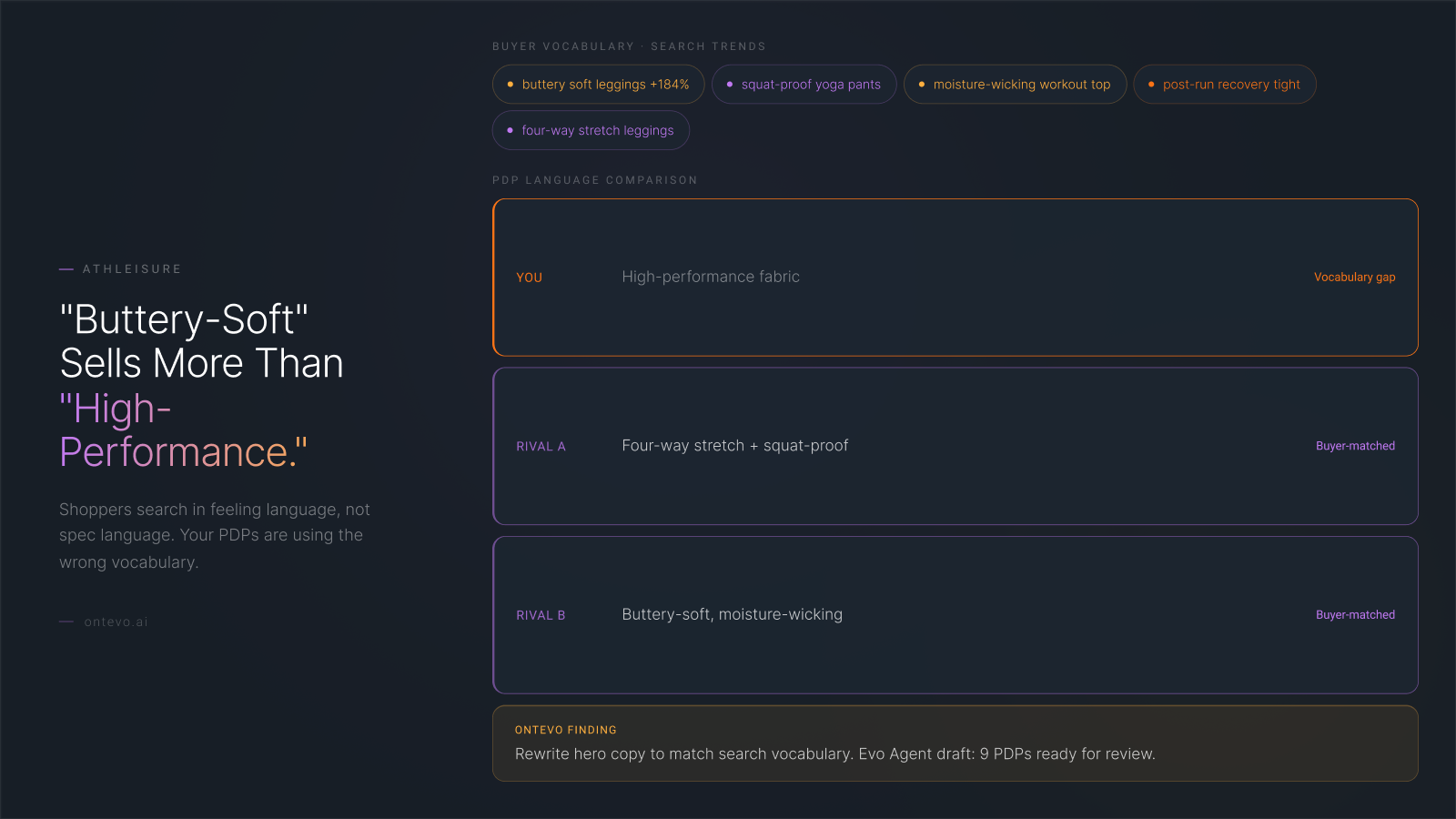
This is where Ontevo's Product Architect agent comes in. It drafts the reformulation brief based on review-mined demand signals and competitive spec gaps, then maps the ingredient story to PDP messaging that matches how consumers actually search, translating "Glass Skin" to "Niacinamide + Hyaluronic Acid" and "won't oxidize" to "airless pump delivery system." You review every draft. You approve every change. Your brand voice, your call.
The Intelligence Gap in Your Current Stack
Here's where every tool in the standard $6,125/mo DTC skincare stack goes blind:
- Triple Whale / Northbeam ($200-1,000/mo): Sees ROAS decline. Cannot diagnose product-level cause. We break down why attribution tools can't diagnose product-level conversion problems in detail.
- Klaviyo ($1,300/mo): Optimizes email/SMS flows. Cannot tell you that 62% of cart abandoners drop off on the PDP, not at checkout.
- Yotpo ($750/mo): Collects reviews. Does not mine them for R&D intelligence or benchmark against competitor review corpora. There's a fundamental gap between collecting reviews and mining them for R&D intelligence.
- Spate / Trendalytics: Identifies trending ingredients. Cannot connect trends to YOUR spec gaps or YOUR customer demand signals.
- Jungle Scout / Helium 10: Amazon keyword intelligence. Blind to review-level product feedback.
The missing layer: No tool in the standard stack connects trend signal → spec gap → review validation → reformulation brief → PDP optimization → conversion lift. That's the closed loop that eliminates the CAC Tax.
This is a category gap, not just an Ontevo pitch. Whatever solution you evaluate (internal team, consultant, platform), ask whether it closes this loop end-to-end. If it only covers one segment (trends OR reviews OR attribution), it's another dashboard, not a diagnosis.
Stop Optimizing the Funnel. Fix the Asset.
The full financial picture for a $3.5M DTC skincare brand:
- $876K/year in unrealized revenue from product-level conversion gap
- $85K per failed SKU launch when spec misalignment meets a production run
- $73,500/year in SaaS costs subsidizing a funnel that underconverts at the product level
That's over $1M/year in combined leakage and waste, before you count the opportunity cost of the trending ingredients, packaging formats, and price positions your competitors are capturing while you test another ad creative.
The DTC skincare industry spent a decade optimizing distribution: ads, email, attribution models, creative testing frameworks. That playbook is exhausted. CPMs are $45-65 and climbing. Every brand has Klaviyo flows. Every brand runs UGC.
The next decade belongs to brands that optimize the asset: formulation, packaging, spec positioning, price-value alignment. The brands that win will have better products rather than better ads, positioned against real demand signals, priced in the sweet spot, and packaged in the format the market has already chosen.
If your ingredient deck, packaging format, and PDP spec claims can't survive a side-by-side comparison with your top 5 competitors, no amount of ad spend will save you.
Your listing was written before airless pumps became the standard. The market moved. The question is whether your next production run will move with it, or become the next $85K write-off.
Ontevo Research. Where this post carries figures, they come from Ontevo's own scan corpus or are modeled from scan patterns across the category. No figure is measured from a named customer.