The Trust Tax: How One UX Bug Creates Permanently High CAC
Your CPA Didn't Spike. Your Product Page Is Leaking.
Parents don't impulse-buy strollers.
They research for 3-6 weeks: Wirecutter, Babylist, Reddit's r/BabyBumps, Amazon's "most helpful" reviews sorted by lowest rating first. By the time they see your Meta ad, they've already read 50+ reviews about products in your category. Including yours.
This is the longest consideration cycle in DTC ecommerce. And it breaks the standard playbook (Meta ads → landing page → conversion in 1-3 sessions), because that playbook assumes low-consideration purchases. Baby gear sits at the other extreme: it's where new parents project every anxiety they have about keeping a tiny human alive.
A single UX flaw (a buckle that pinches, a fold mechanism that requires two hands, a missing safety certification) costs more than one sale. It enters the review corpus. And every future parent reads those same reviews.
We call this the Trust Tax: the permanent surcharge on every dollar of ad spend created by a product-fit gap that lives in your reviews forever.
Brands with spec and UX gaps see conversion drop from the category average of 2.8% to roughly 1.6%. That nearly doubles effective CPA, from ~$80 to ~$140. Same traffic and same ad creative, but fewer conversions and more money burned.
The Trust Tax is a product-fit problem wearing a marketing costume, not a marketing problem.
The Math: What the Trust Tax Actually Costs
Let's stop hand-waving and run the numbers for a $2.5M/year baby gear brand.
- Annual paid media spend: ~$300K+
- Category-average conversion rate: 2.8%
- Conversion rate with spec/UX gaps: ~1.6%
- Wasted ad spend from conversion gap: ~$187K/year
That $187K buys traffic, not customers: visitors hit the PDP, scan for the spec stack, don't find it, and bounce. Your CMO is optimizing creatives while the product page is silently hemorrhaging conversions.
But the ad waste is only half the story.
Layer in inventory risk. A single SKU that missed a trending spec (say, you launched without a one-hand fold mechanism) requires 30-40% markdowns to clear. At 5,000 units × $45 landed cost, that's $225K in exposed inventory. Markdowns cost $67K-$90K per affected SKU.
Total annual burn: $337K-$412K. That's 13-16% of revenue, gone not to a competitor's better ad but to your own product page.
This is the number your CFO needs to see: not your ROAS or your click-through rate, but the gap between what parents demand and what your PDP delivers, expressed in dollars.
The Anatomy of a UX Bug: The Buckle That Kills Conversion
Let's zoom into the most common trust-destroying UX bug in baby gear: the pinching buckle.
"Pinching or difficult-to-operate buckle/harness" is the #1 negative review theme across the competitive cohort. And the damage it causes follows a predictable cascade:
- One parent posts a TikTok showing a buckle pinching their baby's skin.
- It gets 500K views.
- Every parent researching that product now searches "[brand] buckle pinch."
- Amazon's algorithm surfaces negative reviews mentioning it.
- Conversion craters overnight.
It gets worse. Even without a formal recall, a single CPSC inquiry letter triggers retailer pull-backs. Target and Buy Buy Baby can pull your product from shelves within 48 hours of an inquiry: not a recall, an inquiry.
And with 90-120 day manufacturing lead times from China and Vietnam, you can't course-correct until next season. Every spec miss compounds into two quarters of lost revenue.
The buckle is just one example. The pattern is universal: in high-trust categories, a single visible flaw costs you every sale that touches the review corpus where it lives, not just one.
The Five Specs That Drive 80% of Registry Additions
Enough about what's broken. What are parents actually looking for?
Based on competitive benchmarking across the top sellers on Amazon and Babylist, five specs drive the vast majority of purchase decisions:
- One-hand fold mechanism: 2,400+ mentions in Amazon/Babylist reviews as an unmet need. Parents imagine the scenario: holding a baby in one arm, collapsing the stroller with the other, in a parking lot, in the rain. If your stroller can't do this, it fails the mental simulation before it fails the checkout.
- UPF 50+ extendable canopy: Sun protection is a safety signal, not a nice-to-have. Parents searching "UV stroller canopy" are filtering, not browsing.
- Machine-washable removable fabrics (OEKO-TEX certified): "Can I throw this in the wash?" appears in thousands of reviews. OEKO-TEX certification is the trust shortcut for chemical safety.
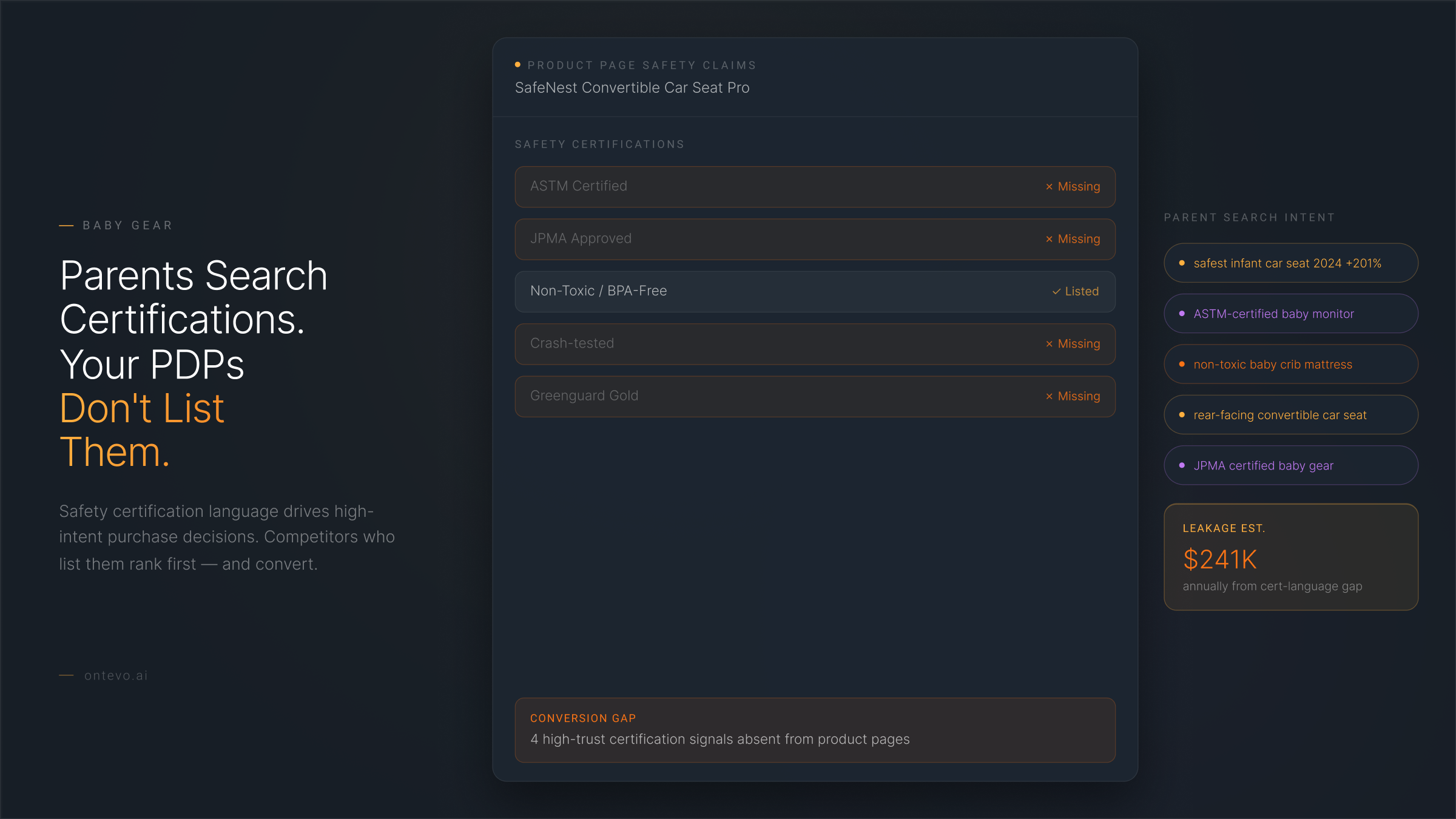
- JPMA certification badge prominently displayed on PDP: 85% of top-selling baby gear PDPs display this badge. Missing it is a trust shortcut issue, not a safety issue; your product may well be safe. Parents scanning 10 PDPs in 20 minutes use the badge as a filter.
- Magnetic or no-pinch harness buckle system: The direct answer to the #1 negative review theme. Brands that solve the buckle problem create a positive review magnet, not just fewer complaints.
78% of top-10 strollers now list one-hand fold, UPF 50+ canopy, and machine-washable fabrics. These are table stakes, not aspirational features. Missing even one creates a measurable conversion cliff.
Think of it as a spec stack. Parents scan for the full stack rather than evaluating specs individually. Missing one triggers doubt about the whole product.
The Simulation: What 5 Synthetic Personas Reveal
Reviews tell you what parents say. Simulations tell you what they do.
When we ran synthetic buyer persona simulations against a mid-tier stroller, the results were stark: 5 of 6 personas rejected the product primarily on the fold mechanism. Not price, not aesthetics, not brand recognition: the fold.
This matters because traditional A/B testing on PDPs tests copy and imagery. It doesn't test whether the product itself passes the parent's mental checklist. You can optimize your hero image all day, but if the product fails the one-hand fold test, the conversion won't move.
The one-hand fold is the #1 dealbreaker because it maps to a real-world scenario every parent imagines before buying. It's a trust proxy for "this brand understands my life," not a feature.
Practical takeaway if you don't have simulation tools: Pull the top 100 reviews of your top 3 competitors on Amazon. Ctrl+F for "fold," "one hand," "buckle," "wash," and "UV." Count the mentions. That's your priority list, ranked by frequency.
The $299 Cliff: Price Psychology in Baby Gear
There's a price-value cliff that makes the Trust Tax even more punishing.
$299 is the psychological ceiling for mid-tier strollers. Above $299 without a clear spec advantage, add-to-cart rates drop 25%. Similar cliffs exist at $199 for high chairs and $49 for developmental toys.
The implication is brutal:
- If you're priced at $319 and missing one-hand fold or UPF 50+ canopy, you're above the value cliff AND below the spec threshold. Double penalty.
- If you're at $279 with the full spec stack, you're in the sweet spot: below the cliff, above the trust threshold.
Map your price point against your spec completeness. If you're above the cliff, you need more specs, not fewer. If you're below it, you have margin to invest in the specs that close the trust gap.
This is where the Trust Tax compounds. A brand paying the tax is stuck: conversion is low, so they can't afford to invest in product improvements, so conversion stays low. The brand below the cliff with the full spec stack captures the customers (and the reviews) that compound in the other direction.
Mid-read check: Want to see which specs your top SKU is missing, and what it's costing you? Run a free Rapid Scan on your top SKU. Takes 30 seconds. No sales call required.
The Review Intelligence Gap: Why Yotpo Can't Save You
Here's the elephant in the room: most baby gear brands already use review tools: Yotpo, Okendo, Stamped. They collect and display reviews. They're good at that.
But they don't mine reviews for product intelligence.
The gap is massive: 35-50% of competitor reviews on Amazon and Babylist contain "Safety Anxiety Signals": phrases like "is this JPMA certified?," "worried about the buckle pinching," and "wish the canopy had UV protection."
Standard review tools surface sentiment: positive or negative. They don't extract spec-level signals. They don't connect "I wish this folded with one hand" to the engineering spec "one-hand fold mechanism" to the conversion impact on your PDP.
Similarly, Triple Whale and Northbeam tell you ROAS is declining. They can't tell you it's declining because your stroller lacks a one-hand fold. The 3-6 week consideration cycle breaks both last-click and multi-touch attribution models. By the time a parent converts (or doesn't), the touchpoint that mattered (reading a negative review on Babylist three weeks ago) is invisible to your attribution stack.
This is a symptom of a larger problem: most brands have 50 dashboards tracking yesterday's metrics, zero systems detecting tomorrow's spec shifts. The tools are good at what they do. They just weren't built to answer the question: "What should we build next?"
The process of systematically mining competitor reviews for market gaps maps parent language ("easy fold," "one-hand collapse," "parking lot fold") to engineering specs ("one-hand fold mechanism") to conversion impact. That semantic bridge (what we call the Golden Master Ontology) is what turns review noise into product strategy.
Cross-Vertical Pattern: The Trust Tax Isn't Just Baby Gear
The Trust Tax appears in every high-consideration, safety-adjacent category. The mechanics are identical; only the specs change.
- Cookware: 4 of 5 competitors claim "Metal Utensil Safe." If you don't, you lose the comparison shopper. "Warped" appears in 22% of 1-star reviews. The same spec-gap pattern costs cookware brands $8,500/mo when their product wins on quality but loses on the listing.
- DTC Skincare: 42% of 1-star reviews mention packaging (pump failures, leaking), not formula. Parents buying baby skincare are the same trust-driven buyers: they read every review, and one packaging complaint poisons the well.
- MedSpa: Patients research providers for weeks, reading every review. One mention of "felt rushed" craters consultation bookings for months.
The common thread: in high-trust categories, the cost of a single visible flaw is a permanent increase in acquisition cost, not one lost sale, because the flaw lives in the review corpus forever. The Trust Tax compounds. It never expires.
The Fix: A Practical Spec Audit You Can Do This Week
Here's a genuinely useful framework. You can do this with a spreadsheet and an afternoon. No tools required.
Step 1: Pull the Reviews
Export the top 200 reviews (sorted by "most helpful") for your top 5 competitors on Amazon and Babylist. If you can't export, copy-paste into a Google Sheet. Tedious, but it works.
Step 2: Search for the Five Trust-Critical Terms
Ctrl+F each review set for: fold, buckle/harness, wash, UV/sun/canopy, certified/JPMA. Tally mentions and note sentiment: positive ("love the one-hand fold") means the competitor has it; negative ("wish this folded easier") means the market wants it and isn't getting it.
Step 3: Cross-Reference Against Your PDP
For each of the five specs, answer three questions:
- (a) Does your product actually have this spec?
- (b) Is it mentioned on your PDP?
- (c) Is it above the fold?
This is where most brands get a nasty surprise. Many have the spec but don't feature it. Your stroller has OEKO-TEX certified fabrics but your PDP doesn't say so. That's a zero-cost, zero-lead-time fix that no amount of ad optimization will surface.
Step 4: Check Your Price Against the Category Cliff
$299 for strollers, $199 for high chairs, $49 for developmental toys. If you're above the cliff, your spec stack needs to be bulletproof. If you're below it, you have room to invest.
Step 5: Set Up Cascade Alerts
Create Google Alerts for "[your brand] + recall," "[your brand] + pinch," "[your brand] + CPSC." Early detection of a viral UX complaint can save a quarter of revenue. A CPSC inquiry can trigger retailer pull-backs within 48 hours; you need to know before your retail partners do.
This is the manual version of what automated review intelligence does at scale. For brands with 10+ SKUs across Amazon and DTC, manual auditing becomes untenable; that's where systematic tooling matters, and it's why autonomous AI agents are replacing the agency model for this kind of work.
The Registry Season Clock Is Ticking
Baby gear has sharp seasonality. Peak months: March-May (spring registry season) and November-December (holiday gifting + Q1 baby boom prep).
With 90-120 day manufacturing lead times, spec decisions made in August-October determine Q1 registry performance. If you're reading this during peak outreach months, you may not be able to change the physical product in time, but you can fix the PDP.
Zero-lead-time fixes that move conversion:
- Feature existing specs more prominently (move JPMA badge above the fold)
- Add a 15-second fold demo video to your hero carousel
- Update lifestyle photography to show one-hand fold in action
- Rewrite bullet points to lead with the spec stack, not brand story
The window between "identifying the gap" and "registry season" is shorter than most founders think. Every week your PDP is missing a trust signal is a week of compounding Trust Tax.
What This Looks Like When It Works
A brand that audits its spec gaps, updates PDP messaging to feature one-hand fold and JPMA certification above the fold, and adds a fold demo video sees conversion recover from ~1.6% toward the 2.8% category average.
At $300K annual ad spend, that conversion recovery represents roughly $187K in recaptured efficiency. That's not new spend, just existing spend finally working.
The compounding effect runs in reverse:
- Better conversion → better ROAS
- Better ROAS → algorithm rewards you with lower CPAs
- Lower CPAs → more budget for inventory and product development
- Better product → better reviews → fewer markdowns → healthier margins
This is the opposite of the Trust Tax spiral. Call it the Trust Dividend. Same ad spend, same traffic, radically different outcome, because the product page finally matches what parents are looking for.
The difference between a brand paying the Trust Tax and a brand earning the Trust Dividend comes down to one thing: whether the specs parents care about are visible on the page where the decision happens. Budget, creative, even product quality matter less than that.
Quantify Your Trust Tax Before Registry Season
You're already spending $300K+ on ads. The real question is whether you can afford not to diagnose the problem.
Ontevo benchmarks your top SKU against the competitive cohort, identifies which of the five trust-critical specs you're missing or under-featuring, and puts a dollar figure on the gap. The Product Architect agent drafts updated PDP copy. The Simulation Engine tests it against synthetic buyer personas. You approve every step before anything ships.
Your listing was written before magnetic buckles existed. The market moved. Run a free Rapid Scan on your top SKU →
Ontevo Research. Where this post carries figures, they come from Ontevo's own scan corpus or are modeled from scan patterns across the category. No figure is measured from a named customer.